Which advanced transport management technologies exist
 Luiz Felipe 6 min read
Advanced transportation management technologies respond to an old problem of the sector in Brazil: the operation generates much more information than spreadsheets, notebooks and the phone can organize, and a decision made without this organized data tends to be a decision made late.
Fleet management technologies contribute in different ways, acting on operational and administrative stages to generate more savings, productivity, safety and operational efficiency, among other benefits. The size of this gain, however, depends on use: a tool that is implemented and not fed with data returns a nice-looking report and the same decision as before.
Learn more about the subject:
- What are the advanced transportation management technologies in Brazil?
- What are the technology systems for transportation management?
- What is the impact of these technologies on fleet management?
What are the advanced transportation management technologies in Brazil?
Advanced transportation management technologies in Brazil are a set of digital tools and systems designed to optimize the operation and the administration of vehicle fleets.
This set brings together families that are quite different from one another: vehicle tracking software and telematics systems, sold by companies specialized in onboard equipment; route management platforms; and integrated logistics solutions.
These are technologies that allow a more precise analysis of data, improving decision-making and providing benefits such as cost reduction, greater safety and better control over transport operations.
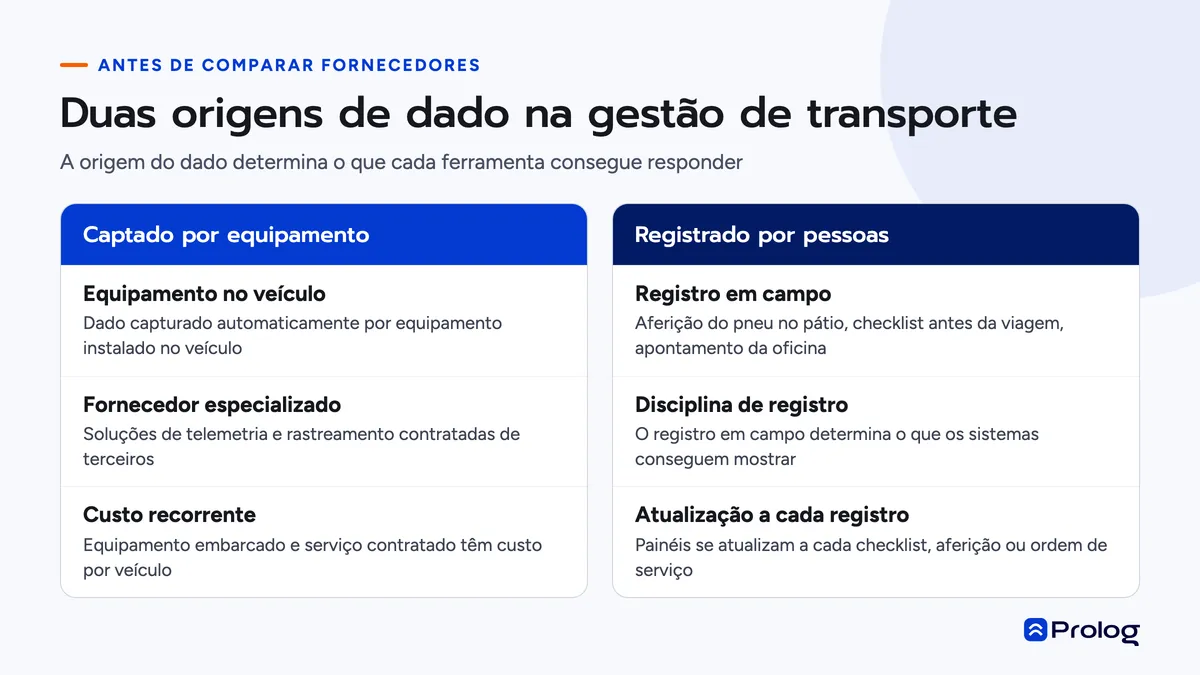
Before comparing suppliers, it is worth separating two origins of data, because that is what determines what each tool can answer. There is data captured automatically by equipment installed in the vehicle, the domain of telematics and tracking solutions contracted from third parties. And there is data recorded by people: the tire inspection in the yard, the checklist filled in before the trip, the workshop's records. Tire management, checklist and maintenance systems work with this second origin, and that is why the discipline of recording in the field determines what they can show.
What are the technology systems for transportation management?
Transportation Management System (TMS)
The Transportation Management System (TMS) is a platform with comprehensive features, whose goal is to optimize the aspects of transportation logistics, from planning to the execution of deliveries and keeping track of them.
Depending on the solution, technology in transport can make it easier to schedule routes efficiently, handle cargo tracking and manage costs. Where the TMS usually stops is at the asset's life cycle: it keeps track of the cargo and the customer, not the tire casing or the open work order.
Route planning and route monitoring systems
Route planning systems make it possible to plan the most efficient routes for deliveries, considering factors such as distance, traffic and delivery deadlines. In this way, they optimize time and fuel consumption.
Systems focused on monitoring transport operations, on the other hand (generally supplied by the same tracking and telematics companies), track the status of deliveries in real time and allow changes or an immediate response to unforeseen events on the route, providing complete visibility of the transport process. Since they depend on onboard equipment and a contracted service, they carry a recurring cost per vehicle, which usually guides which vehicles receive the device first.
Business intelligence (BI) tool
Business intelligence (BI) tools go beyond the simple collection and analysis of operational data. They are capable of turning large volumes of raw data into understandable and useful information.
This includes keeping track of market trends, evaluating the performance of routes and vehicles and identifying areas for improvement.
With BI, transportation managers can project future demand based on history, guide the allocation of resources and base decisions on concrete data that supports the company's strategy and growth. Two caveats avoid frustration: a projection is not a guaranteed forecast, and BI does not correct bad data; it only shows faster what was recorded, including what was recorded incorrectly.
ERP system
ERP (Enterprise Resource Planning) systems offer a comprehensive and effective integration of various business functions. Besides covering areas such as transport, finance and human resources, ERPs also provide detailed analyses of operational and financial performance.
They help optimize processes, improve accuracy in demand forecasting and allow a unified view of the data, which is essential for strategic decision-making and for long-term planning. On the other hand, they usually treat the fleet generically, hence the common practice of integrating the ERP via API with specialized tools, instead of expecting it to provide the detail of maintenance or tires.
Specific systems for different areas of the fleet
These fleet systems are focused on the efficient management of the fleet's vehicles, including maintenance, scheduling of vehicle use and keeping track of performance.
There are specific technologies such as a maintenance management system, tire management system, electronic checklist and fuel management, each one focused on optimizing a specific area of fleet management, contributing to the overall efficiency of operations.
What these tools have in common is that they depend on records made in the operation, not on automatic capture. The counterpart is that they go down to a level of detail that generalist systems do not reach: the individually identified tire, the item that failed on the checklist, the work order with parts and labor separated.
What is the impact of advanced transportation management technologies on the fleet?
Process automation
Advanced transportation management technologies make it easier to automate various processes, making operations more efficient.
This includes, for example, route optimization, in which algorithms suggest the best paths considering traffic, distances and delivery deadlines, with potential savings of time and fuel.
Another example is the automation of preventive maintenance, in which a system dedicated to this area of the fleet generates alerts based on the recorded mileage or hours, so that no inspection is forgotten.
Increased operational efficiency in fleets
With better tools for managing operations and keeping track of them, companies can operate with greater precision and agility, improving productivity and the quality of service.
The technologies allow more effective coordination of the fleet's resources, improving route planning, trip scheduling and vehicle allocation.
When the operation subscribes to real-time tracking from a telematics supplier, this adds the possibility of responding faster to unforeseen events, adapting routes and schedules as needed.
In addition, efficient maintenance management contributes to reducing delays and incidents, raising the punctuality and reliability of the services provided. Continuous monitoring of driver behavior, where it exists, comes from telematics solutions contracted for that purpose.
Cost reduction
One of the consequences of using these technologies is the reduction of operating costs.
The various systems can help cut expenses in the fleet's main areas, such as fuel, maintenance and tires. In addition, efficient fleet management can also reduce administrative costs.
To know whether the savings actually happened, it is worth defining before implementation which numbers will be compared (cost per kilometer, cost per tire removed, workshop rework) and measuring the same indicators afterward, in the same segment of the fleet.
Real-time data updating and analysis
Some of these technologies update and analyze data in real time, offering a clearer view of the fleet's performance.
The reach, here, depends on the origin of the data. Dashboards fed by third-party telematics track driving behavior, fuel use and vehicle conditions minute by minute. Dashboards fed by inspection and the workshop are updated with each record: with each checklist submitted, each tire inspection, each work order closed, and it is this flow that supports decisions about maintenance, tires and compliance.
Prolog works on this second front, with tire management, electronic checklist and maintenance management: the data comes in through the inspection in the field and the workshop's records. To explore how this fits into your fleet's efficiency, schedule a free demo of Prolog App.
Frequently asked questions
What are the advanced transportation management technologies?
What does a transportation management system (TMS) do?
What is the difference between ERP and fleet-specific systems?
How does technology reduce costs in fleet management?
What is BI used for in transportation management?
// newsletter
Fleet management content, straight to your inbox
Articles on tires, maintenance and fleet operations. No spam.