An in-house fleet tire shop: what it is and how to set it up
 Diego Paludo 11 min read
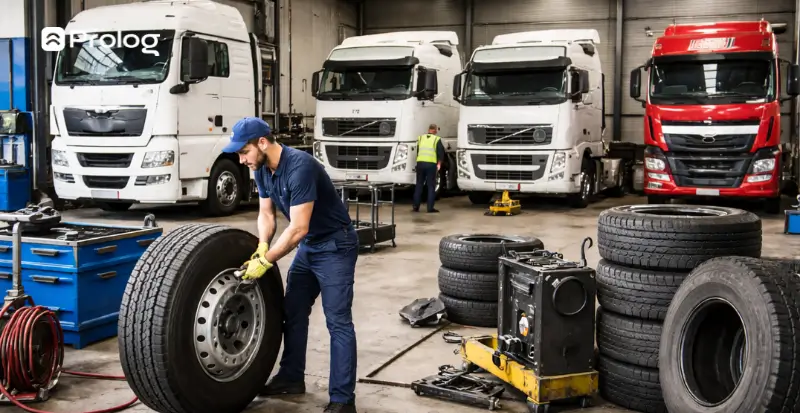
Every medium to large truck fleet reaches a point where relying on outside tire shops no longer makes sense.
The cost per service visit, travel time, lack of control over what is done to the tire and vehicle unavailability while waiting for service become recurring issues and, beyond a certain volume, the figures favor bringing services in-house.
Having an in-house tire shop resolves these issues. But it creates others: physical facilities, a team, processes, inventory control, safety and indicators. A well-run tire shop is a strategic asset. A poorly run one is a fixed cost that does not deliver what it should.
Read on:
- The strategic role of an in-house tire shop in fleet management
- Physical facilities: what an in-house tire shop needs
- The team: who they are and what they need to know
- Core processes: what needs to happen in the tire shop every week
- Inventory control: what many tire shops get wrong and how to get it right
- Indicators: what to measure to assess tire shop performance
- Tire shop safety: what must not be neglected
- How technology turns the tire shop into a data collection point
The strategic role of an in-house tire shop in fleet management
An in-house tire shop is more than a place to replace tires and adjust their pressure. In a fleet operation with dozens or hundreds of vehicles, it is the control point for one of the largest operating costs.
When the tire shop is internal, the fleet gains direct control over service quality (pressure calibration, rotation, mounting, repairs), the traceability of each tire by its fire number, response times for corrective and preventive services, and the data that feeds tire management as a whole.
Each service visit generates information about inflation pressure, tread depth, service type, casing condition and disposal reason. If this data is recorded and consolidated, the tire shop becomes the basis for all tire purchasing, retreading and budget planning.
If it is not recorded, the tire shop is just a tire repair workshop: it resolves immediate needs but does not feed management (which is the main advantage of bringing the service in-house).
Physical facilities: what an in-house tire shop needs
A fleet tire shop differs from a commercial roadside tire shop. Service volume is higher, vehicles are heavy, and processes need to be standardized to work efficiently and safely.
Space and layout
The tire shop needs enough space to service at least one entire vehicle at a time, with safe circulation around it. Ideally, the layout should allow a continuous flow: an entry and assessment area, a service area (mounting, demounting, pressure calibration, repairs) and an exit area with final inspection. If volume justifies it, more than one service bay prevents bottlenecks.
The floor must be level, withstand the vehicles’ weight and be easy to clean. Lighting needs to be suitable for visual inspection.
Essential equipment
The minimum equipment for a truck fleet tire shop includes:
- an industrial air compressor with capacity matching the pressure calibration volume;
- a hydraulic or pneumatic jack for heavy vehicles;
- a torque multiplier (wheel wrench) with a torque wrench to control tightening;
- a tire changer for heavy-vehicle tires;
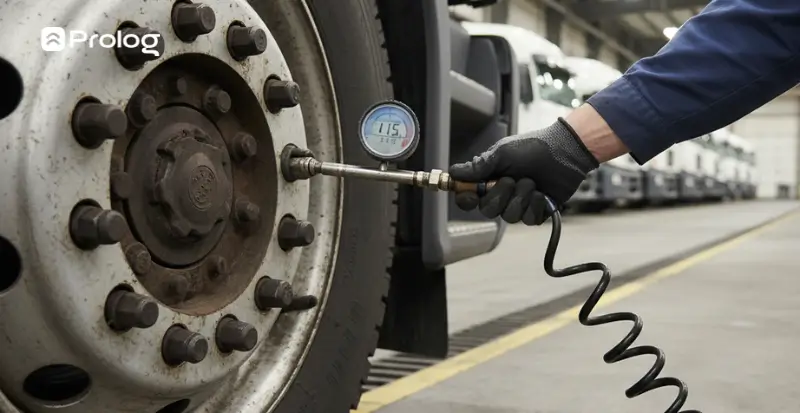
- a tire inflator with a calibrated pressure gauge;
- a tread depth gauge;
- a digital pressure gauge (when the operation seeks greater precision and system integration);
- a tire repair bench (cold and hot repairs).
Besides service equipment, the tire shop needs recording tools: clipboards or electronic devices for checklists, visual tire identification by fire number and access to the tire management system (where available).
Inventory area
A separate, organized space for storing new tires, retreaded tires awaiting mounting, casings awaiting shipment to a retreader, casings awaiting disposal, and parts and supplies (repair patches, valves, inner tubes, adhesive).
Tires must be stored upright, protected from direct sunlight, heat sources and chemical products that could degrade the rubber.
The team: who they are and what they need to know
A fleet tire shop does not need many people; it needs the right people, with proper training and clear processes.
The fleet tire technician is the key person. This professional performs day-to-day services: mounting, demounting, pressure calibration, rotation, repairs and visual inspection. They need to master both the technical work and recordkeeping, because every unrecorded service means lost data.
The ideal profile is someone with heavy-vehicle tire experience, familiarity with the company’s operating procedures and the discipline to follow checklists. If the operation uses a tire management system, the tire technician needs to know how to use the tool, which requires specific training.
Depending on service volume, you may need more than one of these professionals.
A practical reference: each tire technician can service an average of 6 to 10 vehicles per day for routine services (pressure calibration, inspection, rotation). More complex services (mounting, demounting, repairs) reduce this capacity.
For fleets of 50 to 100 vehicles with daily service, two tire technicians are the minimum to cover regular demand and unexpected events.
Supervision may be needed. In larger operations, the tire shop needs a technical lead or supervisor who is not performing the work. This person coordinates service flow, ensures processes are followed, keeps track of indicators and connects the tire shop with fleet management.
Core processes: what needs to happen in the tire shop every week
A well-run in-house tire shop operates through processes. The routines that need to be defined and carried out regularly are:
Scheduled pressure calibration
Pressure calibration is the most basic process and the one with the greatest impact on tire useful life. Its frequency must be defined by operating policy (weekly is the recommended minimum for fleets with intensive driving).
Each pressure calibration must record the pressure found and the adjusted pressure, by tire and position.
Periodic fleet inspection
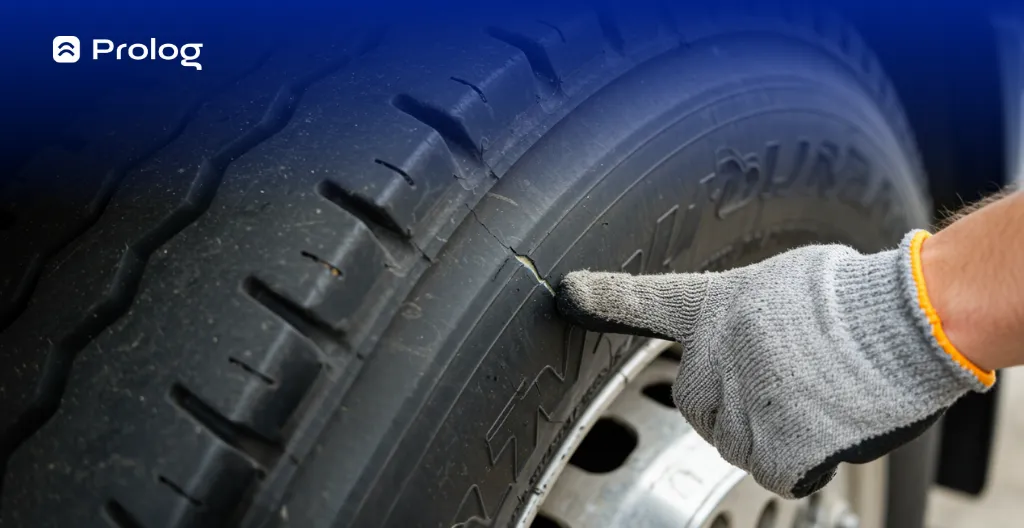
A scheduled inspection that does not depend on the vehicle “showing an issue”. It covers all tires (including spares), measures tread depth, checks for irregular wear, identifies damage and checks whether what is mounted matches what is recorded in the system.
A common reference is to inspect 20% of the fleet per week.
Scheduled rotation
Rotation evens out wear between positions and extends the set’s useful life. It must be based on mileage or inspection results, with each tire’s source and destination positions recorded.
Corrective service with records
Punctures, damage and emergency replacements will happen. The process needs to ensure that every corrective service is recorded with the same discipline as preventive service, because corrective data is just as important as preventive data for understanding what is happening to the fleet’s tires.
Sending and receiving tires for retreading
Casings sent for retreading need to be recorded on departure (with fire number, condition and reason for sending) and on return (with approval or rejection status and rejection reason). This record is the basis for keeping track of the fleet’s retreadability rate.
Periodic inventory counts
A physical check of tire inventory (mounted, in reserve, being retreaded, awaiting disposal) against system records. Frequency depends on volume, but monthly is the minimum. Differences between physical and digital inventory indicate a recording failure or an unidentified loss.
Inventory control: what many tire shops get wrong and how to get it right
Tire inventory is one of the areas where fleet tire shops most often lose control. The most common mistakes:
- Inventory without individual traceability. The tires are there, but nobody knows exactly which ones: how many are new, how many are retreaded, each tire’s fire number, or how long they have been idle. Without individual traceability, control is based on volume.
- Urgent purchases. When inventory is not tracked against consumption projections, replenishment happens when stock runs out. Urgent purchasing costs more and eliminates negotiating power with suppliers.
- Tires idle for too long. Tire rubber degrades over time, even without use. Excessive or poorly sized inventory means tied-up capital and degradation risk. Ideally, safety stock should be calculated based on average consumption per month.
- Casings accumulating without a destination. Casings awaiting shipment for retreading or disposal accumulate when there is no defined outbound process. They take up space, create inventory confusion and delay the return cycle.
Effective inventory control has a simple structure: every tire entering the tire shop gets a record (fire number, condition, origin), and every tire leaving gets a record (destination, reason, date). The management system consolidates the data, but the principle is recording it at the source.
Indicators: what to measure to assess tire shop performance
A tire shop that does not measure cannot know whether it is working well. The essential tire management indicators for tracking fleet tire shop performance are:
Tire CPK (cost per kilometer)
Shows how much each tire costs per kilometer traveled. It allows comparisons between brands, suppliers, vehicles and periods. If the tire shop is doing its job well (pressure calibration, rotation, inspection), CPK tends to fall over time.
Average tire useful life
Indicates how many kilometers each tire travels before replacement. The goal is for this number to rise over time, directly reflecting the quality of tire shop processes.
Retreadability rate
This is the percentage of casings approved by the retreader. The higher, the better, because it means tires are reaching the end of their life with sound casings, as a result of proper pressure calibration and the absence of avoidable damage.
Premature disposal rate
This is the percentage of tires that leave the fleet before reaching their expected useful life. If this number is high, the tire shop is not fulfilling its preventive role and tires are being lost prematurely.
Average service time
Reflects how long the tire shop takes to service a vehicle (preventive and corrective services separated). It indicates operational efficiency and helps determine team size and capacity.
Compliance with the inspection plan
Measures the percentage of the fleet inspected according to the planned schedule. If the target is 20% of the fleet per week and actual execution is 10%, preventive processes are failing, and useful life and disposal indicators will reflect this in the following months.
There do not need to be many indicators, but they do need to be tracked. A simple dashboard with these six figures already gives the fleet manager a clear view of how the tire shop is operating and where it needs to improve.
Tire shop safety: what must not be neglected
A fleet tire shop works with heavy vehicles, high-pressure tires and equipment that poses real risks if used incorrectly. Safety is not an optional item; it is a condition for operating.
The tire technician must use, at a minimum:
- gloves for protection against mechanical hazards;
- safety glasses (especially during mounting, demounting and pressure calibration);
- steel-toe boots, hearing protection (when noise levels require it);
- an appropriate uniform (no loose clothing that could catch in equipment).
Some procedures allow no shortcuts:
- never adjust tire pressure with the employee facing the tread (risk of bursting);
- always use a safety cage to adjust the pressure of tires mounted on rims;
- check rim condition before mounting the tire (a damaged rim poses an explosion risk);
- do not exceed the manufacturer’s maximum pressure;
- use a hydraulic or pneumatic jack suitable for the vehicle’s weight; never improvise supports.
A disorganized tire shop is also unsafe. Misplaced tools, unstable tire stacks, wet or oily floors and obstacles in circulation routes are sources of accidents. Organizing the environment is part of safety, not a separate item.
In addition to technical training, the tire shop team needs specific safety training, with a defined frequency and attendance records. This includes correct use of PPE, emergency procedures, safe handling of heavy tires and equipment operation.
How technology turns the tire shop into a data collection point
Everything described so far (processes, control, indicators and inventory) can be done on paper or in a spreadsheet. And that is how many tire shops operate.
But sooner or later, forms pile up, data is not cross-referenced, indicators are not calculated, and the manager has no visibility into what is happening in the tire shop until someone manually compiles everything.
That is why technology is indispensable. The tire technician records the service on their own phone, the data goes to the system, the indicator is updated automatically and the manager accesses consolidated information without waiting for anyone to transcribe a form.
In practice, what changes with a tire management system in the tire shop:
- Each service record becomes structured data, with date, time, person responsible, vehicle, tire and service type. There is no ambiguity or information loss.
- CPK is calculated automatically per tire, vehicle and period. The indicator that would be impossible to maintain manually in large fleets becomes available without additional effort.
- Inventory control is updated in real time. Each relocation (mounting, demounting, sending for retreading, disposal) feeds the inventory automatically.
- Inspection generates alerts. Anomalies identified in the checklist can be converted into work orders, ensuring that the detected issue is addressed rather than merely recorded.
The Prolog Tire Management solution was built to work within a fleet tire shop’s routine, with integrated digital inspection, individual traceability by fire number, retreading control and indicators such as CPK, useful life and disposal rate calculated from the data the tire shop itself generates.
The tire shop that was once just the place to change tires becomes the data center for tire management. And management that once relied on memory and spreadsheets becomes supported by structured, continuous information.
See how Prolog Tires works in tire management for your fleet with an in-house tire shop. Request a demonstration.
Frequently asked questions
What is an in-house fleet tire shop?
When does bringing the fleet tire shop in-house pay off?
What equipment does a fleet tire shop need?
How many tire technicians does a fleet need?
Which indicators show whether the tire shop is performing well?
// newsletter
Fleet management content, straight to your inbox
Articles on tires, maintenance and fleet operations. No spam.