IoT system for maintenance management: how to adopt it
 Luiz Felipe 7 min read

For some years, vehicle maintenance has been evolving beyond traditional practices. IoT sensors in fleet maintenance fit into this context: onboard devices, supplied by companies specializing in this type of solution, used to keep track of vehicle condition in real time and speed up the transmission of information to the operations center.
With the data collected, it is possible to carry out a more accurate failure diagnosis, predict future maintenance needs and optimize vehicle use.
These IoT sensors therefore end up contributing to crucial transport operation goals, such as reducing costs and increasing fleet productivity.
Learn more below:
- What IoT sensors in fleet maintenance are
- What they are used for and how they work
- Benefits of using IoT sensors in fleet maintenance
- How to implement IoT sensors in fleet maintenance
- Managing data and taking action based on IoT sensors in fleet maintenance
What are IoT sensors in fleet maintenance?
IoT sensors in fleet maintenance are devices installed in a vehicle to collect information on the condition and performance of components and transmit it to a system that organizes it.
Remember that “IoT” stands for “Internet of Things”, a technological innovation applied in several sectors of the market. In Brazil, Decree No. 9.854/2019, which established the National Internet of Things Plan, defines IoT as “the infrastructure that integrates the provision of value-added services with capabilities for physical or virtual connection of things with devices based on existing information and communication technologies and their developments, with interoperability”.
The same decree helps set expectations when comparing suppliers: devices are “equipment or subsets of equipment with mandatory communication capability and optional sensing, actuation, data collection, storage and processing capabilities”. Communication is mandatory; sensing, collection and processing vary from one model to another.
Sensors can be installed in several parts of a vehicle to keep track of everything from tire pressure to oil levels, engine temperature and other parameters.
Through an internet connection, the data collected by sensors are sent to a central management platform, allowing detailed, continuous analysis.
What are they used for and how do they work?
IoT sensors in fleet maintenance provide a comprehensive, up-to-date view of each vehicle's health.
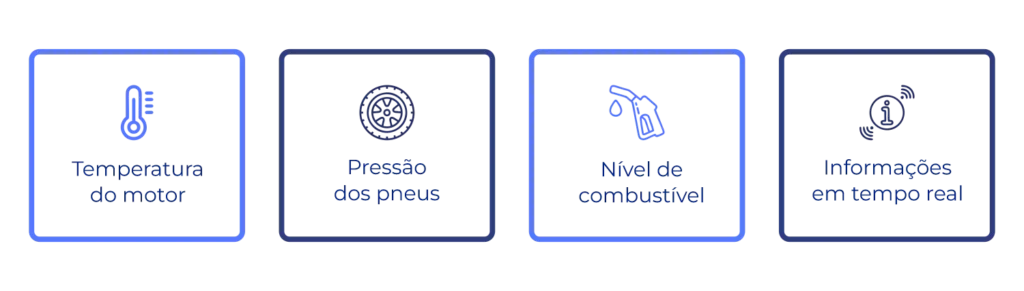
They work by capturing specific vehicle data, such as engine temperature, tire pressure and fuel level, among others, and transmitting this information in real time to a centralized management platform over the internet.
A caveat rarely found in sales materials: “real time” is usually a matter of configuration, not an automatic property of the equipment. Reading frequency, transmission interval and behavior in areas without network coverage are generally adjustable parameters — and define whether data arrive in seconds, in minutes or only when the vehicle regains a signal. It is worth asking the supplier about this.
These sensors can also be integrated with artificial intelligence platforms, opening up possibilities for predictive maintenance strategies aimed at optimizing maintenance scheduling, reducing costs and minimizing vehicle downtime.
Benefits of using IoT sensors in fleet maintenance
Implementing IoT sensors in fleet maintenance can transform transport operations. See the main benefits reported for this technology:
- Predictive maintenance: sensors can identify signs of issues before they become critical and allow more timely preventive intervention, which tends to reduce the number of costly corrective maintenance services.
- Reduced maintenance downtime: continuous monitoring of vehicle condition by onboard devices helps anticipate unscheduled stops and, consequently, increase fleet availability.
- Greater safety: keeping track of indicators that affect vehicle safety, such as tire pressure and engine temperature, contributes to accident prevention.
- Cost savings: with optimized fuel management and less need for maintenance services over the long term, through more accurate maintenance based on actual vehicle condition, reducing fleet operating costs becomes more feasible.
- Increased vehicle useful life: maintenance scheduled based on actual vehicle condition allows intervention before natural wear becomes excessive, which tends to extend the fleet's useful life.
These gains, however, are not automatic: they depend on someone reading what the device indicates and turning it into a work order.
How do you implement IoT sensors in fleet maintenance?
Implementing IoT sensors in fleet maintenance is a process that requires strategic planning and careful execution to ensure the technology is used to its full potential.
Start by assessing the fleet's specific needs, identifying which aspects of maintenance can be optimized using sensors for IoT in fleet management.
After this analysis, suitable devices must be selected based on criteria such as accuracy, durability and compatibility with existing systems. It is worth adding total cost to these criteria, including installation, connectivity and maintenance of the device itself throughout the contract.
The next step involves installing sensors in vehicles, which must be carried out by qualified professionals to ensure correct configuration and operation of the overall setup.
At the same time, it is necessary to configure IT infrastructure to collect, store and analyze the data generated, which may involve integration with fleet management software that supports IoT technology.
Training for the fleet management team and maintenance technicians is also necessary to ensure they can interpret data and make decisions based on accurate information.
5 tips for managing data and taking action based on IoT sensors in fleet maintenance
Set clear goals for data collection
To take advantage of the potential of IoT sensors in fleet maintenance, it is essential to define specific objectives for data collection.
These goals can range from improving vehicle safety to optimizing fuel consumption or reducing downtime.
With this clarity, it becomes easier to determine which data are needed, how to collect them efficiently and, later, how to use them to achieve the desired results.
Integrate sensors and systems
This integration allows a continuous flow of information between vehicles and the operations center, ensuring that collected data are accessible and usable in real time.
This enables the management team to make data-driven decisions, improving operational efficiency and fleet maintenance effectiveness.
In practice, this exchange usually takes place through an API, and it is worth defining a common key between the two sides beforehand — usually the license plate or fleet number. This key allows what the device recorded to be combined with that vehicle's service history.
Use supporting tools for data analysis
Generative artificial intelligence tools such as ChatGPT can be useful in this process, supporting the interpretation of large volumes of data, identifying patterns and providing insights.
By sending organized data and using clear prompts, this type of assistant helps save time on organization and report generation, so you can focus even more on analysis for strategic decision-making.
Two caveats accompany this use: cross-check the numbers returned by the assistant against the original source and check the tool's privacy policy before sending sensitive operational or driver data.
Continuously monitor and adjust data collection and analysis
As the fleet evolves and new technologies are introduced, it is important to periodically reassess data collection and analysis strategies to ensure they continue to meet operational needs.
This includes updating sensors, reviewing data collection parameters and adapting analysis tools as needed.
It is worth including an easy-to-forget item in the review: how many devices stopped sending data during the period, since faulty or disconnected equipment often goes unnoticed.
Create a predictive maintenance routine
The basis of predictive maintenance is to use advanced technologies such as IoT sensors to collect detailed data on vehicle operating condition in real time.
Using this information, it is possible to identify patterns, predict imminent failures and schedule maintenance before larger issues occur.
To implement a predictive maintenance routine, define specific monitoring parameters based on the individual needs of each fleet vehicle.
Also continuously analyze incoming data for early detection of potential failures and create a flexible maintenance schedule that can be adjusted based on the analyses carried out.
It is worth distinguishing two data sources that are often confused. The first is onboard data, generated by equipment installed in the vehicle and provided by companies specializing in this hardware — this is the source discussed throughout this article. The second is process data: the inspection completed by the vehicle operator and the record made in the workshop, which feed each vehicle's maintenance history.
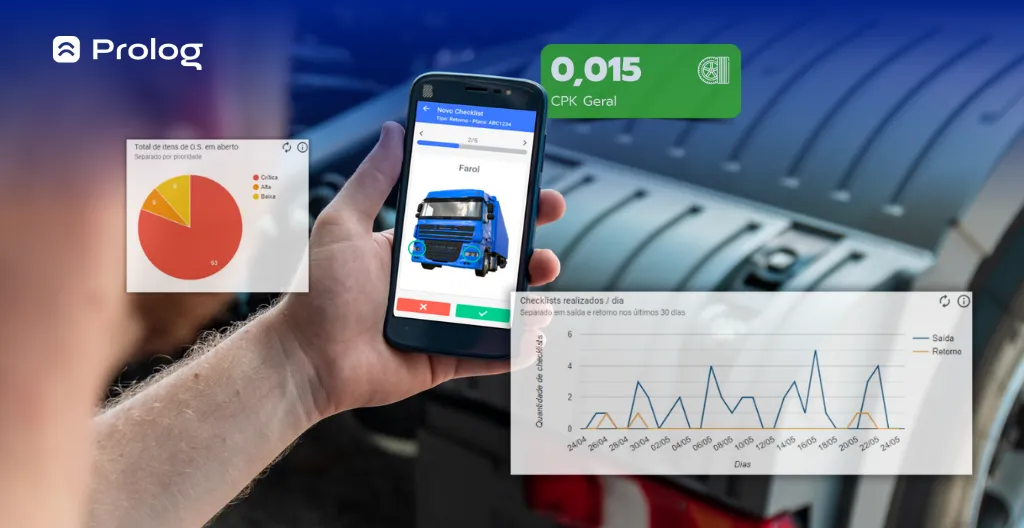
Prolog App works with this second source. The Electronic Checklist is completed on a mobile phone, accepts photos taken at the time of inspection, works even without an internet connection and automatically generates a Work Order (WO) when a nonconformity is indicated. From there, maintenance management controls costs and inventory, opens an individual WO at any time and schedules automatic WOs by mileage or date. The two sources do not exclude each other: an open API is available for integration with other systems.
Start transforming fleet maintenance management with a system specialized in maintenance. Get to know Prolog App and book your free demonstration.
Frequently asked questions
What are IoT sensors in fleet maintenance?
What are IoT sensors used for in a fleet?
What benefits are reported for IoT sensors in maintenance?
How do you implement IoT sensors in fleet maintenance?
What precautions should a fleet take with collected data?
What is the difference between onboard data and process data?
// newsletter
Fleet management content, straight to your inbox
Articles on tires, maintenance and fleet operations. No spam.