Professional drivers' mental health
 Prolog 6 min read

Professional drivers' mental health needs to be included in fleet management as an operational risk. Sleep, fatigue, working hours, breaks and working conditions affect how the operation plans routes, organizes shift schedules, demands deliveries and learns from incidents.
This focus avoids two common mistakes: treating the topic solely as an HR matter or turning everything into the individual driver's fault. Fleet management can look at work design, identify pressures that increase risk exposure and create routines for discussion, recording and review before the operation relies solely on serious events to react.
Professional drivers' mental health is an operational matter
Driving for work is a risky activity. The HSE, a health and safety reference organization, advises that risk assessment consider three areas: the journey, the driver and the vehicle. For fleet managers, this shows that risk lies neither solely in mechanical condition nor solely in individual driving skills.
Mental health is part of this analysis because psychosocial risks may be linked to job content and working schedules. The WHO also points out that poor environments, including excessive workloads, low control over work and insecurity, pose a mental health risk. In transport routines, these factors appear in very concrete decisions: delivery pressure, little room for breaks, last-minute route changes and limited participation by the person carrying out the trip.
The point is not to diagnose drivers within the operation. The point is to ask whether work has been designed to reduce foreseeable risks. When shift schedules concentrate fatigue, routes leave no room for rest or demands treat breaks as an issue, management needs to review the system, rather than just ask for greater attention.
Sleep and fatigue affect focus, reaction and driving
Insufficient sleep is not a minor well-being detail. The NHLBI states that sleep deprivation can impair learning, focus and reaction. The same institution points out that drowsy driving is responsible for serious injuries and deaths in car accidents, and that harm from sleep deficiency can happen in an instant, such as in a collision.
The HSE states that tiredness increases reaction time and reduces vigilance, alertness and concentration, impairing driving ability. This puts fatigue at the center of risk management: an operation that depends on tired drivers to meet its schedule is accepting a foreseeable weakness.
MedlinePlus reports that most adults need 7 to 8 hours of sleep per night for good health and mental functioning. The fleet does not control drivers' private lives, but it controls some of the work that affects rest: schedules, trip sequences, waiting, communication of changes and pressure to meet time windows. That is why it is worth considering when drivers are more likely to feel fatigued when planning working hours.
Working hours, breaks and rest need to fit the routine
In Brazil, Law No. 13.103 establishes an 8-hour working day for professional drivers. The same law guarantees a minimum 1-hour meal break for employed professional drivers and 11 hours of rest within 24 hours. For freight transport, it provides for 30 minutes of rest within every 6 hours of vehicle driving.
These legal references provide an objective baseline, but do not resolve operational risk on their own. Breaks and rest need to appear in planning and execution. If the route leaves no room for a stop, if the delivery window ignores waiting or if demands turn meals into delays, the actual routine falls out of line with the procedure.
More consistent management turns these points into simple controls: a shift schedule reviewed before the trip, realistic time for stops, clear guidance when the route falls behind schedule and room for the driver to report that a planned break did not happen. The formal obligation becomes management when someone checks whether it fitted into the working day.
Working conditions help organize risk and staffing
The WHO states that there are effective actions to prevent mental health risks at work and protect and promote mental health at work. It also defines organizational interventions as actions that assess and then mitigate, modify or remove workplace risks.
For the fleet, this shifts the response from an isolated talk to operational design. Discussions about self-care may have a place, but do not replace reviewing shift schedules, routes, goals, communication and breaks. The HSE advises against placing drivers under pressure to meet delivery goals.
When the company discusses staff retention and availability, it is important to maintain this limit: the evidence dossier for this topic does not support promising reduced turnover, fewer absences or increased available staffing. What it does support is that poor working conditions pose a mental health risk and that workplace risks can be assessed and reduced through organizational interventions. Retention and availability should therefore be treated as topics deserving discussion alongside actual working conditions, rather than promised results.
This distinction protects management from easy conclusions. Instead of saying that a mental health action solves a driver shortage, the fleet can ask whether its schedules, breaks, goals and participation channels create a more workable, safer routine discussed with those who drive.
Participation and recording move the topic beyond improvisation
The WHO states that workplace mental health actions should take place with meaningful participation by workers and their representatives. In fleets, this is crucial because drivers know details that spreadsheets do not show: a stopping point that does not work, recurring waiting, a stretch of road that increases tiredness, guidance that arrives late and demands that squeeze breaks.
The HSE recommends planning routes in consultation with drivers or representatives, considering, for example, the need for rest breaks. This consultation does not remove the company's responsibility; it improves planning quality by bringing the plan closer to actual execution.
It is also necessary to record what happens on the road. The HSE recommends implementing a system for workers to report work-related road incidents and near misses. These records help distinguish isolated errors from operational patterns: overly tight routes, poorly planned schedules, delivery pressure, communication failures or breaks that never fit.
How to start without turning everything into HR
A practical approach is to review critical routes one question at a time. Does the route allow rest breaks? Does the shift schedule concentrate driving at times of greater fatigue? Does the delivery window match distance, loading, unloading and waiting? Does deadline pressure push drivers to sacrifice meals or rest?
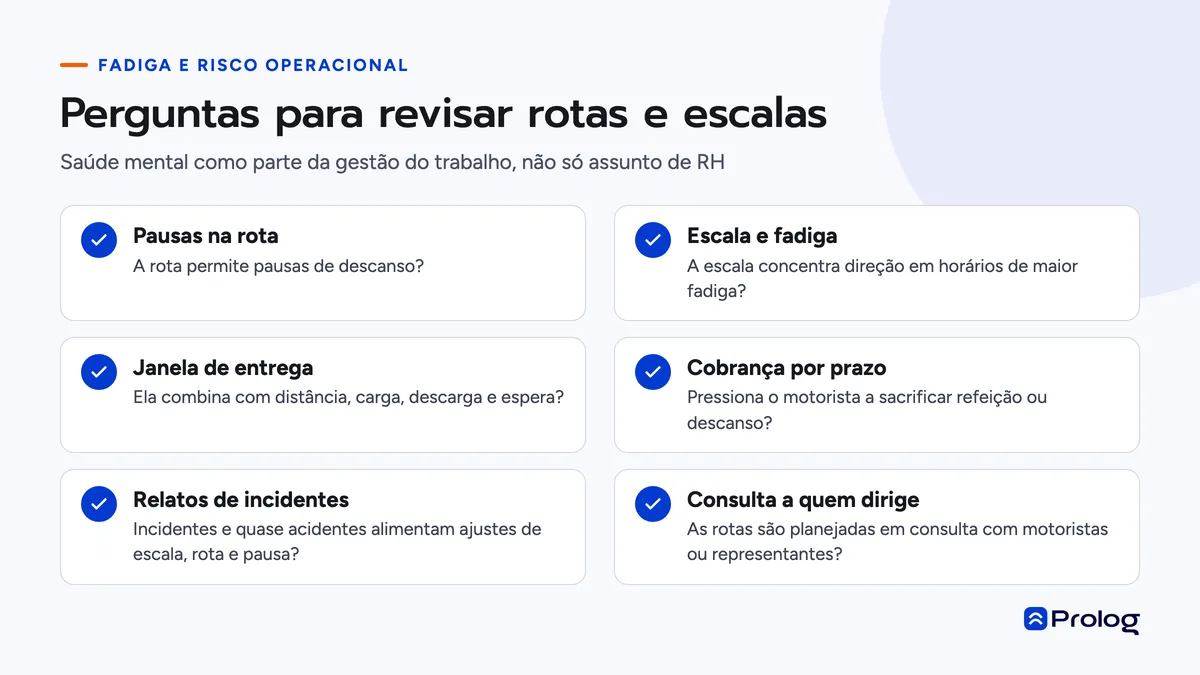
Then establish a short review cycle to analyze reports. Incidents and near misses should feed into adjustments to shift schedules, routes, breaks and communication. If recording becomes only individual accountability, the operation loses the chance to correct work design.
Finally, separate facts from management goals. There is a basis for stating that sleep, fatigue and working conditions contribute to operational risk. There is a legal basis in Brazil for treating working hours, meals, rest and breaks while driving freight vehicles as routine reference points. This evidence dossier provides no basis for promising retention or availability results. The safer decision is to treat mental health as part of work management, through listening, recording and continuous operational review.
Frequently asked questions
How does professional drivers' mental health fit into fleet management?
Is driver fatigue an operational risk?
What does the law provide for professional drivers' working hours and rest?
Does mental health improve driver retention and availability?
How can this topic be addressed without reducing everything to individual behavior?
// newsletter
Fleet management content, straight to your inbox
Articles on tires, maintenance and fleet operations. No spam.