
Prolog investment return: how soon does it pay for itself?
 Jean Zart 6 min read
When a fleet manager considers adopting a management system, the most objective question to ask is: how soon does this investment pay for itself? It is not about features or dashboards, but real financial returns, measured in Brazilian reais saved each month.
The answer depends on the size of the operation, its current level of control and which solutions are implemented. But Prolog customer data show that returns usually appear in the first few months and, in many cases, within the first quarter.
What Prolog actually offers
Before discussing returns, it is worth clarifying what is being adopted. Prolog offers three solutions that a company can implement independently or together:
Tire management system
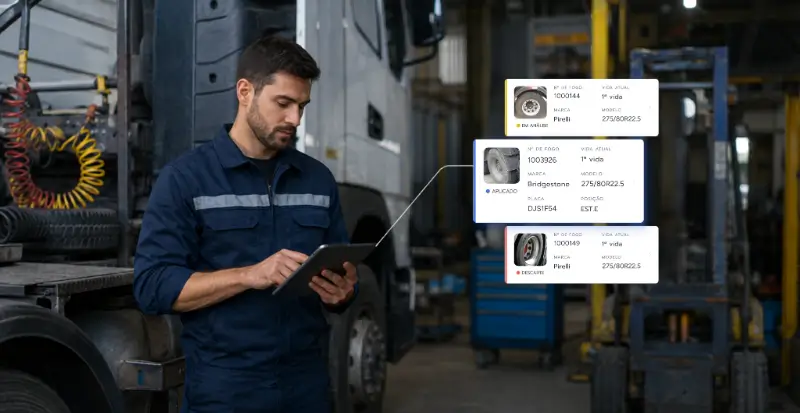
The Prolog tire management system provides comprehensive control of the tire life cycle. In other words, from tread depth and pressure inspections with its own electronic equipment to keeping track of retreading, disposal and CPK by make and model.
It also includes Prolog's tread probe kit, which connects to the system and eliminates manual data entry.
View this post on Instagram (video in Portuguese)
Electronic checklist
The Prolog electronic checklist is a digital vehicle inspection platform where drivers complete the checklist through the app before and after each trip. Out-of-standard items therefore generate work orders automatically, connecting issue identification to corrective action.
Maintenance management system
The Prolog maintenance management system is software for controlling work orders and preventive and corrective maintenance. It also includes a schedule, vehicle histories and workshop performance indicators.
Where the return from the Prolog tire management system comes from
When it comes to tire management, this has historically been the solution with the fastest and most measurable return. That is because tires are high-value, high-turnover assets with a direct impact on several operating costs.
Returns include:
Reduced premature disposal
Every tire that completes its full life cycle means money that no longer needs to be spent. A truck tire costs (in Portuguese), on average, from R$2,200.
That is why, when the operation manages to reduce premature disposal through regular inspections, planned rotation and detection of mechanical issues that accelerate wear, the savings are direct and immediate.
At Conlog, implementing Prolog helped eliminate early tire disposal.
More successful retreads
Retreading costs between 30% and 40% of a new tire's price and delivers between 80% and 90% of the original mileage.
Every casing recovered instead of discarded represents good savings. With inspection data and each tire's history, the decision to retread or discard moves from visual inspection to data-driven decision-making.
Cobeb, a Prolog customer, reduced retread rejections by 50% after starting to use our tool.
Improved CPK
With CPK calculated by make, model and route profile, the operation starts purchasing better. In other words, it buys the tire offering the best value throughout the full cycle, rather than the cheapest tire. This change in purchasing logic alone already generates returns.
Fuel savings through proper calibration
Tires with incorrect pressure increase rolling resistance and, consequently, diesel consumption.
Studies indicate that correct calibration can save up to 3% in fuel consumption, a percentage that translates into significant amounts over a month in fleets with dozens of vehicles running daily.
MC Transportes, a transport company and Prolog customer, achieved savings of 4%.
Where the return from the Prolog electronic checklist comes from
The return from the Electronic Checklist is spread across more areas and partly preventive. This makes some gains less visible in the short term, but no less real:
Eliminating paper
At Avilan Transportes, digitizing the checklist and tire management eliminated more than 2 tonnes of paper per month.
Besides direct printing and storage costs, eliminating paper brings greater speed: information that previously took days to reach the manager becomes available in real time as inspections are recorded.
Reduced inspection time
With the process standardized in the app, inspections become faster and more consistent. Drivers follow a defined flow without forgetting items, and records are immediate. For operations with dozens of vehicles inspected each day, the time savings accumulate.
Early failure detection
When the checklist identifies a nonconformity and a WO is opened automatically, maintenance acts before the issue develops.
Fixing a brake whose wear was identified during an inspection costs less than dealing with a failure on a route, whether in repairs, towing, vehicle downtime or compromised cargo.
Fewer insured incidents and impact on insurance
The structured checklist ensures that vehicles do not leave with critical items pending. Over time, this is reflected in the fleet's insured incident rate and, consequently, in insurance renewal negotiations.
Where the return from the Prolog maintenance management system comes from
The return from Maintenance Management appears in reversing the ratio between corrective and preventive maintenance and what this means financially:
Less corrective maintenance, more preventive maintenance
Corrective maintenance costs more than preventive maintenance in two dimensions: the repair itself tends to be more expensive (because the issue has developed), and the vehicle is idle longer (because the work was not scheduled). Each corrective maintenance service avoided is a double gain.
Increased mechanical availability
Each additional vehicle running per day is productive capacity that generates revenue. A fleet with 100 vehicles that increases mechanical availability from 85% to 92% puts, on average, 7 more vehicles into operation daily, without buying a single new asset.
Reduced MTTR (mean time to repair)
When the workshop receives the WO with vehicle history, failure context and prioritization by criticality, diagnosis is faster and repairs are more accurate. This reduces the time the vehicle spends idle in the workshop.
Payback time in practice
The payback period varies with fleet size, the level of control the operation already has and which solutions are adopted. But the pattern observed among Prolog customers follows a consistent logic:
In the first 30 days, the focus is implementation: asset registration, parameter configuration, team training and the start of data collection. This is the foundation-building phase.
From the second or third month, the first results begin to appear.
In tire management, this translates into reduced disposal and more retreads. In the checklist, it means detecting failures that prevent corrective maintenance. In maintenance, it means a better-organized WO queue and the start of a reversal between corrective and preventive maintenance.
Between the third and sixth months, returns tend to consolidate and exceed the monthly investment. The database already allows comparative analyses, processes are running and indicators begin to reveal patterns that support more accurate decisions.
The most costly investment is the one never made
In fleets with more than 50 vehicles, the difference between structured tire management and management without control can represent the difference between 8% and 20% of total operating costs spent on tires. This can easily mean hundreds of thousands of Brazilian reais per year.
Investment in management technology does not create a new cost: it makes existing costs visible and provides the resources needed to understand how to reduce them.
Would you now like to understand the expected return for your operation? Talk to a Prolog specialist and receive a personalized assessment.
Frequently asked questions
How soon does an investment in Prolog pay for itself?
What solutions does Prolog offer?
Where does the return from Prolog tire management come from?
How much does retreading save compared with a new tire?
What is the return from Prolog's electronic checklist?
How does Prolog maintenance management generate returns?
// newsletter
Fleet management content, straight to your inbox
Articles on tires, maintenance and fleet operations. No spam.
Read also
 Prolog


Prolog at SXSW 2026: founders visited Austin
Jean Zart and Luiz Felipe attended SXSW 2026 in Austin to find AI and technology signals applicable to fleet management in Brazil.
Prolog at SXSW 2026
Where the technology that will change your fleet management comes from.
 Jade Zart
 Prolog
