Dump truck inspection: what to check
 Luiz Felipe 4 min read
Do you already know how to inspect a dump truck? Did you know that the checklist can differ according to vehicle models?
A fleet with a variety of vehicles is indeed on the right track. This means it can meet different demands and be a complete solution for companies that need freight transport.
However, one question that often arises is whether different inspections are needed for each of these vehicle types. A dump truck, for example, has specific features that need closer attention — namely, the hydraulic system that moves the dump body.
So, let’s get started:
Which items belong in a dump truck inspection?
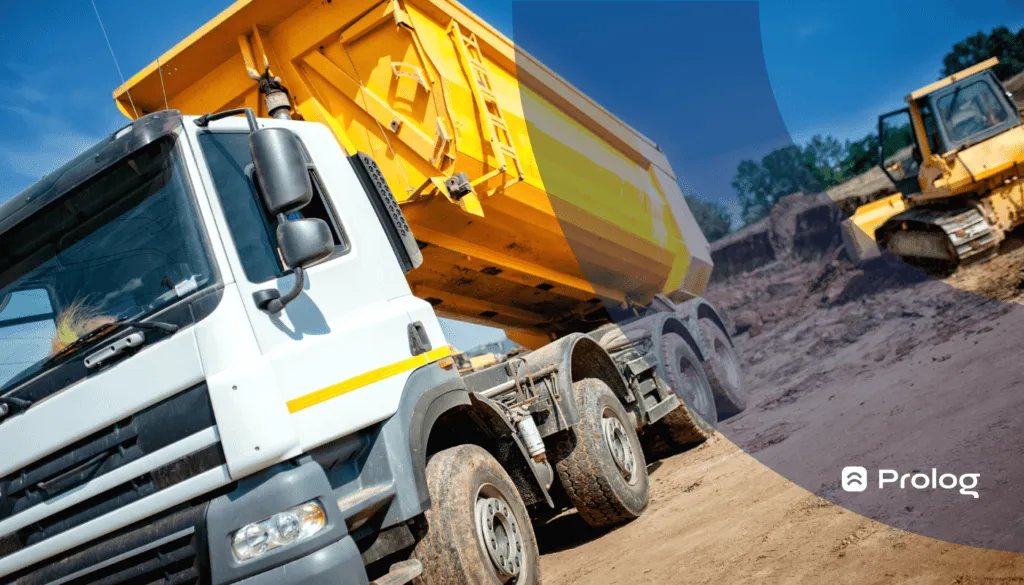
The dump body is lifted by hydraulic systems that use engine power to pump oil and activate the piston, which raises and lowers the body.
Depending on the model available in the fleet, operation may be “manual” (the driver uses controls to manage the entire movement), but in more modern vehicles the process is carried out more quickly from inside the cab.
With that in mind, you can conclude that a dump truck inspection needs to include questions in the checklist such as:
- Is the hydraulic system working correctly, without faults or jamming?
- Is the control system for raising and lowering the dump body responding as expected?
- Is there any wear on the parts that move the dump body?
- Are all pulleys, cables and bolts secure in their places?
Want to see this in your fleet? Talk to a Prolog specialist
Other questions that are not exactly specific to this vehicle, but are extremely important to prevent its operation from being compromised, are:
- Are there signs of hydraulic oil leakage on the vehicle?
- Is the engine oil at the correct level and free of leaks?
- Are all the headlights working?
- Are all movement alarms working and audible?
After that, you also need to examine some elements considering the entire vehicle. Here, you can think of questions that would appear in other truck inspection lists. For example:
- Is the horn working?
- Do all doors close properly, with no signs of issues?
- Are the tires in good condition?
- What is the current fuel level?
- Are the brakes working correctly?
- Is the windshield free of cracks and fractures?
- Is the vehicle documentation available and valid?
Among the many other questions you could use to build a checklist, you should assess what matters most for the trucks in your fleet and for the time of inspection. If it is just a daily check, questions about the air conditioning filter are not considered essential, but those about the headlights are.
So, seek to understand your fleet’s needs to plan a checklist that really works.
Why have a dump truck in the fleet?
This vehicle style is considered very versatile among truck models. Its main distinguishing feature is that its dump body can be raised to remove the transported load (without the need for human intervention).
In other words, it makes unloading the truck much faster.
Because of this feature, it is widely used on construction sites and to transport building materials. It can also be versatile and used in longer operations, carrying bulk loads such as grain, sand, gravel and similar materials.
When a dump truck inspection is carried out frequently and correctly, the vehicle offers a high level of transport safety and also has the benefit of increasing productivity through fast loading and unloading — as well as ease of handling.
Why is dump truck inspection so important?
According to a 2018 survey by FENIVE in Brazil, 58% of dump trucks had mechanical issues. Among the 3.4 thousand vehicles analyzed, around 9 thousand “NOK” items (nonconformities) were found.
Because of the safety device that had recently become mandatory in vehicles in Brazil, this figure was (probably) higher than normal. However, even so, many trucks had issues with brakes, headlights and suspension.
Any “NOK” item can pose a risk to vehicle and driver safety, and you should treat preventive maintenance as a mandatory fleet task. All vehicles must have their inspections up to date.
To help you focus on analyzing data obtained through the checklist and make smarter fleet decisions, we have prepared a free dump truck checklist that may help. Download it to start using it (in Portuguese).
Frequently asked questions
What changes in a dump truck checklist?
How does the system that lifts the dump body work?
Which general items must be included in a dump truck inspection?
Do I need a different checklist for each vehicle type?
What is a dump truck used for in a fleet?
What did the FENIVE survey find in dump trucks?
// newsletter
Fleet management content, straight to your inbox
Articles on tires, maintenance and fleet operations. No spam.