Tires and the environment: fleet impacts and solutions
 Luiz Felipe 5 min read
Fleet managers must pay attention to the environmental impacts caused by tires.
With growing concern for the environment and the need for companies to adapt to ESG and sustainability practices, some tire care measures arise that must be taken into account.
Although these adjustments have already been a topic of discussion and an emerging trend in recent years, there are still many questions about how to adapt and even about why this matters for transportation fleets.
That is why we will cover the following:
- What are the environmental impacts caused by tires;
- The importance of sustainable practices in fleet tire management;
- Which solutions to use to reduce the environmental impacts caused by tires.
What are the environmental impacts caused by tires?
Biodegradation and basic sanitation
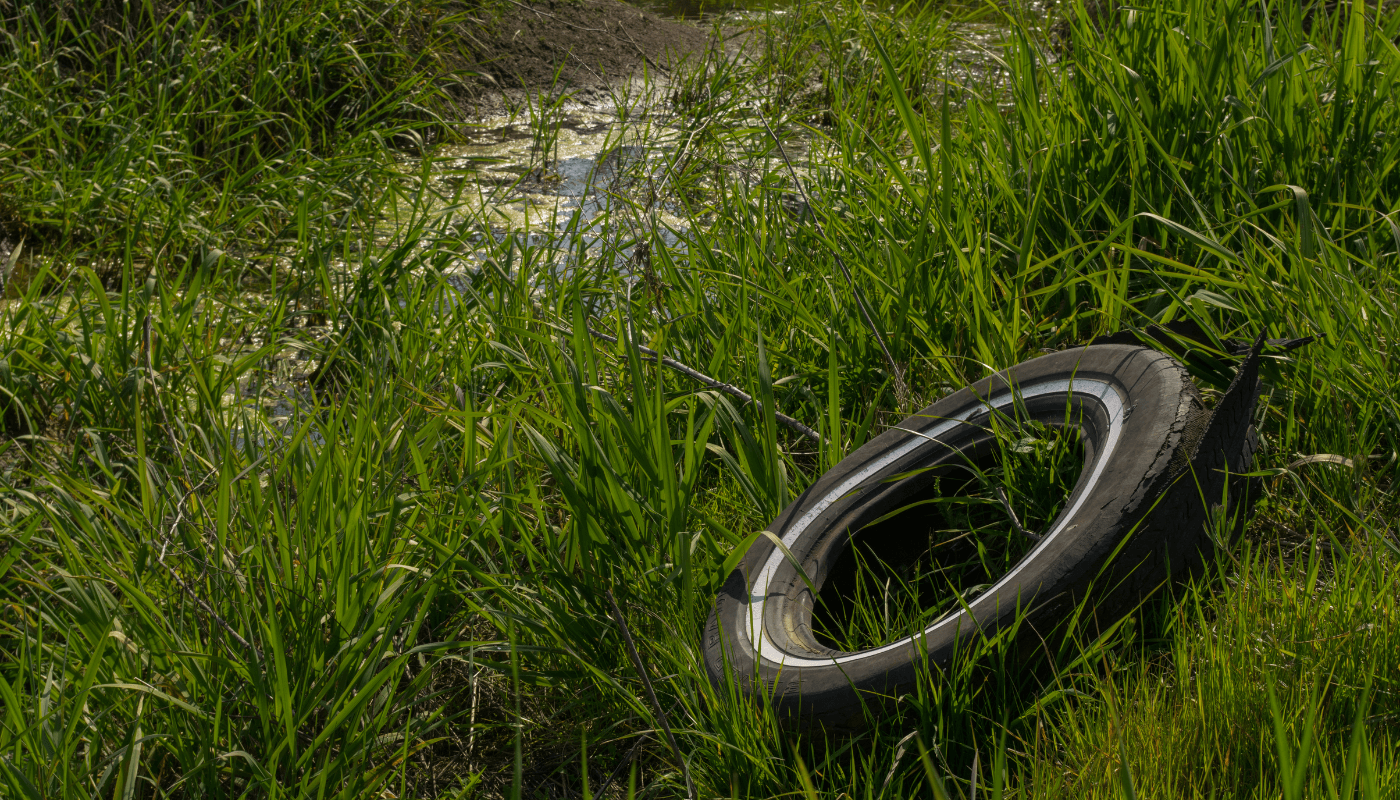
One of the main environmental impacts caused by tires is their long deterioration time, which can reach about 600 years.
During this period, they release liquids and gases, especially when exposed to sunlight and excessive rain, and this can result in soil and water contamination, creating significant problems for local basic sanitation.
Soil and water pollution prevents these areas from being used for planting, construction and other essential activities, harming the quality of life of nearby communities and creating additional challenges for waste treatment and natural resource management.
Exploitation of natural resources
Tire production requires the use of natural resources, including rubber, oil and minerals.
This ends up leading to intensive exploitation of these resources. As a result, the demand for raw materials for tire manufacturing also worsens the degradation of natural areas and can affect biodiversity in the regions where extraction takes place.
Pollutant emissions
Worn tires emit fine particles (called PM2.5 particles) and other pollutants that contribute to air pollution and are harmful to human health and the environment.
These particles are a mixture of solid particles and liquid droplets present in the air. Inhaling these particles and pollutants can cause a range of respiratory and health problems, making this one of the most worrying environmental impacts caused by tires.
Impact on wildlife
Tires discarded in natural environments pose a threat to wildlife and local ecosystems. Animals such as birds, mammals and reptiles can become trapped in discarded tires or be injured when interacting with them.
In addition, the accumulation of tires in natural areas can create favorable conditions for the spread of diseases, serving as breeding grounds for disease-carrying mosquitoes, such as the dengue mosquito. That is why even tires stored before their final disposition need to be kept in covered areas.
Non-recycled waste
A large number of used tires are neither recycled nor reused, which results in their improper placement in landfills and vacant lots.
Tire contamination in these areas can also prevent the use of the region's natural resources, harming both the environment and the communities that depend on these resources. In addition, not every product can be thrown away with ordinary waste, which reinforces the importance of treating used tires as waste that requires proper disposition.
The importance of sustainable practices in tire management
Adopting sustainable practices in the fleet and in its tire management is essential in a country like Brazil, where waste disposition requires care and responsibility from companies.
Instead of treating the used tire as ordinary waste, the fleet can organize processes to store and route this material responsibly. In reverse logistics, the collection and return of solid waste to the business sector help make this return possible for reuse, recycling or proper disposal.
Given this scenario, tire management focused on sustainability contributes to preserving the environment, reducing the environmental impacts caused by improperly discarded tires.
In addition, it can be seen as an opportunity for your company to align with ESG (Environmental, Social and Governance) practice standards and gain competitiveness in the market.
These issues are gaining more and more attention, and many customers already prioritize doing business with companies that show environmental concern.
Therefore, adopting sustainable practices in your fleet management and tire management has become indispensable, not only to reduce the environmental impacts caused by tires, but also for the company to gain competitiveness in the market.
Solutions to reduce the environmental impacts caused by tires
Use sustainable tires
An effective solution to reduce the environmental impacts caused by tires is the use of sustainable tires, also known as green tires.
These models are developed with recycled or biodegradable materials, which helps minimize some of the main environmental problems associated with tires.
In addition, the production of these tires is more sustainable, since it avoids the exploitation of natural resources and reduces waste generation.
These models are often also designed to deliver better operational performance, which contributes to reducing the vehicles' fuel consumption and the emission of toxic gases into the atmosphere.
Form partnerships for tire disposal or recycling
An important strategy to reduce the fleet's environmental impacts is to establish partnerships with companies specialized in tire recycling or disposal.
By doing this, fleets can ensure that their used tires receive proper disposition, avoiding soil and water contamination, as well as other consequences of discarded tires.
Practice reverse logistics with manufacturers
Another interesting solution for dealing with the environmental impacts of tires is to adopt reverse logistics practices in collaboration with tire manufacturers.
This means that used tires are returned to manufacturers so they can be recycled or disposed of appropriately. The logic of reverse logistics is precisely to bring together actions, procedures and means to make possible the collection and return of solid waste to the business sector.
By working together with manufacturers in this process, fleets contribute to a more sustainable tire life cycle.
Manage the fleet's tires
To minimize the environmental impacts caused by tires, it is essential to implement effective tire management in the fleet.
This involves regularly keeping track of tire condition, proper maintenance and choosing sustainable tires whenever possible. Correctly calibrated tires also last longer, improve fuel economy and are safer, which reinforces the importance of a preventive routine.
Tire management also includes keeping track of tire wear, proper calibration and timely replacement for retreading, ensuring that tires are used as efficiently and responsibly as possible.
To speed up and simplify this process, you can count on a technological and innovative tire management solution. Discover Prolog App and how this system contributes to reducing the environmental impacts caused by tires, with individual control of each tire, including wear, retreading, life cycle and cost per tire.
Frequently asked questions
How long does a tire take to decompose?
What are the environmental impacts of tires?
Why do discarded tires attract mosquitoes?
How can a fleet reduce the environmental impacts of its tires?
Why does sustainable tire management matter in Brazil?
// newsletter
Fleet management content, straight to your inbox
Articles on tires, maintenance and fleet operations. No spam.