Are tires made from petroleum? How tires are made
 Jade Zart 5 min read
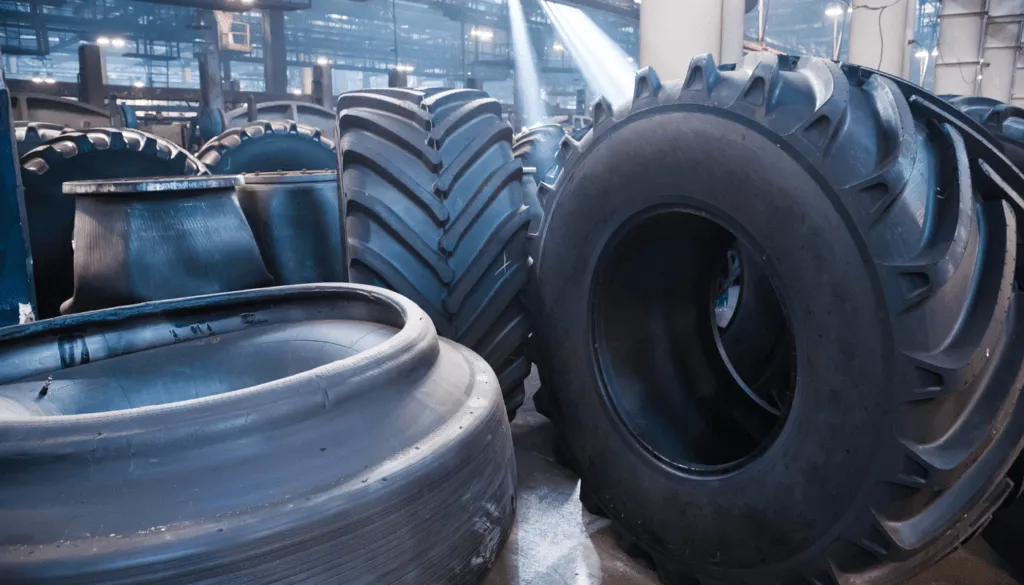
Tire manufacturing is a process that must consider the type of road the tire will face, the function it will perform and external factors that affect tire performance, such as rain, mud and potholes.
After all, tires are essential to transport operations, since they move vehicles and are the main point of contact with the ground.
To learn more about how tires are manufactured and how to use this information in your fleet management, keep reading:
- What the tire manufacturing process involves;
- What raw materials tires are made from;
- What the components of a tire are;
- Questions about tire manufacturing.
What does the tire manufacturing process involve?
Tire manufacturing is a complex process and must follow certain specifications to ensure workplace safety and tire quality.
It involves five stages:
1 – Mixing
The mixture is made with various ingredients, starting with rubber itself, and may include sulfur, antioxidants and many others. In most cases, there are approximately 30 different components.
The proportions used in the mixture vary depending on the tire’s function and desired characteristics. A tire that needs greater strength, for example, needs more natural rubber than other types.
Once mixing is complete, the resulting compound moves to the next stage: cutting.
2 – Cutting and preparation
Before cutting, the mixture must be left to cool so that it becomes more solid than liquid. The strips that form the tire’s structure are then cut.
While cutting takes place, other elements also move into a preparation stage to be coated with rubber. At this stage, the items are cleaned and prepared as needed, whether by heating, cooling or simply keeping the part at room temperature.
With everything ready for use in the tire’s structure, the next stage begins: building.
3 – Building
A tire is built starting with its inner part, the casing: in other words, from the inside out. Today, this stage of tire manufacturing is carried out on a dedicated machine.
All the elements that make up the tire being built are placed in it, from textile parts to plies and tread, and the machine does the rest, assembling the tire with every item in the right place.
Once the entire tire is assembled, it moves to curing. Here is how it works:
4 – Curing (or vulcanization)
Vulcanization is the process of heating rubber, usually with the addition of sulfur. This makes the material more suitable for molding and gives it the necessary elasticity and resistance to high and low temperatures.
The grooves are also formed at this point, when the rubber is at its most pliable.
Once this is complete, the final stage begins: inspection.
5 – Inspection
At this point, a very strict final inspection takes place to prevent a tire from being sold with any defect or fault. The whole structure is checked, including by X-ray, to catch any internal flaws as well.
What raw materials are tires made from?
Throughout the history of tires, different ingredients, or raw materials, have been used in tire manufacturing. Rubber has always been the main material, both natural and synthetic.
The amount of raw material depends on the type of tire and its main function, but, as mentioned above, the mixture contains around 30 different ingredients.
Some of the main materials include natural rubber or polyisoprene, carbon black, amorphous carbon, silica, sulfur, rubber plies, steel, nylon or Kevlar cords, and antioxidants.
Are tires made from petroleum?
Several tire components are derived from petroleum, but tires are not made entirely from this raw material.
What are the components of a tire?
Tire components are the parts that make up a tire after manufacturing. They are:
- Sidewall: made of rubber, it connects the wheel to the outer part of the tire (the tread).
- Plies: the body ply is a mixture of rubber, polyester and nylon that helps support the weight of the vehicle body; there are also stabilizer plies, whose function is to stabilize the tire.
- Beads: steel rings wrapped in a layer of rubber, this part holds the tire on the wheel.
- Belt: belts are usually made of steel and serve to reinforce strength and give the tire greater rigidity.
- Sidewall flank: the rubber part on the sides of the tire, essential for tire stability and where the manufacturer’s information is marked.
- Shoulder: between the sidewall flank and the tread is the tire shoulder, which can be more rounded or elongated and plays an important role in cornering on the road.
- Grooves: the “cuts” in the tread that channel air, water and mud. When needed, they also work on snow-covered roads. They are essential in determining tire grip.
- Inner liner: several layers of rubber that prevent air from escaping and the tire from losing pressure.
- Tread: its material is prepared during the mixing stage of tire manufacturing; it is the part of the tire that will be in direct contact with the ground.
Questions about tire manufacturing
Does tire manufacturing affect durability?
Yes, adding more or less rubber, as well as other ingredients, can affect tire durability.
Likewise, deeper grooves last longer than shallower grooves — a factor decided during tire manufacturing.
To know how to control wear and increase a tire’s useful life, you should carry out tire management activities in your fleet.
How does manufacturing differ between tire types?
Mainly in the amount and volume of each ingredient. Passenger-car tires, for example, use more synthetic than natural rubber, while truck tires use more natural rubber — because it provides greater strength while driving.
However, all of this will be decided according to the function of each type of tire.
Learn more about tires and their history by downloading our free resource: the complete history of tires (in Portuguese).
Frequently asked questions
Are tires made from petroleum?
What are the stages of tire manufacturing?
What is tire curing or vulcanization?
What are the components of a tire?
Does manufacturing affect tire durability?
// newsletter
Fleet management content, straight to your inbox
Articles on tires, maintenance and fleet operations. No spam.