Fleet analyst: what they do and when hiring one makes sense
 Luiz Felipe 4 min read
What does a fleet analyst do? Are they an essential part of your management? Can the fleet manager take on this role?
Basically, the analyst’s role is to assist the manager. But to achieve this ultimate goal, they need to perform several other smaller functions. For example, controlling maintenance and the spending associated with it.
As this is a relatively new position in fleets, there are still many questions about how it works and what results it brings to companies.
Well, that is why we decided to discuss the subject here. Let’s start with the first question:
Do you need a fleet analyst for your data management?
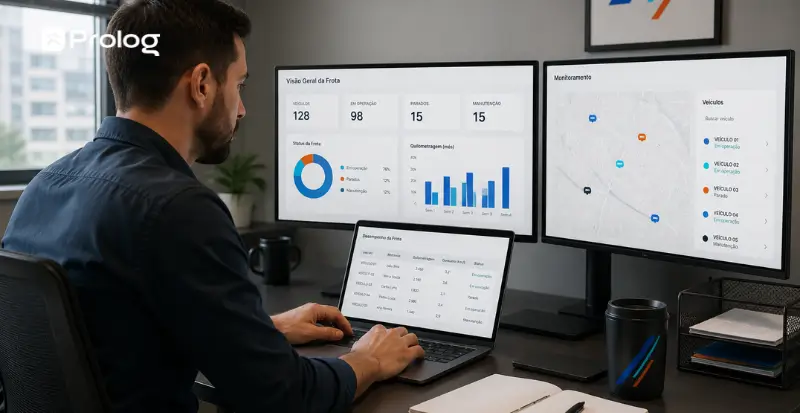
If you want a more efficient fleet and have the resources to hire, yes, you do. After all, the fleet analyst is primarily responsible for reading and interpreting all the data collected in fleet processes.
They also handle maintenance control, spending plans, report production and the development of strategies for cost reduction and logistics process optimization.
What will they analyze?
Everything related to the fleet. For example, route frequency, the number of vehicles on the road and idle, vehicle idle time during trips, adherence to customer schedules, etc.
What will this information be used for?
Using it, the fleet analyst will sit down with the manager and help with some important decisions, such as whether the fleet needs to grow, whether there is an issue in logistics processes or whether a factor is increasing transport operation costs.
One of the biggest advantages for the fleet manager is that the analyst comes to them with a plan and concrete data showing the reasoning behind the proposed strategies.
However, if there is no room or capital for a fleet analyst at present:
Can the manager also become a fleet analyst?
There is nothing to prevent this, of course. Especially in the case mentioned above, where there are no resources to hire. Since analysis is a fundamental function, someone needs to be responsible, and the most suitable person really would be the manager.
As the fleet manager tends to be very busy, handling so many responsibilities can be difficult. It is equally important to emphasize that the roles are performed at two different stages.
In other words, the manager is more of “the office person,” seeking to put alternatives for process efficiency into practice and handling the money.
Meanwhile, the analyst is more of “the shop-floor person,” collecting and analyzing all the information so that the manager can make decisions based on what happens in the fleet every day.
How does the fleet analyst contribute to management efficiency?
That is easy: they bring all the knowledge about the fleet to the manager!
In their routine, they go through all the operation’s logistics processes and record how each thing happens, how long it takes, which employees are involved, who performs each role, and so on.
In other words, the fleet analyst creates a huge knowledge base.
It is also worth remembering that, depending on their experience, this employee will also be responsible for implementing new processes and technologies in the fleet. As they notice gaps in processes, they look for software to resolve the issue in question.
They should also have software for carriers focused on recording everything they collect day to day. It is important to store all the information acquired to actually create that knowledge base.
Why build data-driven fleet management?
Because it has already become inevitable. A carrier that is not working with data about its own fleet today is losing competitiveness.
Data generates insights that would otherwise be difficult to reach. Want a practical example?
Conlog, a carrier from Santa Catarina, was disposing of an average of 5 tires a month before deciding to acquire Prolog’s tire management solution, which collects data on tire pressure and tread depth.
Using information collected with the digital tread probe, the system provides the fleet analyst and manager with analyses of tire wear, replacement forecasts, the CPK of each tire, among others.
With this valuable knowledge, the company managed to bring tire disposal down to zero.
What would the carrier do without the data from this solution? It would most likely continue losing tires and spending above-average amounts on new parts.
That is why data is so fundamental, and the fleet analyst is the person who will identify where this information needs to be collected and what types of analysis will bring positive results for you.
Learn even more about improving your management on our YouTube channel (video in Portuguese):

Frequently asked questions
What does a fleet analyst do day to day?
What is the difference between a fleet manager and a fleet analyst?
Can the manager also take on the analyst role?
What concrete result does data-driven management bring?
Do I really need to hire a fleet analyst?
// newsletter
Fleet management content, straight to your inbox
Articles on tires, maintenance and fleet operations. No spam.