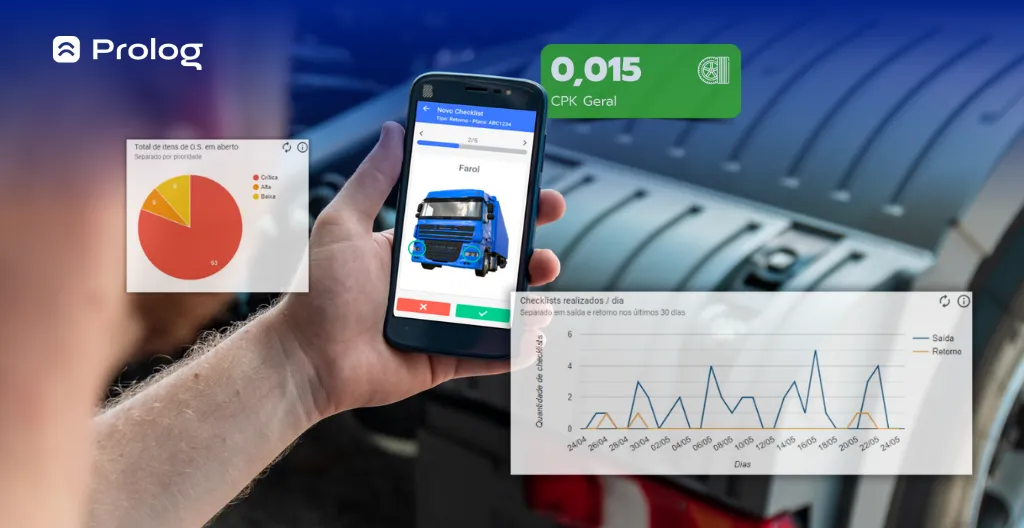
Are logistics spreadsheets still right for your fleet?
 Jade Zart 5 min read

Even though many large transport operations still currently use logistics spreadsheets in Excel, they are becoming less popular.
A few years ago, when logtechs were just starting out, spreadsheets were the alternative that brought the most productivity and organization to fleet management. In fact, they were part of the routines of most Brazilian operations for a long time.
But they are now falling out of use. In this post, you will learn:
- Why logistics spreadsheets are falling out of use;
- When to keep using logistics spreadsheets;
- How to know whether it is time to abandon spreadsheets in your fleet management;
- How to replace logistics spreadsheets.
Why are logistics spreadsheets falling out of use?
Although they were used for a long time to improve the control and productivity of transport operations, the reasons that make them lose popularity among managers include:
Rework in manual data entry
Those who use logistics spreadsheets as a form of management do not have technology systems and apps to use in the fleet's routine. This means that day-to-day information is collected through notes on paper or just in conversation.
So, when everything reaches the manager's hands (and ears), they need to transcribe everything into their spreadsheets. At least that is how it works in a good part of the operations.
In some cases, the employees themselves have access to the spreadsheets and can fill them in on their own. Even so, it does not avoid the worst part of the problem: the rework and the loss of operational productivity.
More errors
Especially in the second scenario we mentioned above, when several people have access to the fleet management spreadsheets, errors happen and can be excessive.
If only the manager has access, the information is a little more reliable, but there is still uncertainty about its accuracy.
Another situation that can happen, in both cases, is a lack of data updates. Either because the manager has no time to fill in the information or because the responsible employee does not do it when they should.
Besides the delay, planning errors can also happen because of this, since you use outdated information as the basis for making decisions.
Not usable in the long term
For monthly control of information, or even for a period of one year, spreadsheets can meet the fleet's needs. Beyond that, however, you already need to replicate the spreadsheet and start using this new document.
The reason is that logistics spreadsheets are limited.
For example, if you extend their use too much, the files become very heavy, making them slow to open and load. Another problem is that they end up visually cluttered, making it hard to find simple information quickly.
As the fleet grows and the number of license plates in the operation increases, you also run into another problem:
Spreadsheets need to be configured with specific codes and formulas to work properly and to automate some features. So far, so good.
But when you need to add new rows and data to control more vehicles, errors in these configurations can happen (and this is quite common), producing incorrect calculations and data across the entire spreadsheet.
That is why you would need to spend some time adjusting your spreadsheet or choose to create a different, more complete document. In either case, there is a loss of productivity and efficiency in the operation's routine.
When to keep using logistics spreadsheets?
If your fleet is mid-sized or small, spreadsheets can meet the basic control needs of your day to day.
So, if the trucking company's plans are to remain in this state for some time longer, save on budgets and generate more cash for the company, spreadsheets are a reasonable option, since they have a lower acquisition and maintenance cost.
This assumes that the manager or other employees know how to use and configure the tool as needed.
Another case in which you can keep spreadsheets in your management is when you do not carry out any form of control. In other words, if you have not yet implemented the routines of collecting, organizing and analyzing data, spreadsheets can be a good way to start.
How to know whether it is time to abandon spreadsheets in fleet management?
Any plan to expand the fleet and increase your transport operations should consider abandoning logistics spreadsheets and acquiring more modern and practical solutions.
If you are facing the problems described above or similar ones, you should strongly consider replacing your spreadsheets with technology systems for fleet control.
Among the reasons to take on this change, the main ones are:
- Low visibility of the operation's data;
- Little or no control over the fleet's vehicles coming in and going out;
- Little or no control over sending vehicles to maintenance;
- No control of work orders;
- The amount of paper in the operation is very high;
- You cannot automate any stage of fleet management;
- There is little productivity in the fleet's routine.
How to replace logistics spreadsheets?
With the large number of companies and startups with solutions aimed at the logistics sector, the best way to solve your fleet's problems involves acquiring the technology best suited to your needs.
The logtechs, as these companies are called, are many. Today you find both ERP systems, for business management, and tools for specific stages of the operation.
For example, for the control of routes, fuel, tires, checklists and fleet maintenance, and so on.
You can be sure that, for every spreadsheet you use, there is a complete technology solution to replace it.
All you need to do is find the main point that needs improvement in your operation and focus on acquiring the most appropriate management model.
To get started, discover the solutions offered by Prolog App.
Frequently asked questions
Is it still worth using an Excel spreadsheet to control the fleet?
What signs indicate that it is time to abandon the spreadsheet?
Why does the spreadsheet generate rework even when the whole team has access?
Why does the spreadsheet stall when the fleet grows?
Where to start replacing spreadsheets?
// newsletter
Fleet management content, straight to your inbox
Articles on tires, maintenance and fleet operations. No spam.