
Freight transport management: routines and roles
 Jade Zart 11 min read

Fleet routines can seem chaotic to an outsider because a transport operation brings many responsibilities together at the same time. Freight transport management exists precisely to make priorities, the people responsible and exceptions visible, instead of letting each urgent issue dictate the day.
The answer can go both ways. After all, without good fleet management, you need to keep chasing deadlines to complete your deliveries. On the other hand, a logistics operation has many processes and stages. In other words, every employee's day is full of tasks.
Now, what are those tasks? And who is responsible for them?
You need the answers to these questions to understand your fleet's situation and what you can do to improve its daily processes, right? So, in this post, learn:
- What transport management is;
- Why freight transport management is important;
- How to manage it efficiently;
- What the routine processes of a transport operation are.
What is freight transport management?
This stage of a transport operation is considered the main one: it is where all daily processes and activities are defined. It is therefore defined as control of all cargo movements, from collection to final delivery, whether to a point of sale or the end consumer.
Management also takes place in other types of transport, but with processes and priorities suited to their different circumstances.
For example, in a bus fleet, the goal is to ensure passenger comfort and safety, with vehicle interior inspections being as important as mechanical servicing.
A freight truck fleet is responsible for keeping interiors in good condition to maintain the quality and integrity of the supplies and products transported, but mechanical and electrical inspection carries much more weight in ensuring the vehicle operates along its routes.
Why is freight transport management important?
The importance of freight transport management lies in providing a basis for decisions about costs, deadlines, vehicle availability and service level. Outcomes such as reducing costs, route times or losses are not automatic: they need to be defined, measured and analyzed in the context of each operation.
- Lower operating costs;
- Less time completing routes;
- Reduced cargo losses;
- Anticipation of transport expenses;
- Creation of more efficient maintenance plans;
- Greater productivity in operating routines;
- Increased market competitiveness.
How do you manage freight transport?
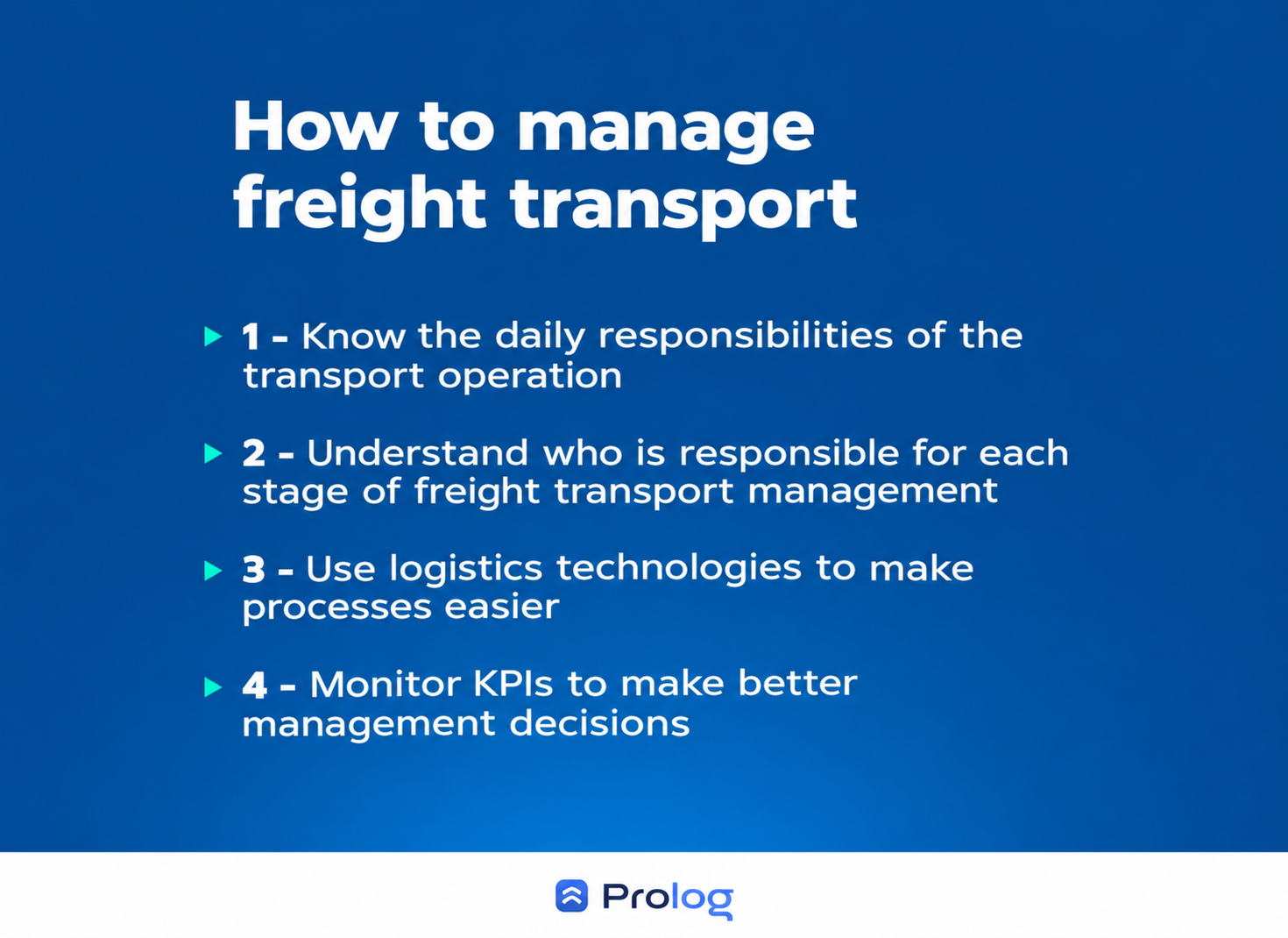
To begin, you need to organize both your routine and those of employees, defining who is responsible for each task and how they can contribute to efficient fleet deliveries.
You also need to define the transport company's objectives and goals so you can identify which performance indicators to keep track of.
For example, if you intend to measure productivity in operating routines, you need to define the average time for completing tasks and use a feasible method to keep track of it.
This gives you the data needed to analyze who is within the planned time, who is well above it or even whether this time is actually achievable.
You can then assess the technologies and systems needed for the prioritized processes. Checklists and digital measuring tools can support inspections; cargo trackers, telematics solutions available on the market and route planning tools meet different needs. The choice should consider the issue to be resolved, the integration required and the team's ability to use the data.
See the main stages in more detail below:
1 – Know the daily responsibilities of the transport operation
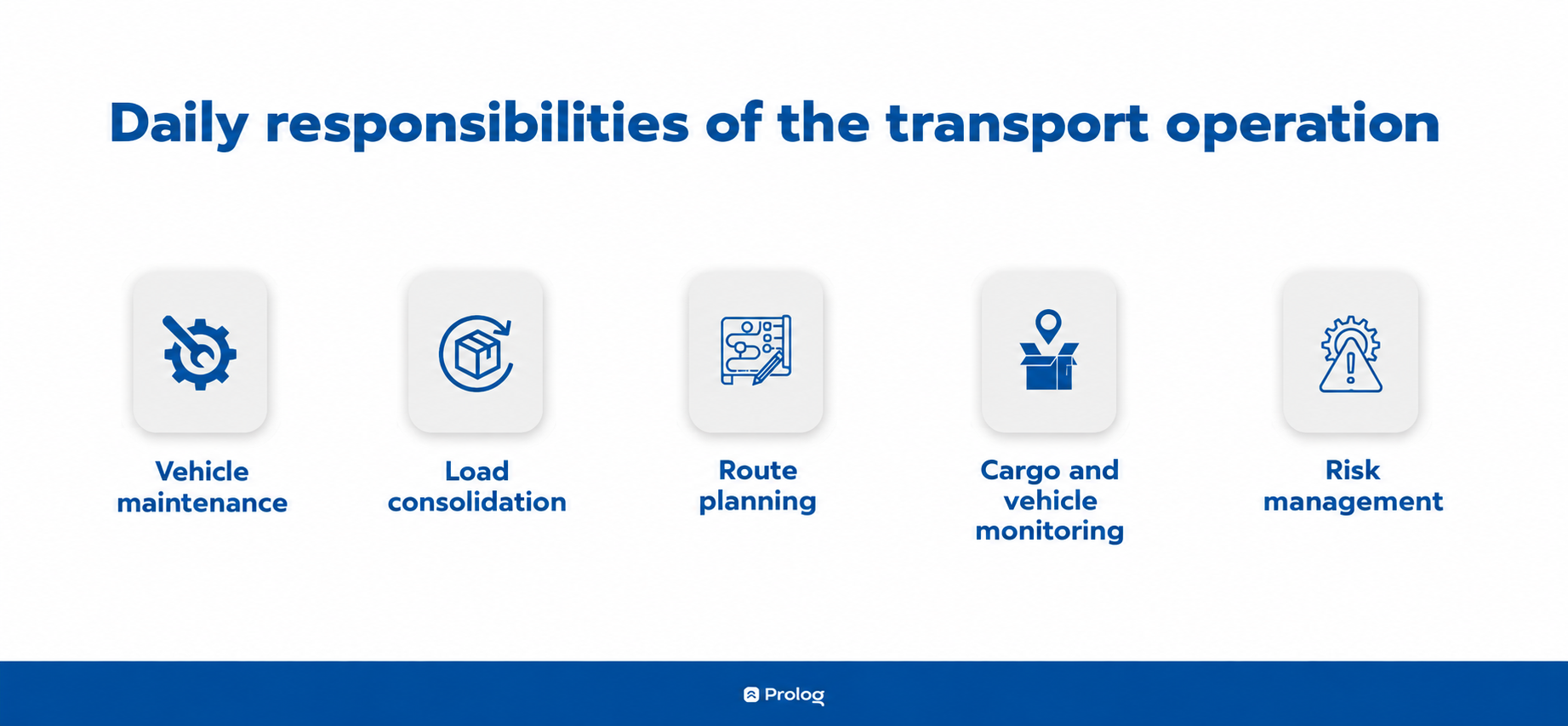
Vehicle maintenance
Caring for vehicle quality and operation is essential to ensure safe, trouble-free trips. Likewise, machinery and equipment must be inspected and maintained when they are part of the operation.
Using a checklist, whether paper or digital, makes it easier to avoid overlooking any detail.
For a maintenance and inspection routine, select items compatible with the vehicle, trip type and most recurring risks. The list should be sufficient to identify relevant deviations; cutting items simply to gain speed can leave out an important issue.
In these cases, include headlights, engine oil, radiator water, fuel level, among others. And always check tires for visible damage such as bulges, cuts or cracks.
Load consolidation
Consolidation consists of making deliveries faster and more efficient. How is this possible? First, by grouping orders by nearby locations. Then, by considering how to combine as many small goods as possible into a single delivery.
Besides speeding up distribution, it is a way to organize warehouses better, also optimizing vehicle loading time before departure.
Deliveries need to be kept track of and organized daily, since new orders arrive constantly and sometimes a product may return to the warehouse because of an incomplete delivery or a return.
Route planning
Freight transport management involves planning both short urban trips and long ones, often anticipating interstate deliveries. Plans are made according to each transport company's size and niche.
In general, trips should be defined based on:
- Distance between departure and arrival points;
- Expected average trip time;
- Number of stops required;
- Average time for each stop.
If the company has no experience with a route yet, route planning systems can support the creation of alternatives. However, the plan needs to be reviewed with those making the trip and consider vehicle, cargo, delivery window, stop and safety constraints.
The goal of route planning is to balance service level, operational feasibility, safety and cost — not just shorten the journey on the map.
Cargo and vehicle monitoring
Monitoring trips can be an important part of freight transport management. GPS, telematics and other market solutions have different scopes; the company should define which data it needs to keep track of, who receives alerts and how information will be used in daily routines.
If it chooses a control method such as RFID, visibility may focus on the cargo, because identification is installed on each product or package according to the process adopted.
Choose the tool according to the risk and the decision it should support. Simply viewing information is not enough: there need to be people responsible and procedures for acting when deviations occur.
Location, speed or driving event data, when provided by the chosen solution, can help investigate incidents. They do not remove the need for contact with the driver, a contingency plan or the company's safety protocols.
It is also important to define how to request support for drivers in the event of a breakdown, accident or cargo incident, with up-to-date contacts and clear escalation criteria.
In fact, another part of daily operating responsibilities is:
Risk management
Although a general contingency plan should be part of the company's annual planning, risks are directly related to trips. So you need to take care of this in the fleet's day-to-day operations.
Anything that can delay delivery, damage cargo or cancel a trip should go into the risk map. The effect can cascade: a maintenance failure, for example, affects vehicle availability, scheduling, customer service and recovery costs.
For example, consider a driver who did not inspect the vehicle before setting off on a long-distance trip. Along the way, the driver stopped and, when it was time to leave again, the vehicle would not start. What now?
If no issue was identified before departure, what action should be taken?
Worse still, if no warning light is on in the vehicle's dashboard, how can you tell what happened? How can you seek or request help from the base? Where should you look for help: tire repair, mechanical repair or electrical repair?
Besides taking a long time to receive assistance, there is a possibility that the vehicle cannot be repaired.
A delivery delay is inevitable either way: the driver has to wait for the truck to be released, or you lose the trip altogether and need to return the vehicle and cargo to base before sending the products on a new route.
2 – Understand the responsibilities at each stage of freight transport management
With so many tasks in a transport operation's routine, a complete team needs to be assembled. Some of the main roles include:
Supervisors, managers and/or coordinators
They take care of organizing processes and distributing tasks to each team within its department. They should monitor and analyze the progress of all routines.
Each manager is responsible for their area: the fleet manager needs to be aware of the entire process, while the tire manager only needs to handle tire-related tasks, and the maintenance manager handles vehicle inspection, operation and performance, etc.
Each operation has different people responsible, depending on its size and available budget. So if there is no capacity to hire a manager exclusively to handle the fleet's tires, this role should be delegated to someone qualified — such as the fleet manager or the person responsible for vehicle maintenance.
Analysts
They are the managers' support, collecting and analyzing fleet data to provide a basis for managers' final decisions. There can be a fleet analyst or specific analysts for each department (tire analyst, vehicle analyst, etc.).
Analysts are also responsible for identifying and suggesting new methods for collecting and organizing fleet data, optimizing processes and information interpretation.
Assistants
They do the company's more hands-on and/or operational work, generally handling tasks involving documents — issuing invoices and work orders.
They also provide the main contact with customers and suppliers, and may be responsible for finalizing freight rates.
Cargo checkers
They check loads and movements in the fleet, recording what happened to each item of goods as needed.
Drivers
No explanation needed, right? But if there is something to add here, it is that drivers are responsible not only for driving vehicles but also for inspecting them and their tires through the fleet checklist and/or tire management system.
3 – Use logistics technologies to make processes easier
Route planning tool
A route planning tool can bring together useful information for comparing route alternatives, but the quality of the result depends on available data and the constraints provided. Treat the suggestion as decision support, not a replacement for operational knowledge.
However, always check with drivers whether the routes are actually good. Sometimes roadworks, potholes or even an outdated system can produce less efficient routes.
Drivers also experience daily life on the roads and should contribute to the mission of reducing fuel costs and shortening delivery times.
Freight transport management system
A complete system may include freight, maintenance and cost management, and so on, all centralized in one place. There are many quality systems, but care is needed with promises to deliver everything.
This is because many fall short on the details of each stage of the operation.
For example, some fleet management software includes tire management as a feature, but only controls tire relocations, recording tires leaving or entering inventory and which vehicle they were mounted on.
In these cases, a tire management system designed specifically for this function may be more worthwhile.
These are analyses and considerations the fleet manager should make, preferably with help from the fleet analyst. Which system offers a given feature, and which has the best tools for the fleet's current needs?
Freight platform
Whether for calculating freight or even finding service providers, platforms with this functionality are already available on the market and can make the pricing process much simpler.
In fact, many of these apps also offer a system for hiring drivers to make your trips.
Options are usually offered based on locations closer to your operation or to a particular distribution center, to reduce transport costs.
Organizer and integrator of routine information
This is a way to centralize and control all your fleet information. As we can see, daily routines involve various tasks, many of which involve recording information, whether about vehicles, tires, warehouse movements or other matters.
A transport company today can use various technologies in its routine, such as an electronic checklist, a fuel management system and tire management software.
This raises the question:
How can you see all these data without having to switch from system to system and spend hours doing so?
By applying APIs, which integrate all software used in the operation and automatically organize different data in one place.
In other words, a logistics control tower, like the one offered by Infleet's system, can bring together information from different processes. Before integrating tools, define which data are needed, who is responsible for record quality and which indicators actually guide operating decisions.
4 – Keep track of KPIs to make better management decisions
By defining fleet performance indicators and applying the technologies needed to collect these data, you can generate analyses and draw accurate conclusions to make better decisions.
References and good practices help, but daily data show which hypotheses hold up in your fleet. Record each indicator's definition, the period analyzed and the changes that occurred in the operation before concluding that an action caused a result.
As for which indicators to keep track of, you should assess them according to the objectives and goals you have defined. Watch:
(video in Portuguese)
Frequently asked questions
What is freight transport management?
What are the daily responsibilities of a transport operation?
How should routes be planned in freight transport management?
Which roles make up a transport management team?
Which technologies support freight transport management?
// newsletter
Fleet management content, straight to your inbox
Articles on tires, maintenance and fleet operations. No spam.


