
Preventive maintenance checklist: what to include
 Jean Zart 21 min read

Preventive maintenance is responsible for identifying irregularities in a fleet's trucks.
An essential task is to create a plan for the team to follow and to define which metrics and performance indicators to track for better control.
Even so, it is not enough to simply record the failures found during maintenance processes. You need to go after the causes, such as poor road conditions, idle driving by the driver and low-quality parts.
All of this affects not only travel time, but also high fuel consumption, among other costs and risks.
With prevention inspections carried out regularly, you generate more satisfactory results both for your own company and for your customers.
What is preventive maintenance?
This is a practice used in many companies to check how machines, vehicles or equipment are working. Its primary purpose is to identify possible failures so that the team can fix them before a breakdown or loss of an asset occurs.
According to the Brazilian standard NBR 5462, preventive maintenance is defined as:
[…] maintenance carried out at predetermined intervals, or according to prescribed criteria, intended to reduce the probability of failure or the degradation of the operation of an item.
Want to see this in your fleet? Talk to a Prolog specialist
Preventive maintenance of vehicles should take place in all transport operations as an everyday routine. Generally, management schedules it for the following reasons:
- Time: After running for a certain period, vehicles undergo natural wear. This helps indicate an expected maintenance interval. For example: inspecting the truck's springs and shock absorber every 6 months.
- Operating hours: When the vehicle makes a long trip, some parts that are fundamental to its operation may need a service, as is the case with tires — which lose pressure or suffer damage, such as cuts and punctures, on their tread.
- Fleet productivity: if the driver drives the vehicle more aggressively, with sudden acceleration and braking, the parts wear out and lose useful life faster. That is why daily inspections at departure and on return to the operations base need to take place, to identify whether this issue requires closer attention.
Although they have these differences, management can also plan maintenance with a mixed trigger. That is, whichever comes first. For example:
The team can inspect the truck's suspension every 10,000 km driven, every 6 months or when it notices signs of a problem, such as loud noises or lack of steering stability — which can happen before the vehicle's scheduled inspection conditions.
This way, the vehicle is not exposed to the risks of waiting for the problem to get worse until a scheduled service date arrives.
How does it differ from other types of maintenance?
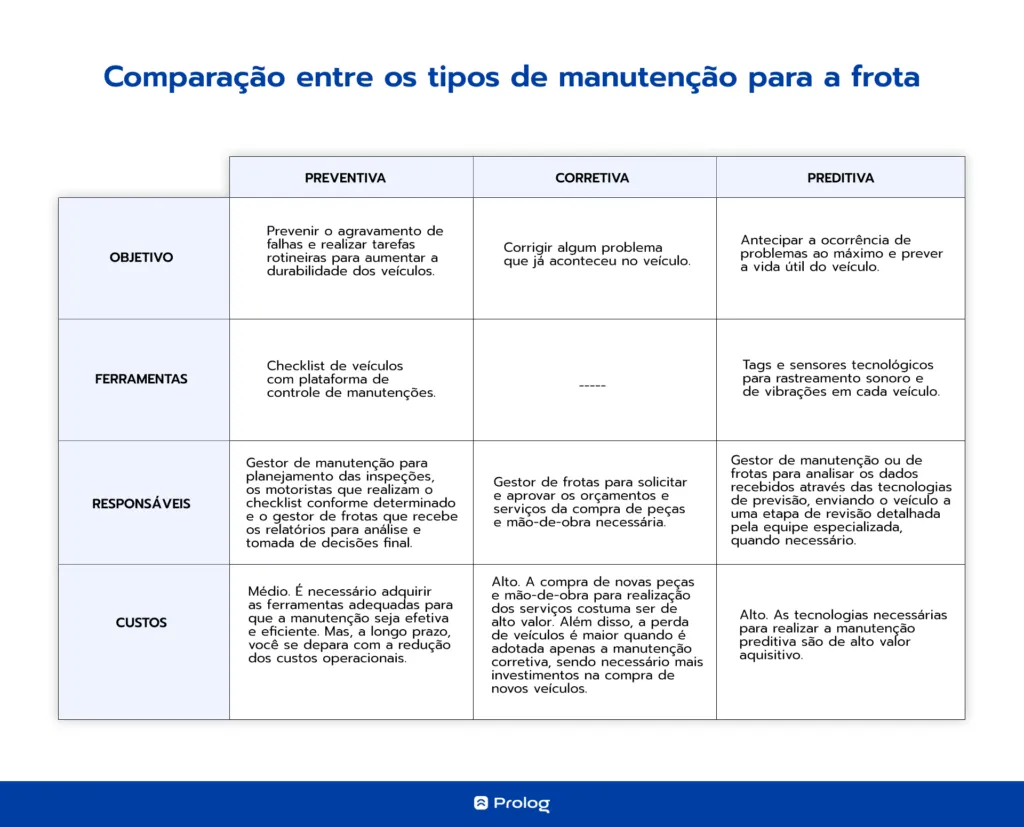
Difference between preventive, corrective and predictive maintenance.
Preventive vs. Corrective
Corrective maintenance happens when a part of the truck already shows an irregularity and needs to be repaired or replaced with a new part.
It is very common in vehicles that do not go through preventive maintenance because, without it, it is not possible to identify the failures that cause a vehicle breakdown on the road or other problems of this level.
Preventive vs. Predictive
Predictive maintenance is a type of monitoring that relies on the assistance of modern, technological equipment. This equipment identifies irregularities through visual, sound and vibration analysis of the vehicle, using tags and/or sensors installed on each vehicle.
In this way, it predicts the expected useful life of the assets and looks for ways to extend that time.
It can be confused with preventive maintenance on some occasions, but it differs mainly by not depending on inspections carried out by drivers — the technologies do all the work.
Why do preventive maintenance in fleet management?
As part of fleet maintenance management, prevention anticipates problems that could occur if the team did not identify a failure in time, avoiding financial losses in the operation.
To truly understand its importance, also learn:
Why did preventive maintenance emerge?
It emerged during the Second World War, when maintenance had a great impact on the advancement of military equipment.
From then on, it became clear that preventing irregularities was of great value for keeping machines working and for avoiding failures during operations.
The same benefit extended to trucks and other vehicles, especially high-cost and high-performance ones, which need to be available so companies can meet their logistics demands and steer clear of the unexpected, such as fleet idleness and accidents.
What is the goal of preventive maintenance?
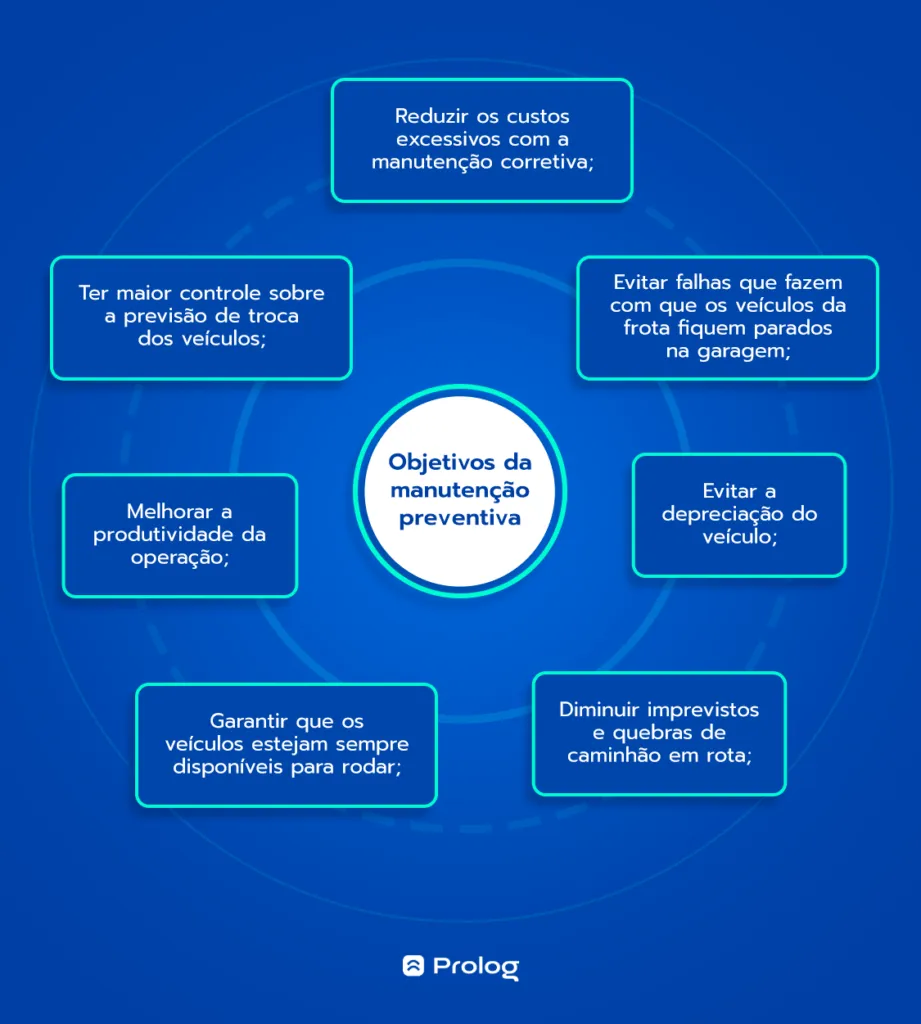
Goals of preventive maintenance.
As mentioned above, the main goal of preventive maintenance is to avoid failures that leave the fleet's vehicles sitting in the garage and needing a large investment for repairs through corrective maintenance, or even the purchase of a new vehicle.
In other words, it helps keep vehicles and equipment always available for use and gives assurance of their efficiency. Likewise, it affects the operation's productivity, because by avoiding breakdowns and the unexpected on the road, the fleet meets its delivery deadlines.
After all, trucks and fuel are expensive, right? So taking care of the fleet in a way that extends its useful life and maintains its performance is a way to save money and use budgets more intelligently.
In addition, prevention also helps avoid vehicle depreciation, making it possible to later sell the vehicle and acquire more modern ones.
What are the benefits of preventive maintenance in fleets?
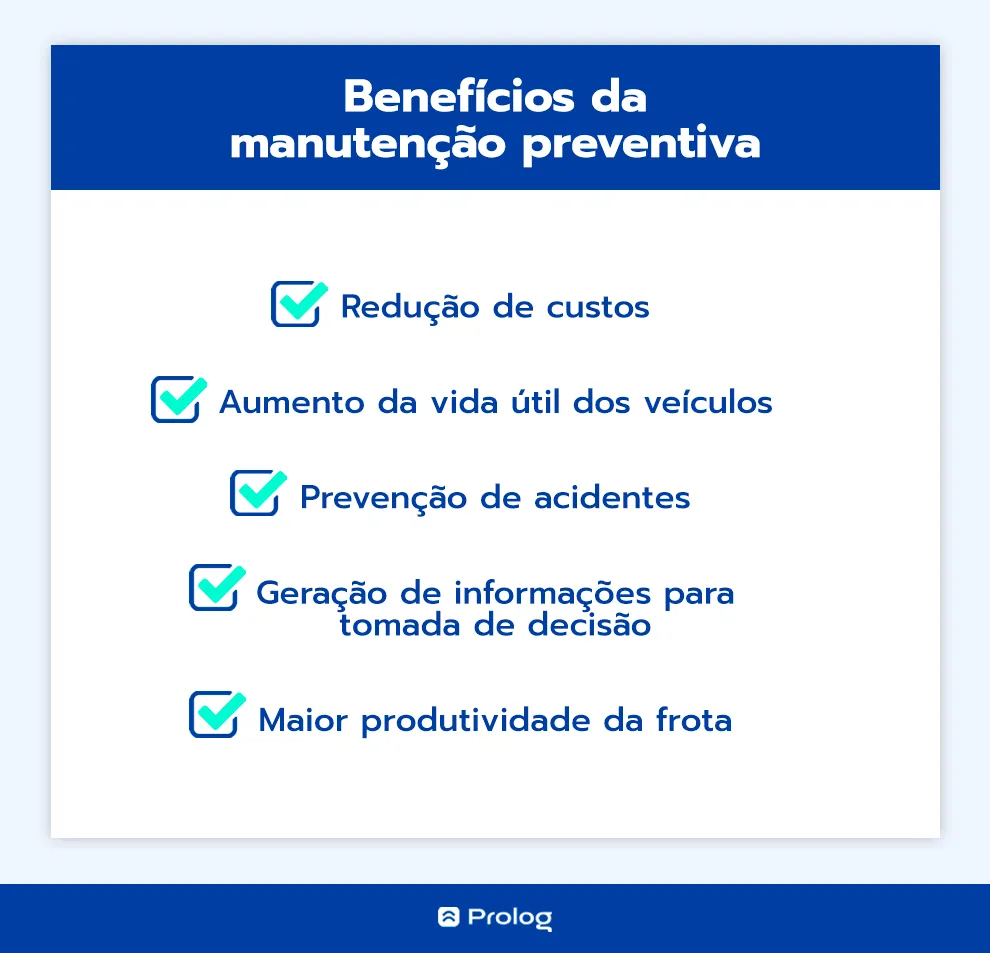
Benefits of preventive maintenance.
Cost reduction
Some vehicle parts need a more detailed service so that the team recognizes failures in time, avoiding an imperceptible increase in fuel consumption.
With preventive maintenance, it is much harder for this kind of case to happen, because inspections, even if they are only daily and more superficial, help the driver get to know their vehicle completely, quickly identifying any problems that arise.
Some factors of this type of maintenance that bring cost reduction are:
- Fewer corrective maintenance jobs;
- More control over budgets and buying parts in advance;
- Fewer cases of broken-down or problematic vehicles on the road;
- Greater knowledge of high-performance vehicles in your operation, leading to smarter purchases in the long term.
Longer vehicle useful life
With the help of preventive maintenance, parts will keep working well for longer and operate at their maximum capacity smoothly. In addition, this care increases the useful life of the part and, consequently, of the entire vehicle.
Accident prevention
Some components of cargo trucks, when they fail, can cause serious accidents, putting the lives of employees and other drivers at risk. That is why one of the main benefits of preventive maintenance is avoiding these risks.
In fact, some companies work with a “zero accidents” policy, practicing both prevention and other actions, such as driver training.
Generating information for decision-making
When the team carries out preventive maintenance, it writes down information about the vehicles on paper or in digital systems, making the data accessible to the manager for later analysis.
The history also allows the manager, if more serious problems occur with a vehicle in the fleet, to analyze the data to understand the causes behind them. For example, by investigating the items with the highest number of occurrences or the inspection frequency the vehicle had been receiving.
By carrying out this more complete analysis, the fleet manager can decide which vehicles are more worthwhile, with a better cost per kilometer and fewer problems over their useful life.
In addition, it is important to record the drivers responsible for each vehicle and trip. Sometimes, the cause of a vehicle's early loss is a driver's bad driving habits.
Higher fleet productivity
If a vehicle has no problems, it means it is making its trips without interruptions. In other words, making deliveries on time — and this is one of the productivity indicators your operation can track.
In the same way, vehicles do not need to sit idle for repairs, always being available to run the planned routes. Likewise, avoiding delivery delays.
How do you carry out preventive maintenance in your fleet?
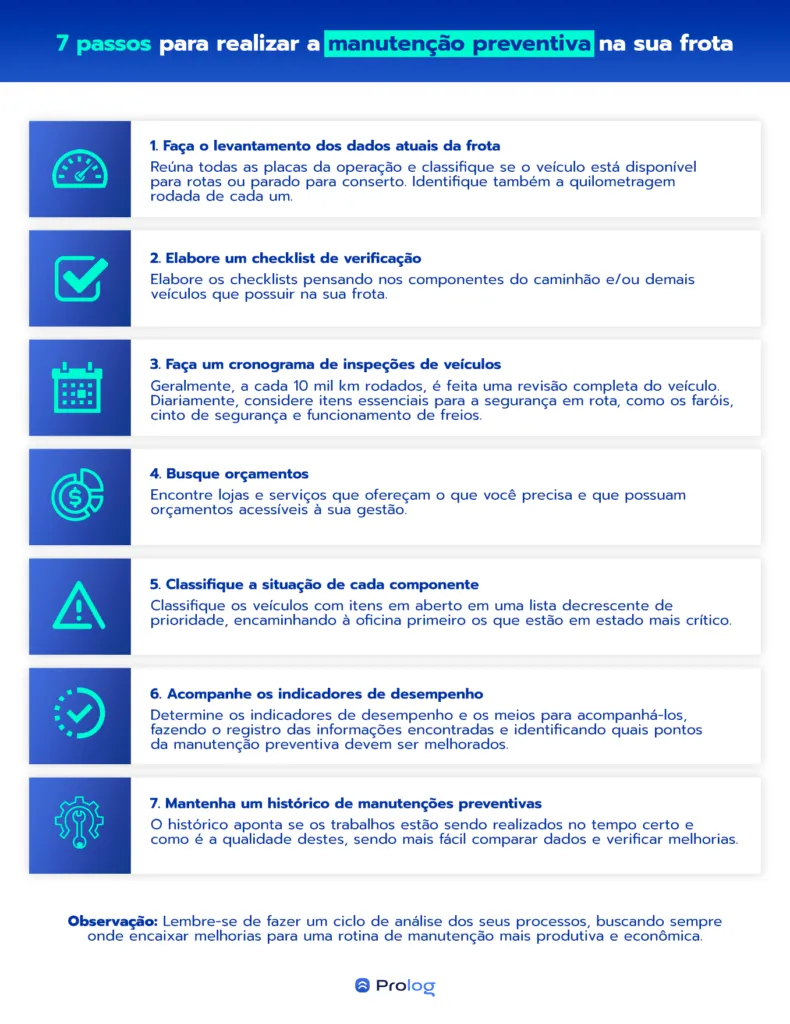
How to carry out fleet preventive maintenance.
1. Gather the fleet's current data.
To know the condition of the vehicles and the maintenance needs of their components, the fleet's current data is the starting point of preventive maintenance.
First, start by gathering the list of all the plates in the operation and try to classify them by availability to run routes. That is, whether the vehicle is fit to make a trip or is waiting for some kind of corrective maintenance.
Then, by looking at the mileage and the information on the latest services carried out on each vehicle, it is possible to start the inspections that may point to an urgent need for repair or replacement of parts.
2. Create an inspection checklist
To carry out this vehicle inspection stage, the checklist is indispensable.
It is responsible for listing all the items to be checked on the truck. This means you should create the checklists with the components of the truck and/or other vehicles you have in your fleet in mind.
Some examples are periodic checks of the condition of tires, fluids and safety items.
The checklist also serves to record the vehicle's mileage and to have greater control over the drivers responsible for each one.
3. Create a vehicle inspection schedule
One thing is certain: the fleet's vehicle inspections must happen regularly.
Some truck components have a service interval indicated in the manufacturer's manual, and you can start by checking that. The other items have different types of analysis.
Generally, every 10,000 km driven, the team carries out a more complete service of the vehicle, including items such as the suspension, and preventive services such as balancing and alignment.
For example, for vehicles that run every day, the ideal is to do the daily checklist.
In it, the driver records the condition of the truck before leaving the garage and after returning from the trip, checking items such as headlights, brakes, turn signal lights, seat belt and visible damage to the tires.
To build a schedule, consider the number of trips in your operation for each vehicle and the distance covered on each route. For long trips, which can last more than a day, the team needs to carry out a more detailed inspection.
4. Get quotes
Based on the needs found by carrying out the checklist, you can go after quotes from different stores and workshops, looking for the best prices and payment terms for your operation.
As a general rule:
Of the budget available for preventive maintenance, the company should set aside at least 1/3 for urgent and emergency maintenance. The rest goes to planning preventive repairs.
5. Classify the condition of each component
When the driver takes the vehicle to the workshop, the mechanic records all the problems the driver noticed, such as difficulty controlling the steering and noises.
The ideal is to separate each component to be checked according to its need, as is the case with lubrication, electrical, tire repair, upholstery, bodywork and painting, among others.
At the same time, sending a very large number of vehicles to the workshop compromises the company's services.
That is why the fleet manager should create a list in descending order of priority, giving more attention to the vehicles in the most critical condition and sending them to the workshop. Next, they also need to check with the mechanic their availability to receive the trucks.
6. Track performance indicators
Preparing follow-up reports at the end of each stage of the fleet maintenance plan is the manager's responsibility, and the manager should determine the performance indicators and record them.
Making this a frequent practice allows a thorough analysis, capable of identifying mistakes and successes, and which points of preventive maintenance should be improved.
7. Keep a preventive maintenance history
The history works as a record document, showing whether the work is being done at the right time and what its quality is like. So it is essential to record all maintenance carried out, stating the date and time.
This makes it easier for the manager to compare data and verify improvements as they identify differences between the checklists carried out.
Bonus: Rely on a specialized system
There are several technologies available for planning fleet preventive maintenance. The manager should look for the tool that best fits the company's needs and ideals.
The use of technology allows the systematization and automation of the stages of the maintenance plan, as is the case with preparing reports, which usually takes a few minutes, while in the manual procedure this task can take hours.
Examples of preventive maintenance:
Transmission system
With a fleet maintenance routine, it is possible to extend the useful life of the transmission system, which includes:
- Gearbox;
- Clutch;
- Belts;
- Pedals; etc.
Electrical system
The electrical system is responsible for powering the lights and horns and for recharging the vehicle's battery when it is stopped or moving. Some of its components are:
- Headlights;
- Wires;
- Fuse box; and others.
Braking system
The safety of a heavy vehicle depends mainly on the good condition of the braking system. Its main components are:
- Brake pads;
- Cable connections and the pedal;
- Brake booster;
- Fluid and master cylinder; among others.
Which preventive maintenance mistakes should be avoided?
Buying low-quality parts
Some managers prefer to prioritize cheaper parts, but they may be of questionable quality. When this is confirmed, it triggers wear on other vehicle components and generates a repair cost beyond what was planned.
The solution to avoid excessive and unplanned spending is to buy parts from reliable stores and with brands suited to the truck model. You can even choose to do business directly with the vehicle's manufacturer or supplier.
Neglecting tires
Tire management directly affects the vehicle's fuel consumption. When the driver runs on bald or heavily worn tires, it can lead to traffic fines and accidents.
To avoid these consequences, you should implement a method for fleet tire management, which can include the use of technologies that help with this control.
Treating the whole fleet the same
Each truck has its own specific characteristics. For example, a new model requires less attention than one that has been on the road for longer and may already have outdated technologies.
The solution to have full control of the fleet is to follow the individual performance of each vehicle, in order to understand its own needs and then build a preventive maintenance plan for each one. This is possible through control via fleet inspection checklists.
Managing fuel use poorly
When a vehicle consumes more than the average for a given trip, it is a warning sign for you to investigate a few possibilities.
Among them, as mentioned above, is tire care. When tires are worn or have incorrect calibration, fuel is not burned efficiently.
But, besides this, other reasons for an increase in fuel consumption include:
- Excess load on the vehicle;
- Fuel quality;
- Preventive maintenance items not carried out.
A faulty catalytic converter, a clogged air filter and worn spark plugs are all problems that affect fuel consumption and are part of a fleet preventive maintenance routine.
Therefore, the main solution is fleet management with organized and standardized processes, always seeking complete management of all factors.
In this case, both of the vehicle inspection, assessing the mileage driven by the vehicles, and of fuel, checking whether the expected average amount was used for a given route.
How do you build a preventive maintenance plan?
What is part of the preventive maintenance routine?
Sensory inspections
A sensory inspection is carried out through the senses: when the professional looks for changes and failures in the vehicle through sight, smell, hearing and touch.
It can be used as a kind of screening, requiring the person in charge to have experience to understand the vehicle, knowing where to look for possible problems and identifying wear visually.
Or, for example, recognizing possible problems through the sounds the engine makes, noticing unusual noises while on the road, and even by the smell of the exhaust smoke.
Everything noticed and found in this assessment must be recorded in the fleet's vehicle checklist, as it is a crucial stage of preventive maintenance in a transport operation.
Instrumented inspections
With the use of instruments, equipment and tools, it is possible to look for possible failures and wear of parts. It is a more accurate diagnosis, helping to find problems in the truck's items at early stages.
Generally, this inspection is carried out by predictive maintenance, in which, as explained earlier, tags and sensors are installed to read how the truck is operating.
Cleaning, retightening and lubrication
At this stage, those responsible clean, torque and lubricate the moving parts of the vehicle's components, keeping them in the best operating condition.
Component replacement
When the usage time of a vehicle component is already reaching maximum wear or reducing its performance, the technician responsible for maintenance must carry out the periodic replacement of the part.
This way, it keeps the problem from spreading and leaving the vehicle inoperable.
What should be included in a preventive maintenance inspection?
Everything that affects how a fleet vehicle or piece of equipment works should be included in the inspection checklist.
What you need to assess more carefully is how often each item should be checked, because it ends up being very costly and unproductive to carry out a complete inspection every time a vehicle is going to be used.
That is why the stage of defining schedules is so important when you are starting to implement maintenance management in your operation.
In general, and so you can understand it even better, some of the items that should be part of preventive maintenance are:
Oil
To ensure proper engine operation and lubrication of the parts, the oil and other fluids need to be changed periodically. This can be defined according to the manufacturer's recommendations, found in the vehicle's instruction manual.
Brake system
Fluid, pads and linings are the main elements that should be part of brake preventive maintenance. Over time, they wear out and accumulate impurities that impair their braking capacity and increase the risk of accidents.
Filters
Since their function is to prevent dirt particles from reaching the engine, the air, fuel and oil filters need constant assessment to decide whether they need to be replaced or not.
Normally, the manufacturer's manual contains instructions indicating every how many kilometers the replacement should be done.
However, you can also keep following up and analyzing as you collect data in the maintenance routine, to draw your own conclusions about the best frequency for this task.
Just as you can do this collection and analysis process for all the tasks in this vehicle inspection and fleet preventive maintenance routine.
Cooling system
The cooling system is responsible for balancing the engine temperature, and cleaning it prevents external dirt from blocking the flow of water and fluids.
When necessary, in this same maintenance, hoses and reservoirs can also be replaced with new ones.
Tires
Tires must, without fail, go through periodic checks. In general, pressure needs to be checked every week and wear, that is, groove depth, every month.
Before leaving on a new route, the casing or tread can also be checked for visible damage, such as cuts, bulges or punctures.
This makes it easier to avoid setbacks on the road that force stops, besides helping save money, because tires in good condition put less strain on the engine.
Alignment and balancing
To avoid vibration and keep the ideal wheel angle, alignment and balancing need to be kept up to date. This adjustment can be done in weekly, biweekly or monthly checks, depending on how much the vehicle is used day to day.
The most important thing is that it should always be present in preventive maintenance.
Timing belt
The belt is responsible for providing synchronization between the truck's parts, connecting the valves to the crankshaft, making the wheels work. Over time, this belt wears out and can break.
When it is assessed in advance, as is the intention of preventive maintenance, it avoids greater damage to the engine.
Electrical system and battery
When we talk about the electrical system, we include the maintenance of all fuses, lights and headlights. We also consider the battery and the analysis of its oxidation residues.
When necessary, the parts should be replaced or cleaned.
How often should preventive maintenance be done?
To create a maintenance schedule, you can consider either the average inspection time for each item of the vehicle or its mileage driven.
At first, if you are still a little unsure of where to start, gather information about the vehicle's operation and maintenance history. That way, you can identify a likely date for the next inspection.
Another alternative for starting a schedule in your fleet maintenance management is to use as a basis the vehicle's purchase date and the service interval and mileage indications found in the respective model's manual.
However, keep in mind:
The entire preventive maintenance process is always an adaptation. So, even without knowing the exact dates at the beginning, you go through the cycle of gathering information and analyzing, creating reports, the best alternatives for your operation's routine.
From the moment you start storing this data, you gain a broader view of the data on the fleet's vehicles, being able to understand which are the main problems, the models with the most occurrences, and much other information.
Also gathering the information for a truly effective schedule.
Which tools should you use in preventive maintenance?
Maintenance flowchart
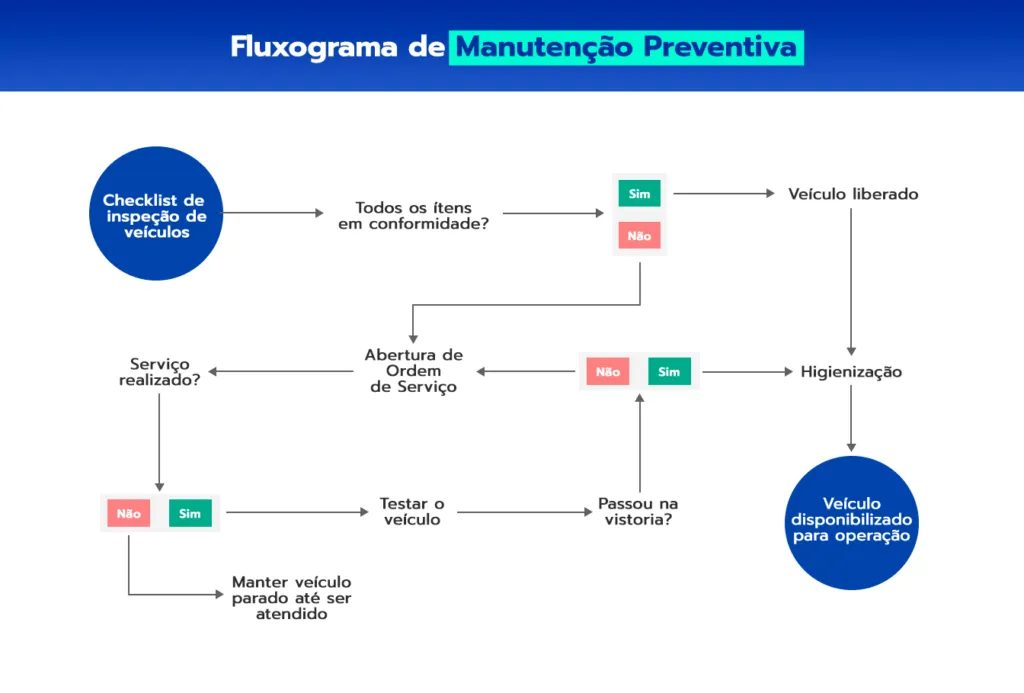
Preventive maintenance flowchart.
The flowchart is a basic tool that consists of a graphic diagram representing a process and mapping the steps the team needs to follow.
In preventive maintenance management, its goal is to put the procedures in order and prevent their phases from being skipped, requiring all requirements to be met. With it, you can ensure a minimum of standardization, organization and agility for the fleet's routine.
Management system
Fleet management software provides complete data, such as fuel, maintenance, documents and traffic fines expenses, among others. It is considered an information hub, where it is possible to access every type of vehicle operation of a transport and distribution company.
It aims at automation, making the routine more organized and practical, with immediate access to any type of material. In this way, it gives much more control over the fleet's vehicles and deliveries.
In addition, it generates more accurate reports, which bring efficiency when finding fast and economical solutions, resulting in proactive decisions.
More specific alternatives, such as a technology focused on maintenance management, can also be interesting, because they bring more complete control over this specific routine.
While fleet software may lack a vehicle checklist, maintenance software will already have one, since it is a crucial tool in this process.
Speaking of which, it is the next tool on our list:
Paper checklist
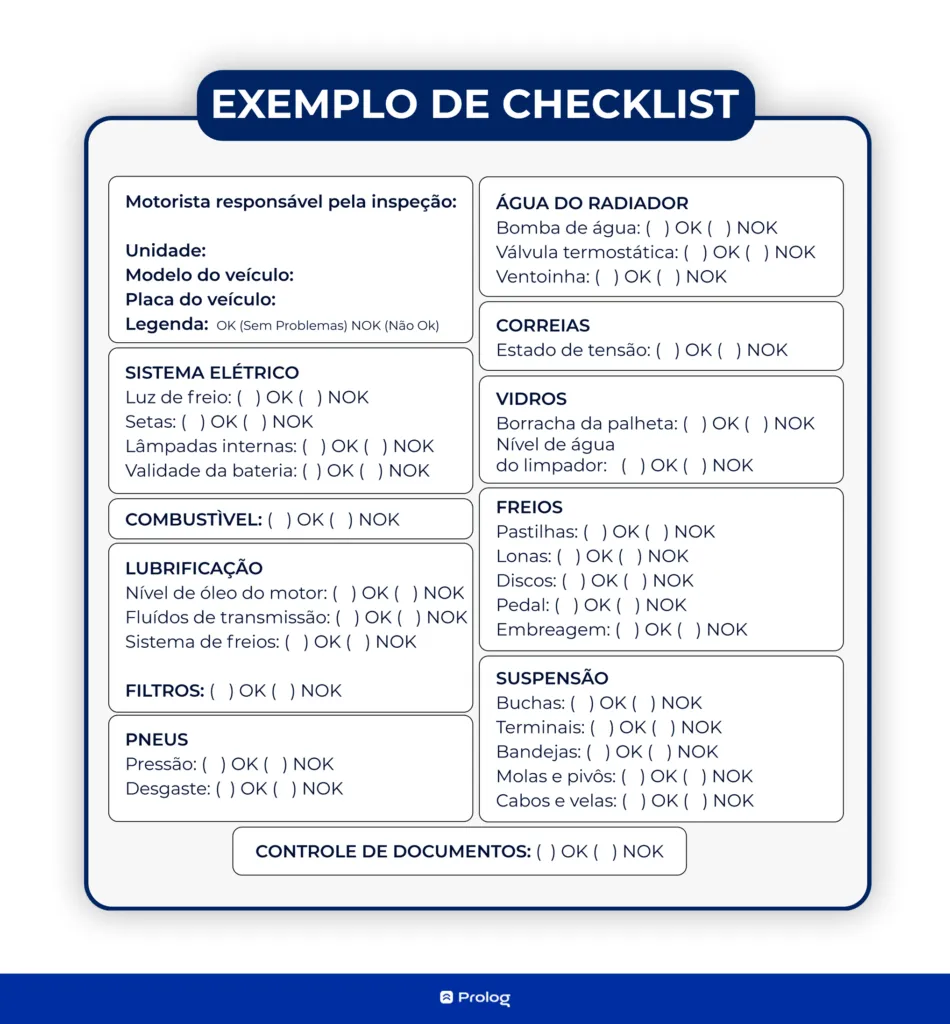
Example of a paper checklist.
The paper checklist consists of a clipboard with sheets or a notebook, where you list the items that will go through the daily inspection.
You can divide it by categories or organize it into a complete, longer list, following the sequence that best suits the mechanic, the driver or the vehicle being assessed. All the templates are customizable, as long as you know how to use programs such as Excel or Google Sheets.
For each item inspected, the employee writes an “OK” with a pen or leaves the field blank for components that do not need repair or replacement; and “NOK” or an “X” when they identify a problem.
After this process in the parking lot or garage, the manager collects the list, manually transfers the data to the control spreadsheet or management system and files it in a suitable, secure place.
Digital checklist
The digital checklist, or electronic checklist, is a tool that lets you create several types of questionnaires through a web system and lets drivers carry out the inspection using only their phone.
Answers are still collected as “OK” and “NOK”, indicating whether everything is fine or not, but, in this case, the system updates all the questions in real time.
The process is very quick and simple. Work orders are even opened automatically for each problem found. Everything is saved with date and time, generating charts and reports automatically, and it allows corrective maintenance requests in urgent cases.
Here, the reports can be accessed directly by the fleet manager, without having to wait for the driver to come back with the checklist in hand — as is the case with a check done on paper.
To learn more about this tool, visit Prolog's Electronic checklist page and see how it works and how you can apply it to your operation's routine.
Also take the opportunity to get to know our fleet maintenance management solution, which connects automatically with the electronic checklist. Discover these and many other features in a free demo. Schedule now.
Frequently asked questions
How do you build a preventive maintenance checklist?
What is preventive maintenance?
How often should preventive maintenance be done?
How do you carry out preventive maintenance in a fleet, step by step?
Which preventive maintenance mistakes should be avoided?
What is the difference between preventive, corrective and predictive maintenance?
// newsletter
Fleet management content, straight to your inbox
Articles on tires, maintenance and fleet operations. No spam.


