Tire grip: factors, risks and how to care for it
 Luiz Felipe 14 min read
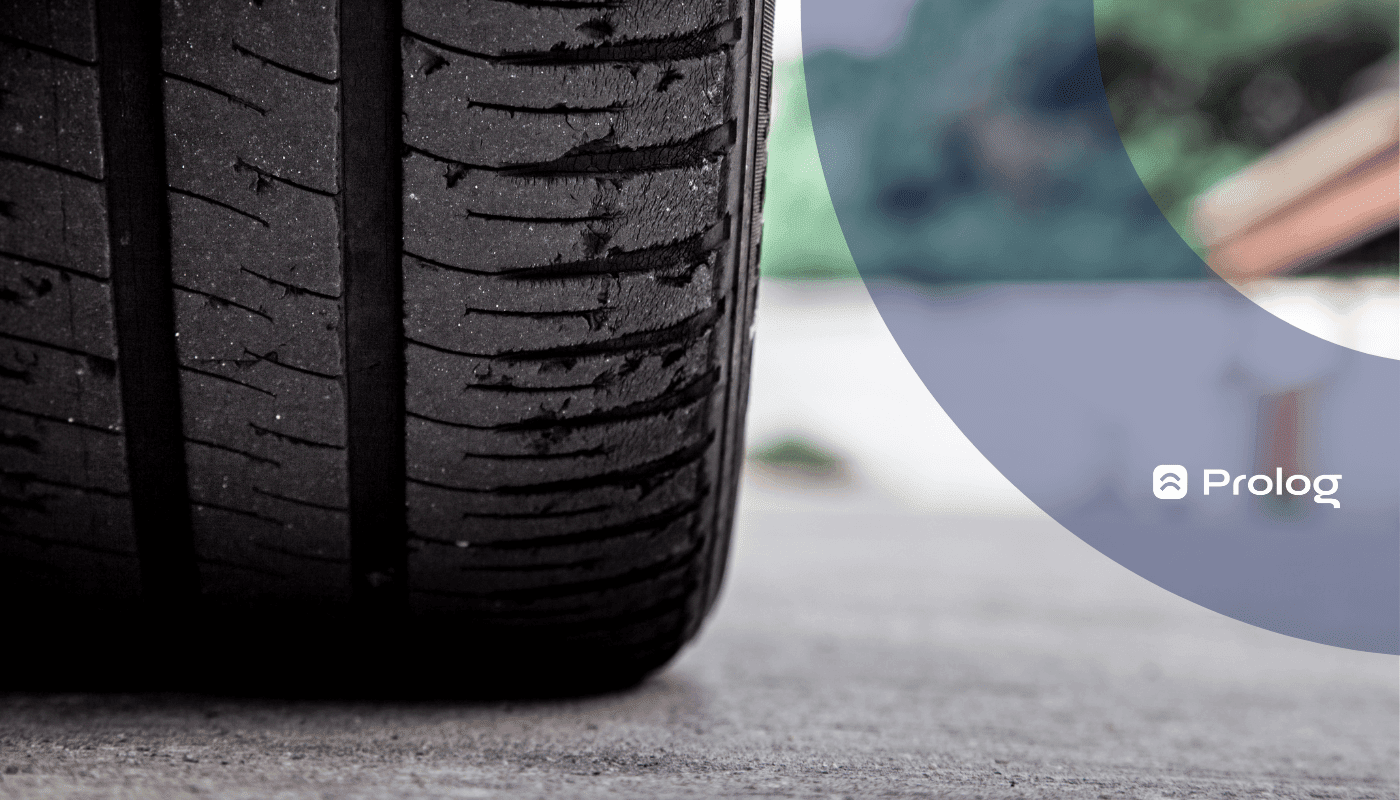
We often talk about tire pressure and wear, and tread depth. All of these are necessary items in fleet tire management. But did you know that a lack of care also leads to loss of tire grip?
On the one hand, it is a very important concept to know, as is understanding what it represents. On the other, it is still not widely covered by fleet and tire portals here in Brazil, which leaves many doubts for anyone looking for more information about it.
Now your issues are solved (or, at least, reduced), because we have gathered all the information on the topic here. Take a look.
What is tire grip?
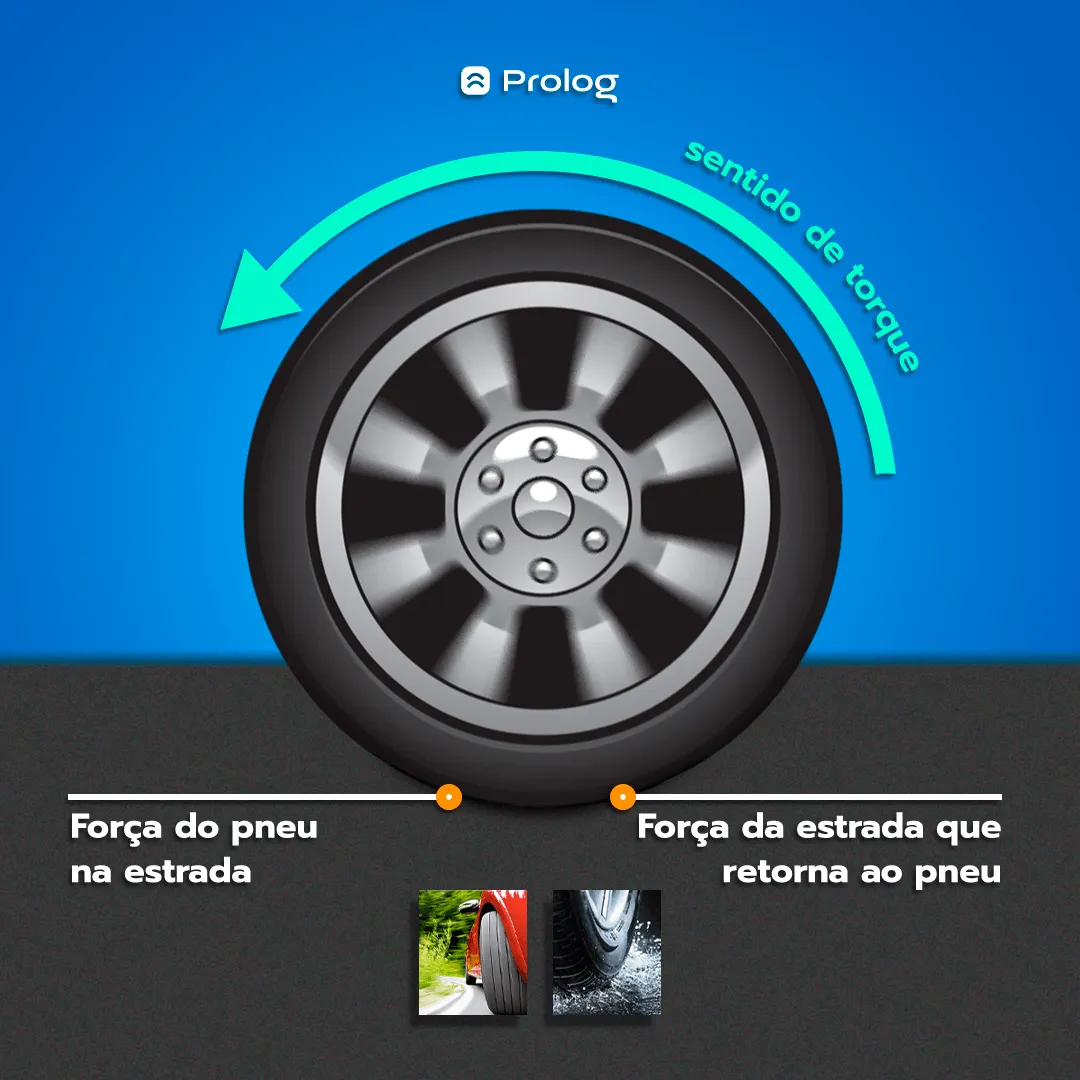
What tire grip is.
When we talk about tire grip, we are referring to the resistance tires offer against the ground they are rolling on. That is, the friction generated on the road while the vehicle is moving.
It is usually noticed mainly in curves and when vehicles brake — moments when traction is needed for the tire to respond to the command given by the driver in the cab.
A tire without the essential grip, for example, can slip or skid when the vehicle takes a sharper curve. This even increases the risk of rollover.
There is also a grip limit for tires, which is technically described as “the maximum tangential force a tire can transmit to the road surface”.
In simpler terms, this means that the tire grip limit is the maximum capacity tires have to withstand acceleration, braking, curves, among others, without being damaged by drag and friction.
The big issue with grip is that it is variable, differing across tire constructions, types of rubber used, groove level, road material, among other factors.
In fact, tires are already manufactured with these elements in mind.
That is why, at dealers, you find tires that claim to be better suited to asphalt, others to dirt roads, and there are even tires developed to run on wet roads, hot ground, burnished concrete floors, and so on.
There really are many options, and all these alternatives only emerged because of tire grip.
This is because it has a direct impact on road transport performance.
To illustrate a situation and explain it better:
Low grip increases the risk of skidding, while very high grip can increase the vehicle's resistance to moving and lead to higher fuel consumption.
Want to see this in your fleet? Talk to a Prolog specialist
How to identify tire grip?
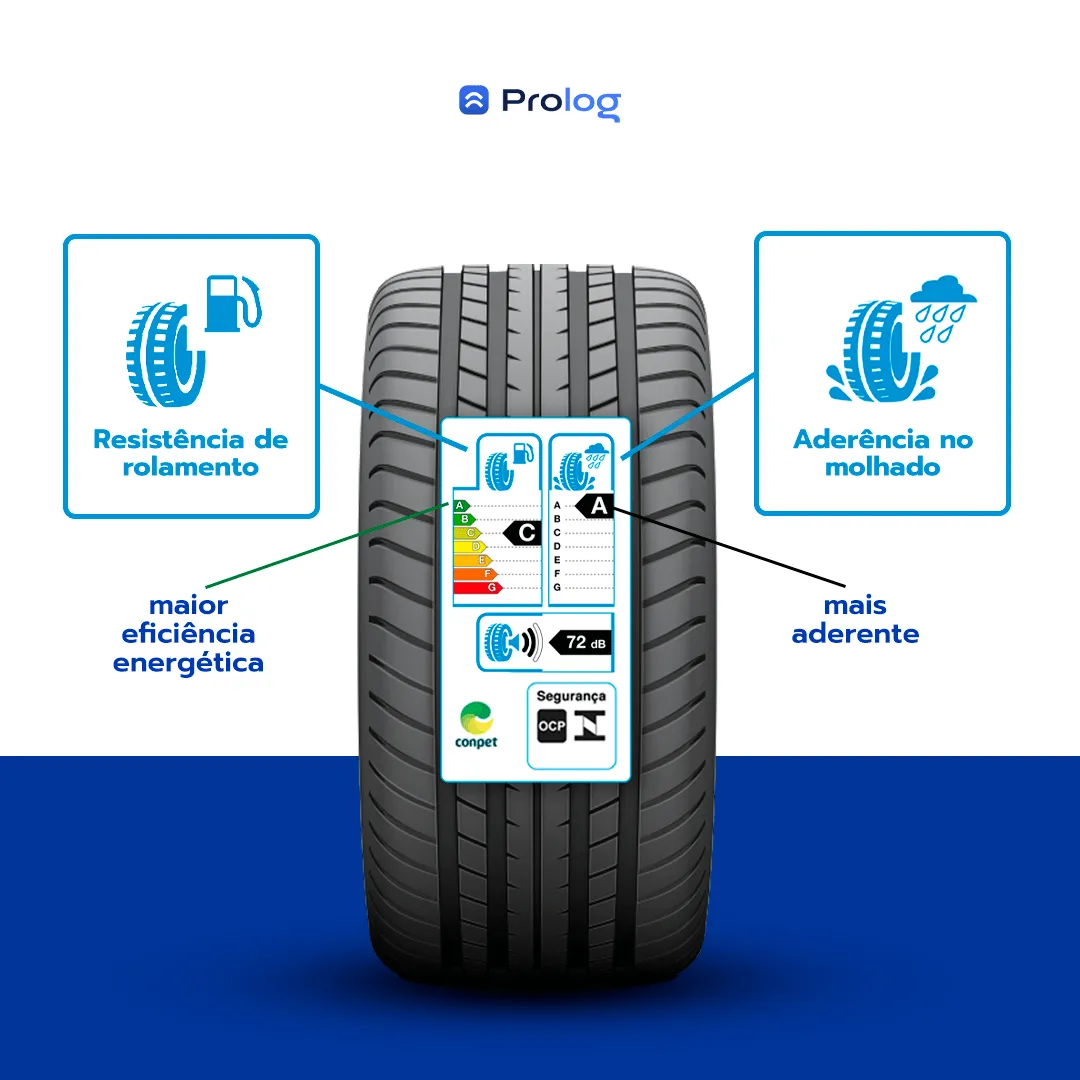
Tire grip identification on the official INMETRO label.
In Brazil, it is mandatorily shown on the INMETRO label of new tires and is identified in two different aspects: rolling resistance and wet grip.
For the first, the rating starts at the letter A, the most energy-efficient model, and goes up to the letter G. The closer a tire is to A, the more efficient it is, also delivering lower fuel consumption.
The second criterion is determined by the letters A to G, with “A” being the one with the most grip. The rating, in this case, is valid for both passenger tires and heavy-duty tires.
What influences tire grip?
Tire width
Generally, the greater the width, the larger the tire's contact area and the greater the grip. It seems logical, but be careful. This is not always true.
On wet surfaces, this greater contact with the ground causes aquaplaning more often.
Moreover, in curves and braking, greater width can bring some disadvantages that go beyond grip, such as increased fuel consumption.
Tread design
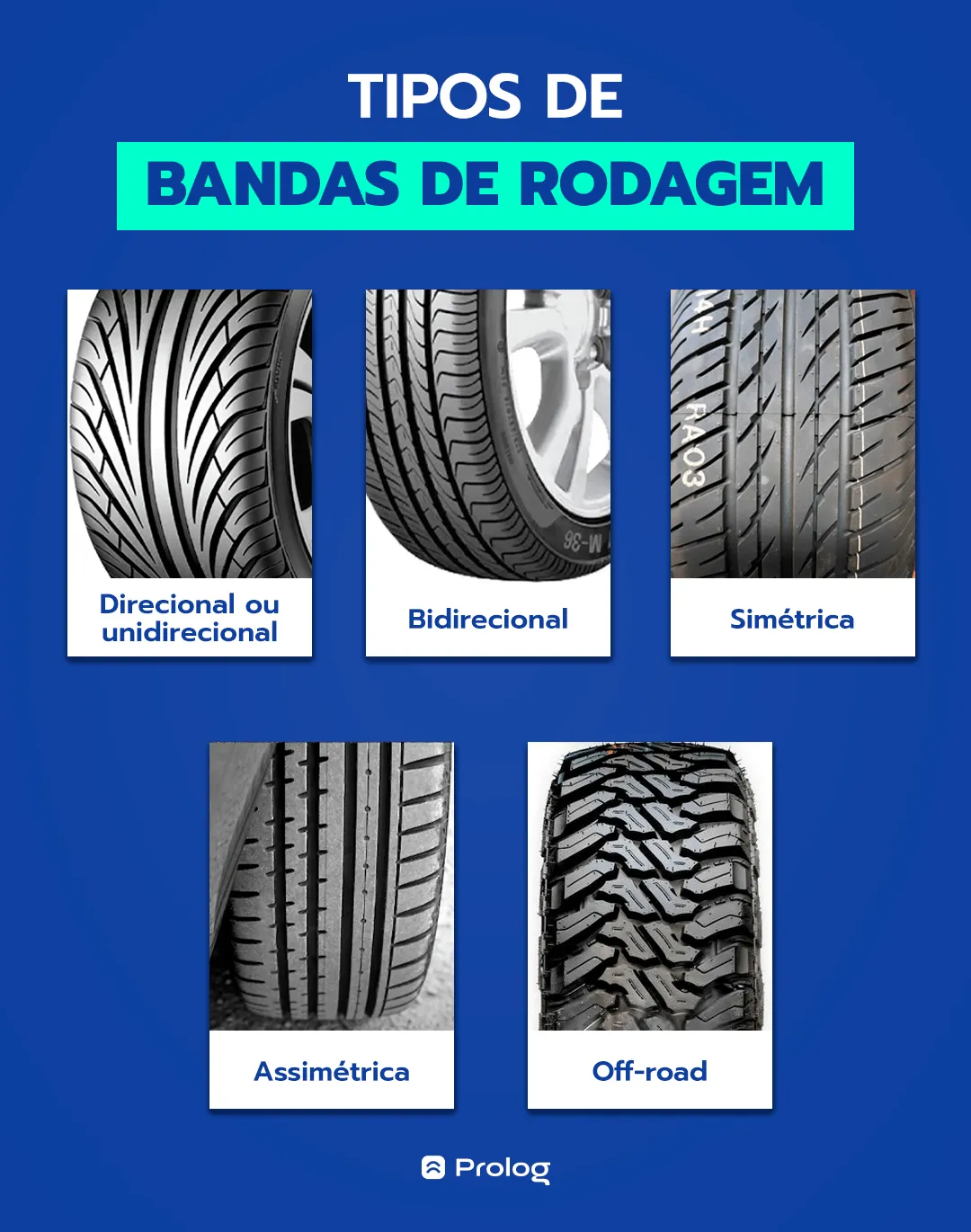
Tread types that influence tire grip.
Tread depth is certainly a factor that influences tire grip.
Besides it, the shape used to create these channels (grooves) and the way they are arranged across the tread, as well as the width of the grooves, play a role in grip.
After all, grooves help drain water and also contribute to the tire's grip on the road. Over the years, different types of tread have emerged, aimed at more specific moments and driving situations. They are:
- Unidirectional;
- Bidirectional;
- Symmetrical;
- Asymmetrical;
- Off-road.
While unidirectional and symmetrical treads perform better on asphalt and on long-distance highway trips, the asymmetrical tread is generally better suited to urban roads — where there is more acceleration and braking, demanding greater tire grip.
Tire pressure
It influences the contact area with the ground, tire flex and the force of the rubber against the pavement, increasing or decreasing rolling resistance.
Pressure below the ideal makes tires flex excessively, which reduces traction and control. As a result, the vehicle may have more difficulty responding efficiently and starts running in a condition that is unfavorable to grip.
In addition, the chances of any road debris causing cuts and punctures in the tires increase.
High pressure, on the other hand, reduces this contact area, making the vehicle unstable and prone to rollovers. It also reduces the available grip because there is less rubber in contact with the ground to generate the ideal friction when driving the vehicle.
Rubber compound
Different types of rubber have different friction coefficients. So this depends not only on the tire manufacturer, but also on the rubber supplier.
In general, the compound needs to balance grip, wear and rolling resistance. More resistant, “harder” rubbers, like those used in some off-road tires, tend to prioritize resistance in severe conditions. More flexible compounds, in turn, help the tire maintain grip, but also need to be compatible with the application, the route and the operating temperature.
Tire condition
A worn tire or, in the worst cases, a bald one, suffers loss of grip. This happens because all its grooves, which fulfill this role, no longer exist.
In Brazil, the law determines that grooves cannot be shallower than 1.6 mm. This is the minimum measurement for the tire to run without impairing the vehicle's performance and safety.
Even so, tires whose grooves have already reached this limit should be inspected by a retreader to assess the possibility of performing a service. Ideally, they should be removed from the vehicle with at least 3 mm of tread depth, preventing the casing from being damaged and the retreading from being rejected.
Vehicle speed
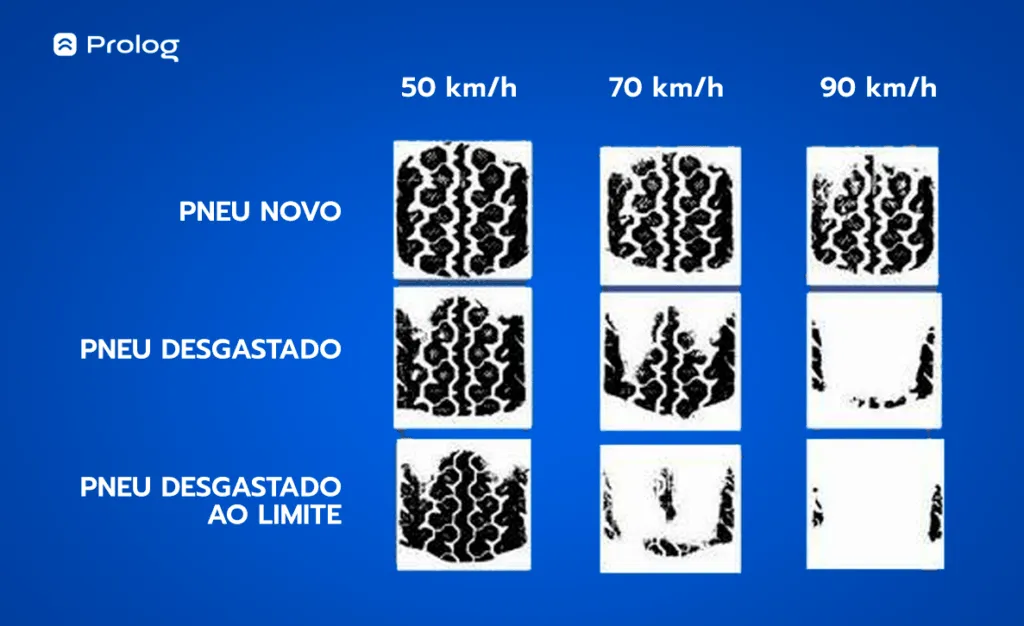
Tire grip on the road from new to its wear limit.
Especially for tires that already have some time of use and wear, the higher the vehicle's speed, the lower its grip on the ground.
High speed increases revolutions per minute, making the vehicle susceptible to a slight loss of contact with the ground. Especially when conditions are not ideal — it is raining, there is frost, the calibration is incorrect, etc.
And the more used the tire is, with medium to high wear, the lower the grip and the greater the risk of suffering this same “lift” off the ground.
Mechanical aspects of the vehicle
Depending on how the vehicle is designed, there may be more traction on the front wheels.
Or, if the vehicle is not aligned and balanced as it should be, this can cause the front or rear tires to suffer irregular wear and lose performance, generating less grip on the road.
This makes the fleet's preventive maintenance even more important, since it is what prevents these mechanical issues.
Load distribution on the cargo body
If there is more weight on one of the tires, it will have greater resistance to rolling and can cause irregular and/or excessive wear.
In the bigger picture, as already established, tread wear ends up leading to loss of tire grip.
Tire and ambient temperature
Tire overheating, as happens on urban trips with a lot of acceleration and braking, damages rubber that is not suited to it and reduces its grip.
Likewise, ambient temperature affects tire rubber.
On cold days, for example, although it helps lower tire temperature after a trip, the rubber becomes stiffer and the pressure may vary, reducing grip on the ground when the tire falls outside the recommended condition.
How does tire grip work on different types of road surface?

Table with the ideal type of tire for each road surface.
The type of surface also influences tire grip on the ground. In fact, many tires today are produced with specific types of surface in mind, aiming for the best possible performance — in terms of safety, economy and performance.
Incidentally, roads themselves are built with the region's traffic level in mind and which main vehicles will be passing through. With engineers prepared for the job, these factors are analyzed and the best material, texture and surfacing for the construction are identified.
For example, asphalt with a higher friction index is used in more urban areas, where there is heavy traffic and a lot of acceleration and braking.
In addition, tire grip is affected by dirt on the road, water, or other factors. Take a look:
- Dry surface: the best option for this ground is to run on wider tires with fewer grooves, which increase the rolling strip and grip. That way, when accelerating or cornering, the vehicle does not lose balance and stability.
- Dirty surface: the presence of sand, oil or other debris on the road impairs tire grip. Usually, this makes them more prone to skidding and/or sliding.
- Wet surface: grip mechanisms are compromised, but this can be countered with tires better suited to this type of surface. For example, deeper, “V”-shaped grooves have increased drainage capacity, as water flows better to the groove outlet.
- Snowy or icy surface: in Brazil, these situations are rare, but if they occur, so-called “winter tires” can be used. In these models, the grooves are more numerous and quite deep, making tire grip on the ground more suitable and reducing sliding. Even so, great care is needed when driving, avoiding sudden, abrupt maneuvers.
Want to see this in your fleet? Talk to a Prolog specialist
Is it possible to measure tire traction and grip?
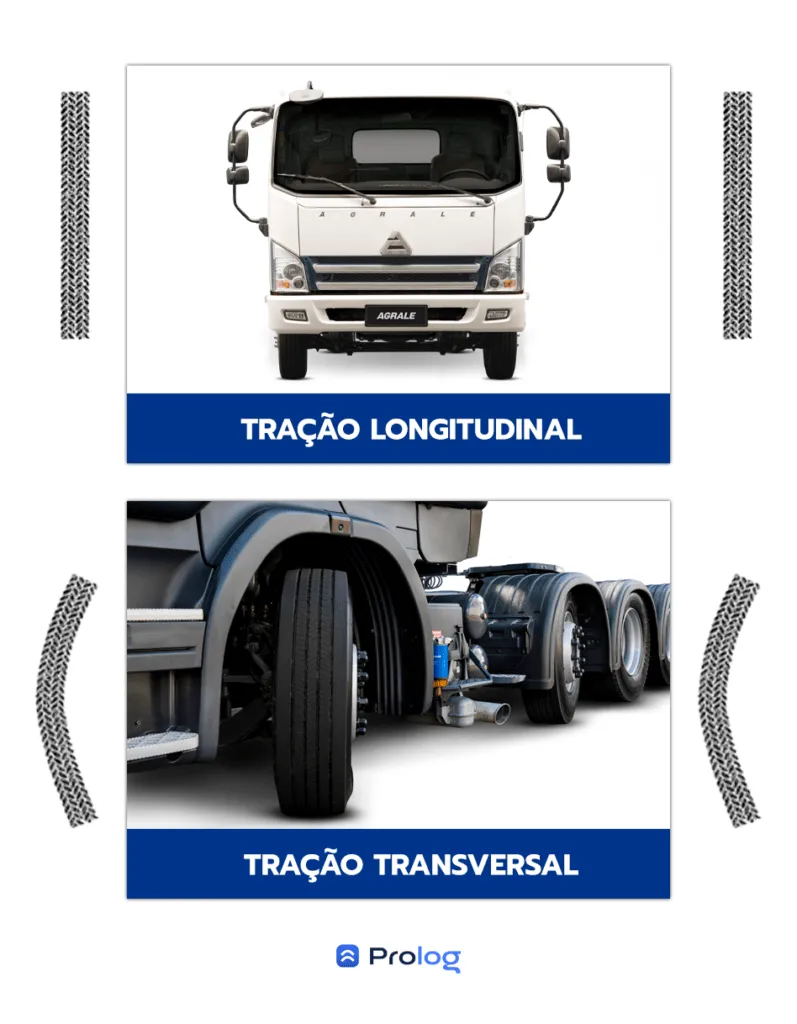
Angles of tire traction and grip on the ground.
It is possible, but given the different types of tires and road surfaces, the tests vary. In fact, depending on how the tire moves, the following types of traction occur:
- Longitudinal traction: when the tire rolls freely (on a straight road), forces are generated on both the tire surface and the pavement.
- Transverse (or lateral) traction: when the tire takes curves or changes lanes, the force generated is different for the tire and for the road.
Over the years, several different meters have been developed, but they all follow a basic principle: using the vehicle to make the rubber slide on the ground.
With some base calculations, the measuring equipment indicates the values needed to reach the final result. Among them:
- Slip speed (S);
- Vehicle directional speed (V);
- Average tire peripheral speed (Vp);
- Tire angular speed (Ω);
- Average tire radius (r).
Before calculating traction, you need to identify the grip speed. For this, the formula is:

Formula to calculate tire grip speed.
Likewise, you need to know the grip index (sometimes referred to as the “slip index”):
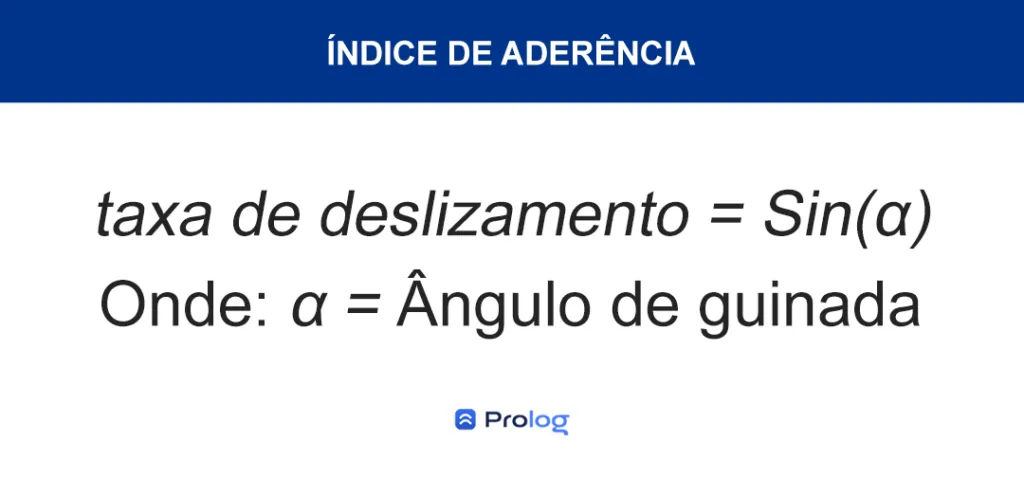
Formula to calculate the tire grip index.
Now, to find the longitudinal traction of the tires, you need to calculate:

Formula to calculate tire longitudinal traction.
And for the transverse traction calculation:
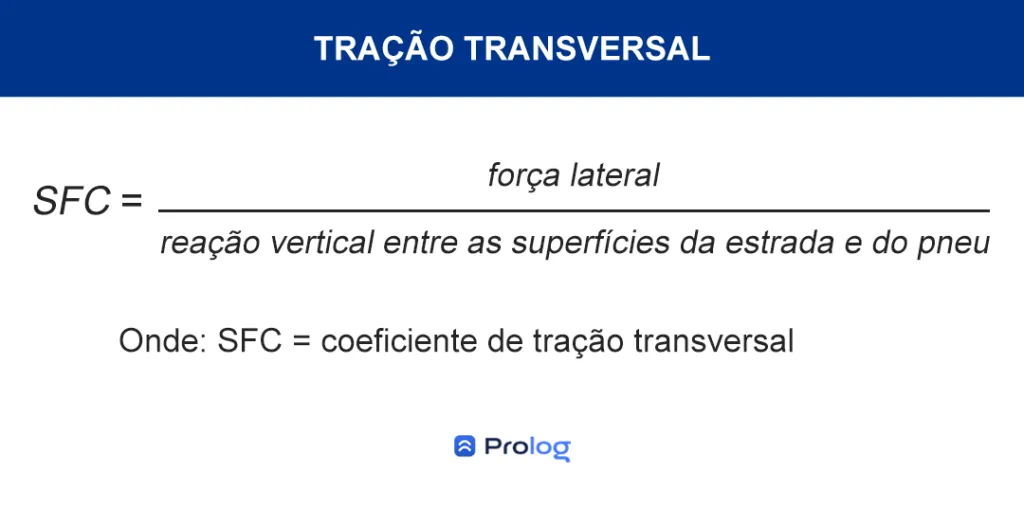
Formula to calculate tire transverse traction.
Why do tires lose grip on the ground?
Tire wear
Among the various types of tire wear, there is not one that does not affect tire grip.
To make it clearer:
Every type of wear has an impact on your vehicle's ride quality.
This happens because the worn tire becomes “smoother” in some areas when wear is irregular and/or localized, disrupting the vehicle's balance and stability.
Even when wear is regular and even across the entire tread, the tire has less depth to resist the ground. Therefore, depending on where it is running, it faces issues like the ones mentioned earlier (skidding, sliding, etc.)
Wheel alignment
Incorrect vehicle angles in relation to the tires reduce their traction.
However, this factor is tied to tire wear. After all, the direct consequence of a lack of alignment is irregular tread wear, with loss of grip being just a consequence of this factor.
Even so, it is worth noting that:
The angles can be incorrect either due to constant use of the vehicle without going through a preventive maintenance routine, or due to incorrect adjustments made by the mechanics team.
Using the wrong tires
Each tire has characteristics that indicate it is more appropriate for certain roads and weather conditions.
So, when you use a model with more flexible rubber, with shallower grooves or even fewer grooves, on a route that greatly increases tire temperature, you are creating a perfect scenario for loss of grip.
The opposite is somewhat less likely. That is, using more resistant tires on less aggressive trips, such as a long-distance trip, does not cause such damaging wear to the rubber.
On the other hand, it hurts trip performance and brings an equally bad consequence for the fleet manager: increased fuel consumption.
What is the impact of grip on the safety of transport operations?
This impact is quite large, actually. Loss of grip can cause many accidents on the road. Have you ever imagined your vehicle aquaplaning on a highway and you being unable to regain control?
The risks of running on a tire without the necessary traction are very serious. They are:
Aquaplaning (hydroplaning)
It happens when the tire loses contact with the ground on a wet road. Because of the worn tread, the grooves cannot drain water as they should.
It can also happen, even with grooves still at a good depth, due to low tire calibration.
Preventing aquaplaning is simple:
You need to take care of your tires and avoid running when they are not in ideal condition.
If it does happen, the best way to handle the situation is to reduce speed gradually. Preferably without slamming on the brakes, because this generates friction without the proper surface to receive it, and the vehicle may skid on the road.
If the roads are already flooded before setting out on a route, you can favor the trip with more suitable tires, such as those with asymmetrical tread, which better favor water evacuation.
Traffic accidents
Friction between tire and pavement is essential for the vehicle to operate correctly and avoid disasters.
Curves and overtaking are the moments that require the most attention. A tire in good condition should not cause concern, although the driver still needs to respect driving rules.
However, if the tread has already lost its grip, the vehicle does not have enough friction to perform maneuvers correctly. Another issue is the increase in braking time.
With low grip, there is also an increase in the vehicle's braking response time. In other words, when you step on the brake, the vehicle takes longer to stop.
Some of the main consequences and even the most common traffic accidents are:
- Vehicle rollover;
- Skidding on the road;
- Running off the road;
- Impact with a fixed object;
- Head-on, rear-end or side collision.
Is it possible to increase tire grip after losing it?
It depends on the reason for the loss. When grip drops due to a circumstantial condition, such as improper calibration, wet surface, dirt on the road or temperature outside the ideal range, correcting the cause can restore part of the grip available for that tire and that route.
When the loss comes from tread wear, however, it does not come back on its own. In this case, you can send the tires for retreading, if the casing still allows this service.
This consists of completely removing the used tread and installing a new one, by a professional company. But there is a detail here: this process can only be performed if the tire casing has not been damaged.
To explain it better:
If the tires are already in a very critical state and have completely lost their grip due to wear, it is very likely that casing fatigue has already occurred and retreading is no longer possible.
Therefore, you need to always follow up on tread wear and take every preventive measure to ensure maximum tire durability.
This includes keeping calibration up to date, measuring tread depth every month and recording all information to identify issues and their causes more easily and quickly.
Did you know that tires have a wear indicator inside the grooves? With them, your wear control also becomes more efficient. Watch this video on the topic on our YouTube channel and keep expanding your knowledge:
(video in Portuguese)
Frequently asked questions
What is tire grip?
Is tire grip the same on any type of road surface?
How does tire pressure affect grip?
Is it possible to recover a tire's grip after it is lost?
What are the risks of driving on tires without grip?
// newsletter
Fleet management content, straight to your inbox
Articles on tires, maintenance and fleet operations. No spam.