CPMV: what it is and the acceptable percentage in a fleet
 Jade Zart 5 min read

Maintenance indicators are essential for you to be able to control and keep track of the results and costs of the services carried out in your transport operation.
Among them is CPMV, the Brazilian acronym for Maintenance Cost over Replacement Value.
It is a calculation done with fleet information to understand the percentage of maintenance costs for a vehicle compared with its replacement value, and not just with the price paid at purchase.
It also contributes to the decision on whether to keep or replace the vehicle in the operation. See it in more detail:
- What CPMV is;
- What maintenance cost over replacement value is for;
- How to calculate the CPMV of your fleet's vehicles;
- How to use CPMV in your fleet maintenance management.
What is CPMV?
CPMV is a maintenance management performance indicator whose goal is to understand the maintenance cost incurred on each piece of equipment, machine and/or vehicle of a company.
The acronym stands for “Custo de Manutenção sobre Valor de Reposição”, Portuguese for maintenance cost over replacement value. In English-language references, the calculation appears as MC/RAV: maintenance cost divided by the replacement asset value, expressed as a percentage.
That is why it is important to keep the terms separate: CPMV is the indicator; RAV, or replacement asset value, is the base used in the denominator of the calculation.
What is maintenance cost over replacement value for?
CPMV is very useful for understanding when it is time to renew the fleet's vehicles.
That is because it indicates whether the amounts spent on the vehicle's maintenance services have exceeded the limits or are still within parameters considered acceptable.
But remember that this is an auxiliary indicator, so it is important to consider other maintenance indicators before making a decision, such as a vehicle's reliability level.
In addition, CPMV in fleet maintenance serves to:
- Understand a vehicle's cost-benefit over time
By calculating how much maintenance a vehicle requires during certain periods, you gain a long-term view of that asset, identifying whether the amount needed to replace or maintain an equivalent vehicle still makes up for the time it was in use in the fleet.
- Identify whether maintenance costs are being managed well
If the vehicles' maintenance amounts are very high, this will show up in the maintenance cost over replacement value calculation as well.
So it can be a sign for you to look for alternatives to better control your operation's services and the approved budgets, without looking only at an isolated maintenance job.
- Assess whether the fleet's maintenance routine is adequate
If the vehicles have a high CPMV and this happens after a short period of use, the problem is not necessarily in the vehicles, but may lie in incorrect driving or in failures in the fleet's maintenance routine.
- Assess whether the fleet's vehicles are suited to your operations
When the maintenance cost over replacement value is very high, the problem may lie in the vehicle itself. For example, if it is an old vehicle that has already gone through many part replacements, it has probably lost quality on the road.
Another plausible situation is when the vehicle, even if new, loses performance very quickly because it does not have the right conditions to perform in the operations your company needs.
How do you calculate CPMV?
The calculation for CPMV is:
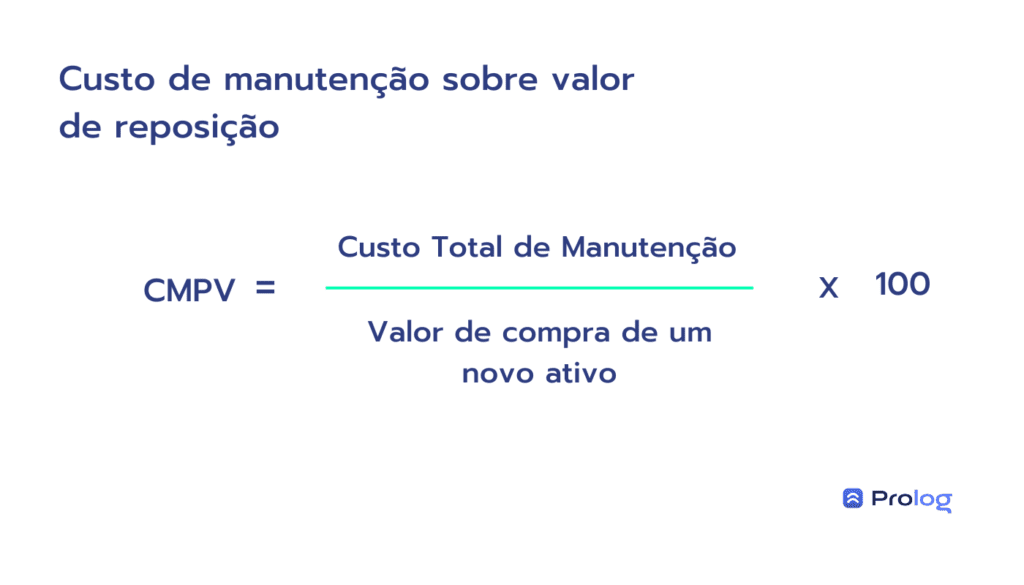
In practice, the indicator compares the maintenance cost for the period with the asset's replacement value. The technical reference in English describes this relationship as the total annual maintenance cost divided by the replacement asset value, presented as a percentage.
How do you use CPMV?
The lower the value you find in your calculation, the better. This means your vehicle tends to remain worthwhile for the operation and its costs are within a more controlled range. But how do you identify a value considered “normal” or even above average?
Parameters of adequate maintenance according to CPMV
You can find reference values through benchmarking against other companies. But there are some reference values described in various papers and books developed by professionals in the field:
- Above 6%: deficient maintenance
- Up to 3%: adequate maintenance
- Up to 2%: high-level maintenance
- Below 2%: world-class maintenance
In other words:
If your vehicle's maintenance cost over replacement value comes to up to 3%, the result can be considered adequate within this reference. Above 6%, the reading starts to indicate deficient maintenance.
It is worth considering that the values depend on the type of vehicle your fleet has. Normally, heavier vehicles have higher maintenance amounts because they are more labor-intensive.
However, if maintenance is carried out by an in-house team and you keep the prevention routine correctly, overall costs can still stay at the same rate of about 2 to 3%.
When should you calculate CPMV?
Another important factor to consider is how often to calculate and keep track of this indicator:
It should be tracked on a quarterly and annual basis, to understand not only the costs at a given point, but to get a view of the trend of increase or reduction in a vehicle's maintenance costs over its time in use.
It is also a way to understand whether the amounts budgeted for your fleet's maintenance match reality and what kinds of adjustments can be made for the operation's next quarter and/or year.
Want to learn more about the main maintenance indicators and how to plan more efficient maintenance management? Download our free guide on the subject (in Portuguese).
Frequently asked questions
What does CPMV measure?
What CPMV percentage is considered acceptable?
How often should CPMV be calculated?
Does a high CPMV mean the vehicle needs to be replaced?
Does the vehicle type change the expected CPMV?
// newsletter
Fleet management content, straight to your inbox
Articles on tires, maintenance and fleet operations. No spam.