Mean time to repair (MTTR): formula and example
 Jade Zart 5 min read
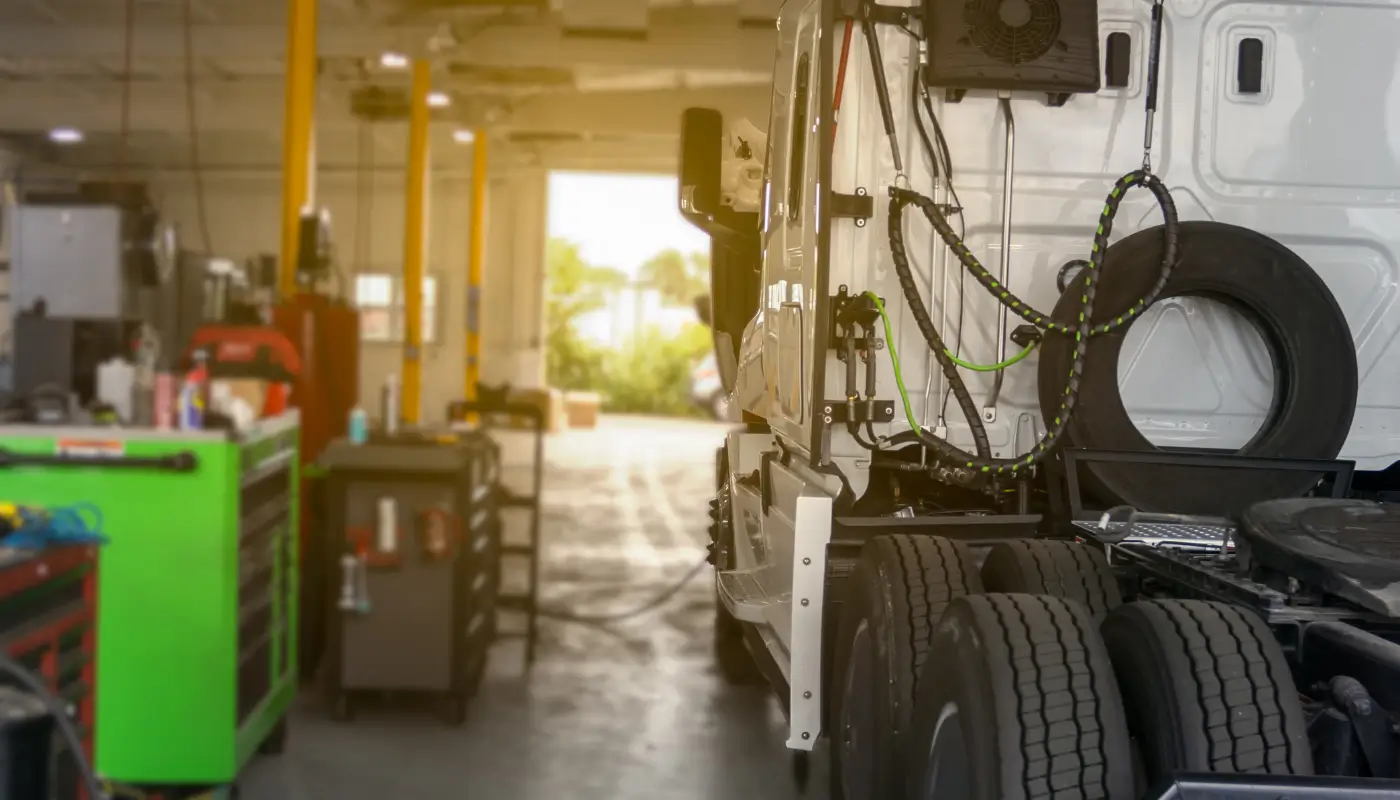
Mean time to repair (MTTR) is a performance indicator that measures the average time needed to repair a vehicle or piece of equipment after a failure occurs.
It is used in maintenance management to assess the efficiency of repair operations and the maintenance team's ability to resolve problems in the shortest possible time.
A low MTTR indicates repairs are being completed quickly, minimizing vehicle downtime and ensuring the fleet is available for operations.
On the other hand, a high MTTR can signal problems in the maintenance team, a lack of spare parts, ineffective procedures or other bottlenecks in the repair process.
Below, we will discuss:
- Why use MTTR?
- How to calculate mean time to repair
- How to improve mean time to repair
- How does MTTR differ from MTBF and MTTF?
- How to analyze your fleet's maintenance results
Why use MTTR?
We know that managing vehicle preventive maintenance is a constant challenge, so here we introduce the MTTR maintenance indicator, which can be a good solution.
In general, this indicator determines the average time needed for repairs, which can help plan your fleet's maintenance to minimize operational disruption.
MTTR also allows possible bottlenecks in the repair process to be identified, such as a lack of spare parts or a gap in your team's training.
For example, if data analysis shows that parts unavailability is one of the main factors increasing repair time, an immediate solution is to optimize the inventory management system (or even implement one if you do not yet have one) to ensure the most critical parts are always available.
Another practical application of MTTR is maintenance team training. If certain types of failures are taking longer to repair because of a lack of specialization, you can investigate the need for specific training.
If repairs to vehicles' electrical systems are taking longer, it will be useful to offer technicians a specialist course on this component or even hire new people for this area, resulting in faster, more efficient repairs.
How do you calculate mean time to repair?
MTTR is calculated using the formula:
MTTR = Total Repair Time (in hours) / Total Number of Failures
The elements involved in the calculation are Total Repair Time, which refers to the total period needed to restore an asset's function after a failure occurs.
This includes the time needed to diagnose the problem, obtain spare parts and carry out the repair, through to the time used to test the equipment and ensure it is working correctly.
And also the Total Number of Failures, which is the total number of times assets failed during the analysis period.
For example, if a vehicle fleet accumulated 50 repair hours during a month and there were 10 failures in total, the MTTR calculation would be:
MTTR = 50 hours / 10 failures = 5 hours
This means that, on average, it takes 5 hours to repair each failure in the fleet.
How can you improve mean time to repair?
This improvement can begin with technologies and systems aimed at fleet maintenance management, standardizing processes and records of information about each service, and establishing clear protocols for rapid response to unexpected problems.
Some of the main factors that can influence mean time to repair are:
- Spare parts availability: if parts are unavailable, naturally it will take longer to repair a vehicle.
- Maintenance team training: the more experienced the team, the faster they can diagnose and resolve problems.
- Maintenance documentation and history: these can help identify recurring problems and the appropriate solutions for each case.
The approaches I most recommend for tackling these problems are more efficient stock and inventory management, both by adjusting processes for parts entering and leaving inventory and by adopting specialized technological tools for this management.
Similarly, using maintenance systems that record and maintain the history of servicing and work on fleet vehicles will affect how you assess service levels and demands on the maintenance team, enabling more accurate decisions to actually reduce MTTR.
How does MTTR differ from MTBF and MTTF?
As we have just seen, MTTR is a performance indicator that measures the average time needed to repair a vehicle or piece of equipment after a failure occurs.
MTBF (Mean Time Between Failures), meanwhile, measures the average time between vehicle failures, meaning it assesses an asset's reliability and durability by showing how long, on average, the equipment operates before a failure occurs.
MTTF (Mean Time to Failure), in turn, is used to measure the average time until failure of a vehicle that cannot be repaired.
Unlike MTBF, which considers the continuous cycle of operation and repair, MTTF applies to disposable items or those with limited useful life, indicating how long equipment should work before failing permanently.
In my experience, all can be used in your fleet's maintenance management; you just need to know their best use and your objective in measuring each one.
How can you analyze your fleet's maintenance results?
Beyond collecting information about vehicles and their maintenance, you need to know how to use it to analyze the reality of your operations and make decisions that produce actual improvements, whether in productivity, savings or safety.
To analyze the results obtained in vehicle maintenance management, you need to know which metrics and maintenance indicators are most important; these are established by defining your objectives.
In other words, if the primary objective is to reduce maintenance costs, you should keep track of indicators such as the number of maintenance services by type, maintenance cost by type, mean time between failures (MTBF), among others.
It is also important to already have a comparison baseline, so you can analyze whether the actions taken are generating concrete results and which indicators are positive or negative.
With continuous, detailed analysis, you can identify patterns and adjust your strategies to constantly improve vehicle performance in your transport operations.
And if you want to keep learning how to control fleet maintenance and perform more accurate analyses to make decisions, we have a course you should not miss.
The course for fleet maintenance managers was developed by me, together with the Prolog team, to contribute to your professional development in the field, expanding your knowledge and enabling you to advance your career.
Learn more and enroll (in Portuguese).
Frequently asked questions
How is MTTR calculated?
Does waiting for a part count?
What should you do when MTTR is high?
What is the difference between MTTR, MTBF and MTTF?
Which indicators should you track alongside MTTR?
// newsletter
Fleet management content, straight to your inbox
Articles on tires, maintenance and fleet operations. No spam.