Fleet planning: what it is and how to do it
 Jade Zart 17 min read

Whether annual or semiannual, fleet planning is a necessary document for maintaining the quality of the services provided.
Through it, the company's management sets goals, objectives and solutions for problems that stood out in the previous period.
To make all of this possible, the performance indicators are analyzed, showing the positive and negative results of each decision and action by those responsible for the fleet and their team.
"Why is planning important?" is a common question for fleet managers.
And it is actually simple: it is the key to observing and assessing the performance of your transport operation. Without it, mistakes can happen that cause high and unnecessary costs and even, in more serious cases, the company's bankruptcy.
To avoid this and follow a path where the work routine is organized and smooth, learn:
- What fleet planning is;
- What fleet planning is for;
- Why fleet planning is important;
- Main challenges in fleet planning;
- How to do fleet planning
- Areas that should be planned;
- How to do an improvement analysis to include in your fleet planning;
- Current trends in fleet management.
What is fleet planning?
Fleet planning is a strategic document whose main objective is to organize the areas related to a company's fleet, from vehicle acquisition to fuel consumption control, setting goals and emergency actions.
Day to day, it is essential to avoid vehicles sitting idle in the parking lot, delays in delivering goods and unexpected expenses. These are details that only organized management, through planning, can anticipate.
In a competitive landscape, being prepared results in quick and correct actions, improving the business's credibility and ensuring success in the market.
Want to see this in your fleet? Talk to a Prolog specialist
What is fleet planning for?
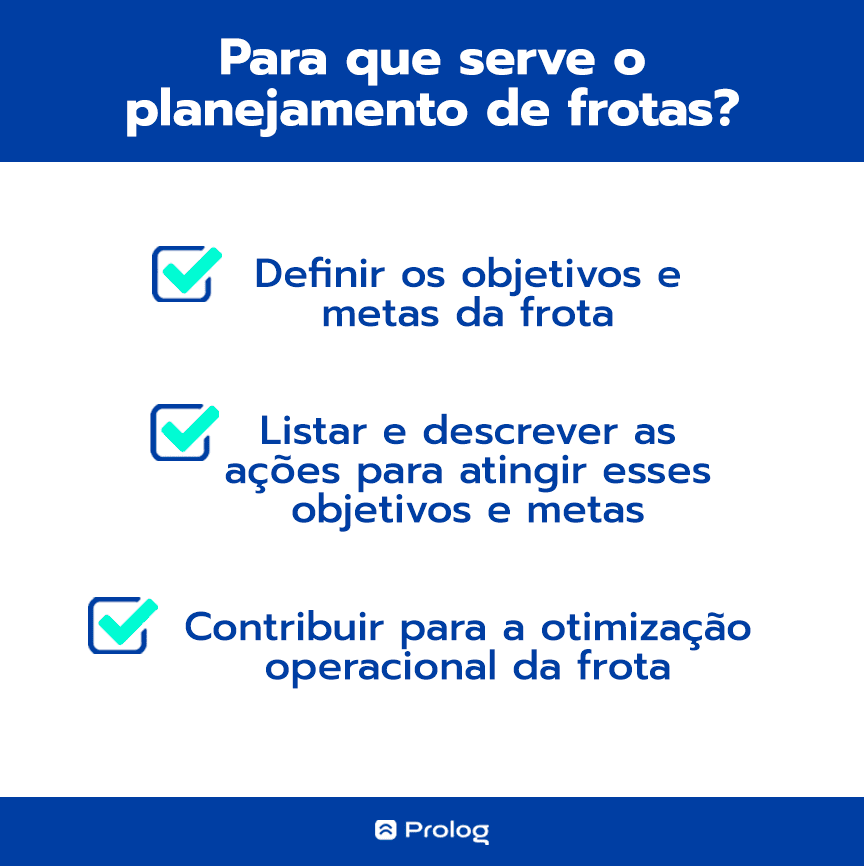
Objectives of fleet planning.
In general terms, it serves to list and describe the fleet's objectives and goals, as well as the actions needed to achieve them. Fleet planning also aims to help in the various stages of transport operations, such as controlling maintenance or driver costs, and so on.
See, in more detail, how it can be useful in each area of the fleet:
Maintenance control
You need to forecast spending and identify when vehicles are going in for corrective services too often. In addition, maintenance planning indicates, in advance, what the drivers' routine for inspecting the vehicles is.
Fuel costs
Refueling vehicles is a part of the fleet that is hard to control, given the lack of control over unstable fuel prices.
Even so, when refueling is handled thoroughly through good management, you can forecast an average monthly amount and plan the allocation of resources intelligently.
Cost reduction actions
The plan also records all of the fleet's assets, from vehicles to tires, and describes an average monthly budget that the fleet can spend, among other details.
That makes it easier to see which actions are needed to reach the objectives initially set.
It is worth mentioning that these objectives should be aligned with the company as a whole, complementing what it seeks for its growth, business expansion, etc.
Driver and document control
Having an average of how many hires should be made over the year and which actions will be taken for driver engagement and bonuses, for example, is important to determine the amounts allocated to this stage.
Likewise, having this general idea helps make the documentation for these services more effective and agile.
As for the fleet's other documents, a forecast can be made in advance to decide how these papers will be filed or whether everything will be digital.
Operational optimization
In the same vein, all the tools and technologies to be acquired for the fleet's next period should already be thought through in advance and, above all, based on data from the last year (or six months).
By understanding the problems found and the solutions needed, you can identify which platforms you need to acquire and can go after the budget to implement each one.
Why is fleet planning important?
It is based on the records of fleet planning and its indicators that new objectives will be set and constant growth can happen satisfactorily.
After all, the fleet may include transport trucks, cargo handling vehicles and cars, among many other types of vehicles.
In addition to having employees across a wide range of departments, it has concerns about legislation, documentation, load variations and many other aspects that require care and investment.
Think about it: do you think it is possible to take care of all this without a plan?
These are services that require care and costs that, when not managed, can increase the risk of accidents and harm the company's future.
Main challenges in fleet planning
Including AI in fleet management
Integrating Artificial Intelligence (AI) into fleet management presents challenges such as the need for adequate technology infrastructure and the adaptation of teams to AI-based systems.
In addition, AI can optimize routes, predict maintenance and improve safety, but it requires a significant initial investment to implement the right solutions.
Companies should carefully assess how AI aligns with their operational and strategic objectives, ensuring that its implementation is carried out effectively and with the necessary support.
Acquiring electric vehicles
The transition to electric vehicles is a challenge that involves considerations about initial costs, charging infrastructure and, at times, driver training.
Although they offer environmental benefits and long-term cost reductions, electric vehicles require careful planning for their integration into the fleet.
To succeed in this transition, management should plan the installation of charging stations and consider the impact of vehicle range on daily operations.
Operating cost control
Keeping operating costs under control is a constant challenge in fleet planning. This includes managing expenses on fuel, maintenance, insurance and licenses.
Companies need efficient strategies to monitor and reduce costs, such as implementing economical driving practices and using technologies to monitor fuel consumption and vehicle efficiency.
Data management
Data management involves collecting, analyzing and effectively using large volumes of information generated by fleet operations. This can include vehicle tracking data, fuel consumption and maintenance records.
Turning this data into actionable insights requires robust data analysis systems and the ability to interpret the information to improve decision-making.
Vehicle maintenance and breakdown management
In this case, the challenge lies in balancing the need for regular maintenance with minimizing disruptions to the fleet's daily operations.
To do this, it is essential to have a well-structured and established fleet maintenance program, whether through prevention or predictive maintenance.
How do you do fleet planning?
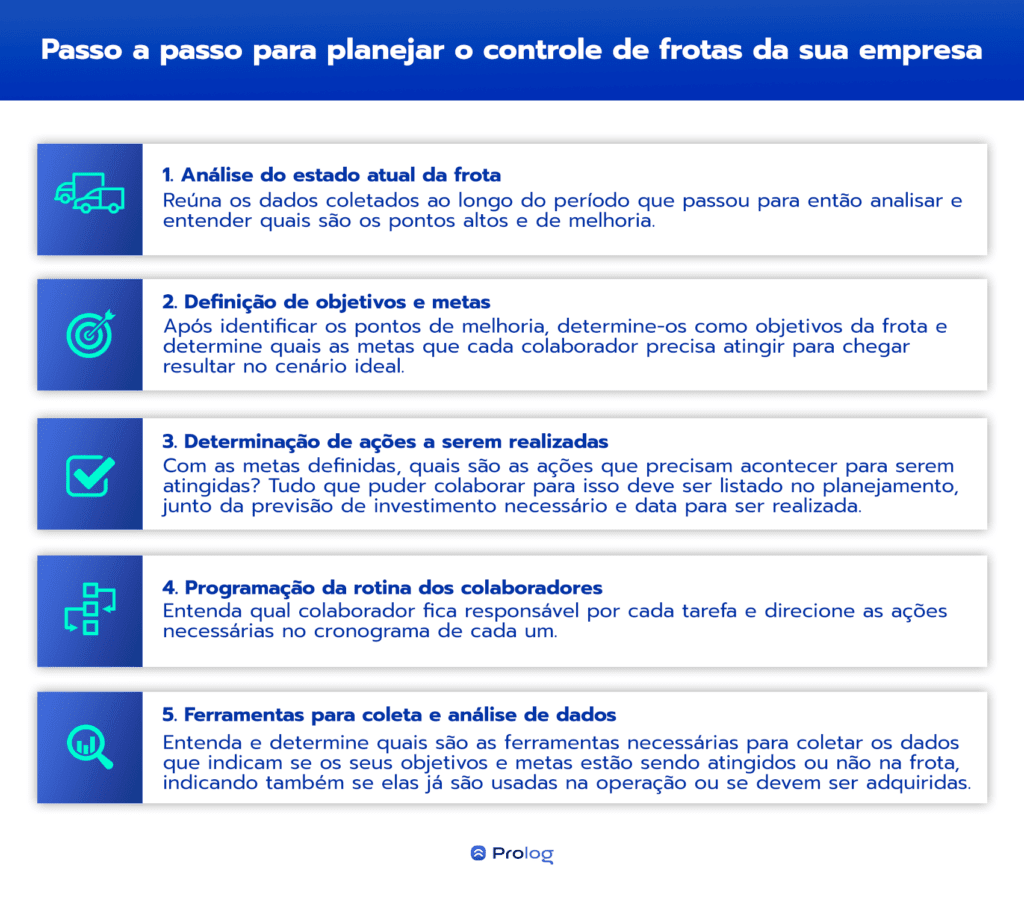
Step by step for planning fleet control.
It usually starts being created in a meeting involving the fleet's managers, administrators and supervisors. The basic steps of fleet planning are data collection, information analysis and setting objectives and goals.
After that, it is time to implement the planned actions and keep track of them to check the results. And, of course, to make readjustments as needed.
Analysis of the fleet's current state
Before creating any plan aimed at new objectives and goals, you need to look at the fleet's current situation and assess the data that serves as a reference for the changes to come.
Only then is it possible to recognize the company's growth and the difference the organization makes.
You may be wondering: what exactly should I look at?
First, you need to do an analysis, both internal and external, of how the past year went.
That is, of the market you operate in, competitors and opportunities, but also of how your fleet performed during the year, what its highs and lows were.
Everything should be based on real data, so make sure you have everything on hand when putting the plans together. That way, you ensure goals are created reliably and are, in fact, achievable.
Setting objectives and goals
From the analysis, it is possible to see more clearly the changes the company needs, categorizing them by priority level.
These changes are the first steps toward achieving the objectives and goals that will be set in this second part of transport operations planning.
Some examples of objectives include:
- Reducing operating costs;
- Implementing a maintenance schedule;
- Saving fuel;
- Bringing in new employee training;
- Controlling tires;
- Optimizing daily routes;
- Controlling trucks entering and leaving the parking lot.
Defining the actions to be taken
Now that the second step has been taken, it is time to investigate what is needed to achieve these objectives and goals.
Issues involving hiring new professionals, specializations and promotions within the company, and the search for systems and technological means to improve the work routine are fundamental.
Scheduling the employees' routine
You already know the company's pain points, you know what needs to improve, you have set the objectives and goals, and you have the right professionals and equipment for the services. What now?
Time to put everything into practice!
Metaphorically speaking, of course. After all, we are still finishing the fleet planning.
But the heart of the matter is that this is the stage where everything happens. In a fleet routine, trucks are loaded, travel to make their deliveries, need planned routes and monitoring, as well as an inspection when they return to the company's parking lot.
This way, each professional should have their responsibilities and save data on the work they do day to day for frequent analyses of fleet performance.
Data collection and analysis
In the last stage, you analyze the information that all the employees working in the fleet have stored, to carry out an assessment and comparison.
It is from the notes on the number of maintenance jobs, route safety, road conditions and tire integrity, among others, that new action plans are created for the company's constant improvement and growth.
Which areas of the fleet should be planned?
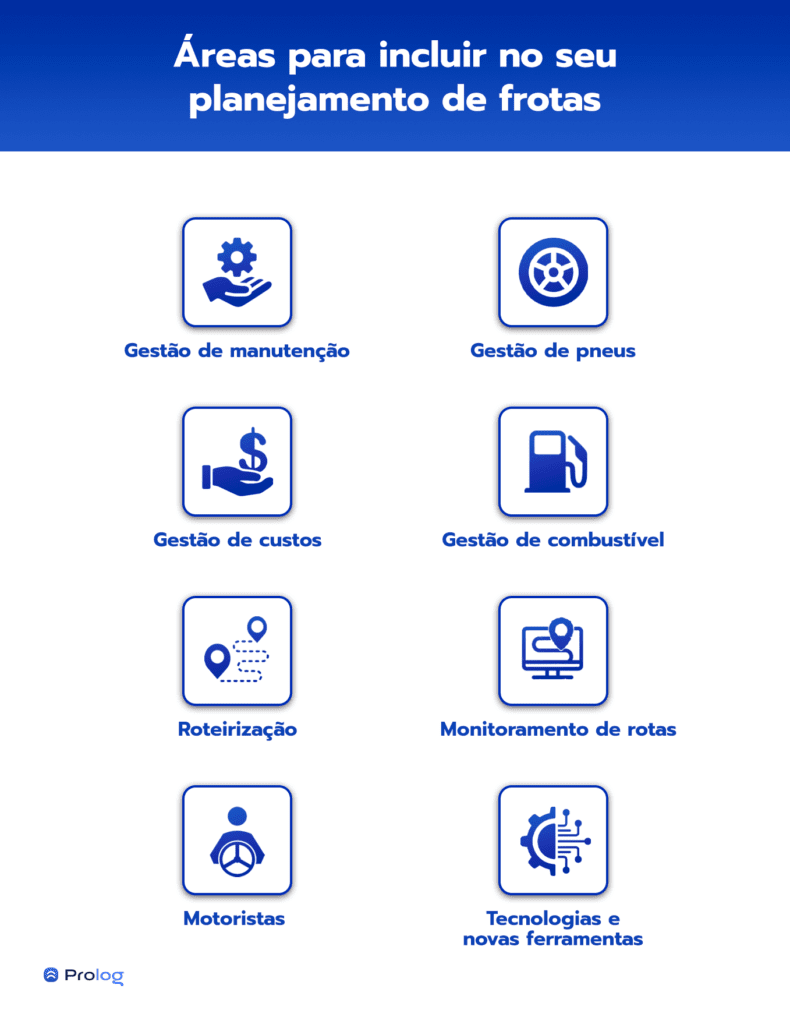
What you should include in fleet planning.
Maintenance management
Lack of fleet maintenance is one of the main reasons that lead to accidents on the roads. Besides putting drivers' lives at risk, the fleet's vehicles and customers' goods may be lost.
For a transport company, ensuring the safety of everyone involved through preventive maintenance on trucks is fundamental.
That is why organizing maintenance management is fundamental to properly handle the routine of:
- Gathering data on the condition of each truck;
- Creating and monitoring a preventive maintenance schedule for each vehicle;
- Sending vehicles in for maintenance;
- Setting the maintenance budget;
- Managing a history of services and maintenance;
- Creating a checklist for daily checks of vehicle parts;
- Keeping track of the daily updates to the trucks' routine.
Tire management
Because they have a high purchase cost, it is important to take specific care of these assets. Tire management emerges as an alternative to lower the costs of these items through control based on frequent inspections.
The person responsible for this area should know the parts that make up tires and the main causes of damage, preventing and fixing irregularities in the part.
Among the activities carried out in this type of management, you need to:
- Know the different types of tires;
- Place orders for new parts;
- Know how to use the right tire for each type of truck and specific ground;
- Maintain ideal tire calibration;
- Check wear;
- Carry out rotations;
- Extend the useful life of the parts through preventive maintenance;
- Send tires for retreading or disposal;
- Guide drivers on basic care.
Cost management
A fleet's costs are divided into fixed and variable. The first are expenses whose amounts management already knows, generally monthly, and the second are those that change according to use — such as fuel.
That is why cost management needs to already know the fixed expenses and control the variable ones according to the demand of each truck and delivery.
Be very careful at this point! You need to keep a close eye on spending, comparing it with the investment amount that was planned, trying not to exceed the forecast so it does not turn into a loss.
Actions that generate savings can also be suggested by those responsible for this area within the company.
Fuel management
Controlling fleet refueling is always a challenge. Prices change constantly and it is not possible to have an exact forecast of the amounts, which also vary between different gas stations.
Since costs are hard to predict, the control carried out by management will have another important function: checking vehicle performance to notice possible problems and failures.
The person responsible for the area can also help with alternatives that generate more savings, such as forming partnerships with gas stations or suggesting more economical routes.
Route planning and route monitoring
Anyone who works with transporting products knows the risks that Brazil's highways pose, especially with regard to cargo theft.
In addition, there is the condition of the roads, poor or closed for repairs, which can damage the vehicle or jeopardize the delivery deadline.
Route planning can help with all of this. By creating a route for the truck in advance, it is possible to look for shorter routes, with lighting, signage and pavement in better condition.
Route monitoring, in turn, anticipates accidents, repairs or hazards on the roads, making it possible to change course instantly to safer and more suitable alternatives.
Driver and team training
Training for drivers should be based on three foundations:
- Internal regulations.
- Traffic laws.
- Updates on the company's operations and new technologies.
It should be scheduled in advance, so that everyone can plan to attend.
It is a good idea to make the meeting a moment of interaction between employees, strengthening bonds and helping improve teamwork.
Technologies and new tools to apply in the operation
New trends emerge all the time in the market, with the aim of speeding up day-to-day tasks and ensuring better data security.
Besides being more practical, systems reduce the buildup of paperwork and allow immediate access to all information.
To find out what is new, you need to keep an eye on the news and also attend industry events — besides showcasing what is new, they can result in great partnerships and prices.
The fleet manager is usually the one responsible for this part. And, likewise, they should know how to put the acquired tools into practice, to help train the employees who need to use them in their routine.
How do you do an improvement analysis to include in your fleet planning?
Spreadsheets
With tools such as Excel and Google Sheets, you can create the tables and lists that help document and plan everything that happens in the fleet.
Vehicle fleet control spreadsheets are manual control methods.
In other words, for the results to come as close as possible to the real numbers, the analysis of the collected data needs to be calculated by professionals in the field who understand performance indicators.
Software
With the huge variety of software we have today, it takes on various stages within logistics. Remember the maintenance, tire, cost and fuel management we mentioned above? Those are the most common systems to find.
There are also route monitoring and checklist systems, which are fundamental in all of the fleet's trips. Most of them collect and store data that helps in the analysis of operational improvement.
ERP
"Enterprise Resource Planning" is the most complete system model. It can encompass fleet control, warehouse and/or inventory management, employee and supplier management, tax integration and document control.
Depending on the system's supplier, more or fewer functions may be present, and it is the most recommended option for logistics companies that want to centralize functions without using several different software products.
On the other hand, many of these systems still need complementary software, as they cannot provide the level of detail each area requires for efficient control.
Current trends in fleet management
Process automation
There are systems to cover various fleet management tasks, some more complete, others more focused on specific matters.
To explain further:
Some software goes as far as handling budgets, fuel control, maintenance schedule control, per-vehicle yield control and so on.
Meanwhile, some systems are more specialized, focused on single tasks. An example of this is the Prolog App tire management system.
With it, you have individual control of the fleet's tires, including wear, retreading, life cycle and cost per tire. It is also possible to support preventive maintenance by mileage or schedule and to open work orders automatically when a nonconformity is identified.
Business Intelligence (BI)
"Business intelligence", as the term is known in English, is a trend for a simple reason:
The use of data to make informed and accurate decisions.
All information about the fleet's health can be brought together in a BI platform.
This way, you can identify the advantages of your transport operations, as well as the failures they currently have — especially regarding lack of productivity and excessive spending. For this reading to be reliable, data preparation needs to be done well, because the quality of the information directly affects the reliability of the analysis.
Use of Artificial Intelligence
The use of Artificial Intelligence (AI) is increasingly present in some systems. With compiled data added to a system, today it is one of the main tools responsible for creating routes.
AI can also appear in administrative tasks and in predictive analyses, which use historical data and past patterns to estimate future results, such as the need for maintenance on a delivery vehicle.
Sustainability
Sustainability in fleets has been on the logistics agenda for some time, but it keeps gaining strength when management needs to reduce waste, consumption and emissions without losing operational efficiency.
Predictive maintenance
Predictive maintenance uses historical data and usage patterns to estimate when a vehicle may need maintenance, helping to plan interventions before the operation is interrupted.
This approach depends on the quality of the data collected and on a good reading of the indicators for maintenance, consumption, recurring failures and vehicle usage history.
When well applied, it helps reduce unexpected downtime, improves workshop planning and makes operating costs more predictable.
That is why it remains an important trend for fleets that want to move beyond a purely corrective routine and toward more preventive, data-driven management.
Growth of automation
Automation keeps growing in fleet management because it can digitize, simplify and centralize manual tasks that used to be scattered across papers, spreadsheets and informal conversations.
This movement can range from automating administrative routines to systems that organize maintenance, record inspections, standardize processes and improve decision-making based on reliable, up-to-date data.
Data intelligence
Data intelligence remains central to fleet management, with an emphasis on collecting, analyzing and effectively using large volumes of information.
BI and data analysis tools help organize indicators of operational efficiency, consumption patterns, productivity, costs and driving behavior, supporting continuous improvements in the operation.
Trend analysis
Trend analysis becomes more relevant when fleet managers need to anticipate market changes and adjust their strategies accordingly.
For example, by assessing trends in fuel consumption, maintenance patterns and technological innovations.
A clear understanding of trends helps companies stay competitive and adaptable, especially when planning combines strategic vision, daily operations and tactical execution.
5G connectivity
5G connectivity remains a relevant technology for the industry because it allows faster and more reliable transfer of large amounts of data.
This can facilitate improvements in logistics, real-time monitoring and significant advances in autonomous vehicle systems and other technologies that depend on a high-speed connection.
Mobility as a service
Mobility as a Service (MaaS) is gaining ground with greater integration between different means of transport.
It is an alternative that offers more flexible and efficient solutions for freight transport and passenger transport, combining different mobility services to optimize routes, reduce costs and improve the user experience.
Sustainability and ESG
Sustainability and the adoption of ESG (Environmental, Social, and Governance) practices remain on the radar of fleet companies.
Fleet companies can seek not only to reduce their carbon footprint but also to integrate responsible social and governance practices into their operations.
This can include adopting electric vehicles, emission reduction strategies, more efficient fuel use and programs focused on employee well-being and positive social impact.
Ready to take your fleet planning to the next level? Download our free guide (in Portuguese) right now.
Frequently asked questions
What is fleet planning for?
What are the steps to put the plan together?
Which areas of the fleet need to be planned?
Spreadsheet, software or ERP: which should you use to analyze the fleet?
What are the main challenges of fleet planning?
What objectives go into a fleet plan?
// newsletter
Fleet management content, straight to your inbox
Articles on tires, maintenance and fleet operations. No spam.