Logistics costs and fleet tire management
 Luiz Felipe 4 min read
Logistics costs add up a company’s expenses after a particular product is manufactured until it reaches its destination.
The concept covers investments ranging from goods transport to taxes, distribution operations, storage, labor and other processes that keep the supply chain running.
In the 2010 to 2012 comparison presented by Brazil’s Institute of Logistics and Supply Chain (Ilos), logistics already represented a significant company expense: companies came to spend 8.7% of net revenue on logistics, compared with 8.5% recorded in 2010. Over the same period, Brazil’s spending on road transport rose from R$ 202.6 billion to R$ 275.6 billion.
Depending on how you manage your operation, the impact on company finances can be quite negative. You therefore need stricter financial control, particularly over costs such as fuel, tires and maintenance — three groups that frequently feature among a fleet’s main areas of concern.
Today, we will specifically look at why tire management reduces operational costs. But first:
What are logistics costs in a transport operation?
Costs can be divided into fixed and variable costs. Respectively, these are costs that do not vary and costs that can change with distance traveled, volume transported, routes, vehicle condition and maintenance needs.
Fixed costs are calculated every month, even if the vehicle is not in use, and include:
- Vehicle licensing and replacement;
- Insurance cost;
- Salaries of the professionals involved;
- Among others.
Variable costs cover:
- Tolls;
- Fuel cost;
- Maintenance parts;
- Repair labor;
- Vehicle and transport accessories;
- Tire servicing;
- Tire retreading;
- Among others.
Tire costs rank second only to fuel spending in many transport operations, generally representing one of the fleet’s largest variable costs.
Tire management thus emerges as an alternative for greater control and visibility over these assets, while also contributing to lower fuel spending when calibration is maintained correctly.
Why does tire management help reduce logistics costs?
Regular checks extend a tire’s useful life, avoiding early disposal and allowing preventive tire retreading when the casing is still in good condition. Consequently, the fleet reduces the need for new purchases over a shorter period.
In other words, if you bought 10 tires in 2 months before implementing tire management, you may start buying fewer tires over the same interval, provided control is applied consistently and operating conditions allow this gain. Over time, you may also reduce the ratio of disposals to purchases — see this case study.
This reduces logistics costs associated with spending on new fleet assets, especially when the company stops treating tires merely as replacement items and starts monitoring pressure, tread depth, rotation, alignment, maintenance history and disposal reasons.
In addition:
Because they last longer, tires receiving regular maintenance are less likely to cause handling problems. After all, incorrectly inflated tires make the vehicle respond inadequately, and tires below the recommended pressure generate excessive heat, structural stress, uneven wear and internal damage.
With tire management, you can reduce the chance of accidents and events that force the truck to stop. Control also supports tires in performing their function well and helps avoid towing, corrective maintenance and productivity losses.
When tire inspection is neglected, parts such as shock absorbers, springs and steering items can be directly affected, impacting vehicle usability and reducing its time in service. Uneven wear can also indicate misalignment, which tends to accelerate tread loss and needs correction by qualified professionals.
What is tire management?
Tire management ensures that vehicles operate properly, without unexpected events such as tire blowouts, aquaplaning or rollovers. In practice, it organizes inspection, maintenance and decision-making routines so each tire is used safely and for as long as possible.
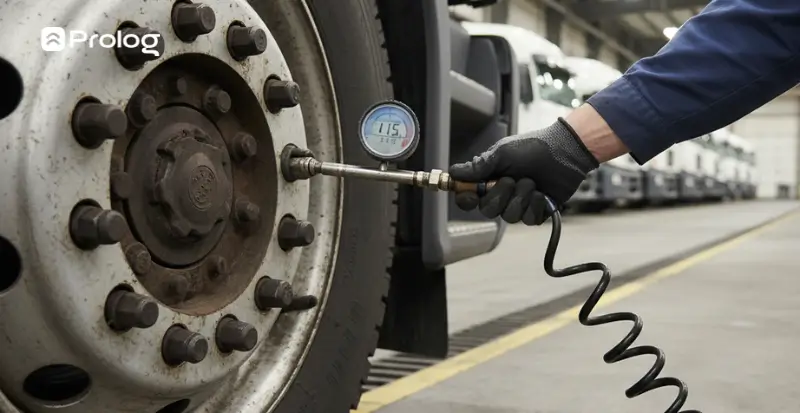
Driving with tires below the recommended pressure, for example, can cause deformation, damaging tire structure while also generating replacement costs and consuming more fuel. Maintaining proper pressure also contributes to maximizing fuel savings.
Tire control therefore acts as an optimization method that prevents these problems. It is responsible for controlling everything related to tires, such as:
- Determining the ideal rotation interval;
- Defining when to replace or recondition tires;
- Suggesting practices to avoid accelerating wear;
- Etc.
Beyond these points, a good tire routine should check pressure, tread depth, signs of uneven wear, bald areas, visible damage, rotation and alignment. Regular rotation helps tires wear more evenly, extending their useful life.
What are other ways to increase fleet savings?
Fleet management can contribute to increased profit, greater market competitiveness and reduced impacts on income through well-designed strategies. In Brazil, the issue becomes even more important because road transport has increased its share of the transport mix, according to Ilos.
Process mapping is the first of these strategies. Standardizing activities can optimize time for other procedures, reduce repeated work and make records more reliable for decisions.
Although performing tasks manually is more accessible at first, investing in digitized routines through systems is an alternative that allows employees to carry out their routines more efficiently, with less information loss and better organization of operational data.
For greater productivity and organization, look for systems that enable data integration, avoiding repeated work, data loss and/or duplication. This gives you concrete, updated information, contributing to more precise and smarter decisions.
How about starting to put what you have learned into practice and generating more savings in your fleet?
Access Prolog’s Fleet Management Kit, with study materials and practical tools for everyday transport operations — checklist templates + tire control spreadsheet (in Portuguese).
Click here to download. (in Portuguese)
Frequently asked questions
What are logistics costs?
How much do logistics costs represent in Brazil?
What are the fixed and variable costs of a transport operation?
Why does tire management reduce logistics costs?
What is tire management?
// newsletter
Fleet management content, straight to your inbox
Articles on tires, maintenance and fleet operations. No spam.