
Preventive or predictive: which is better for trucks?
 Luiz Felipe 9 min read

When discussing fleet management, vehicle maintenance is a recurring and very important topic, but it is not the only type of maintenance. To ensure the best results in your operations, you need to know and understand how to work with all types of maintenance.
There are three main types: preventive, predictive and corrective.
In general, predictive maintenance keeps track of a component’s actual condition to act before failure. Meanwhile, corrective maintenance is carried out when the problem is already present, such as a vehicle part breaking.
In preventive maintenance, the problem is anticipated through a scheduled checking routine, preventing it from becoming bigger — for example, by identifying part wear in time.
Although prevention is generally the most important (and best value), it is worth understanding why.
Read on to learn more about:
- The importance of maintenance;
- The types of fleet maintenance;
- How to plan preventive truck maintenance.
Why is preventive truck maintenance important?
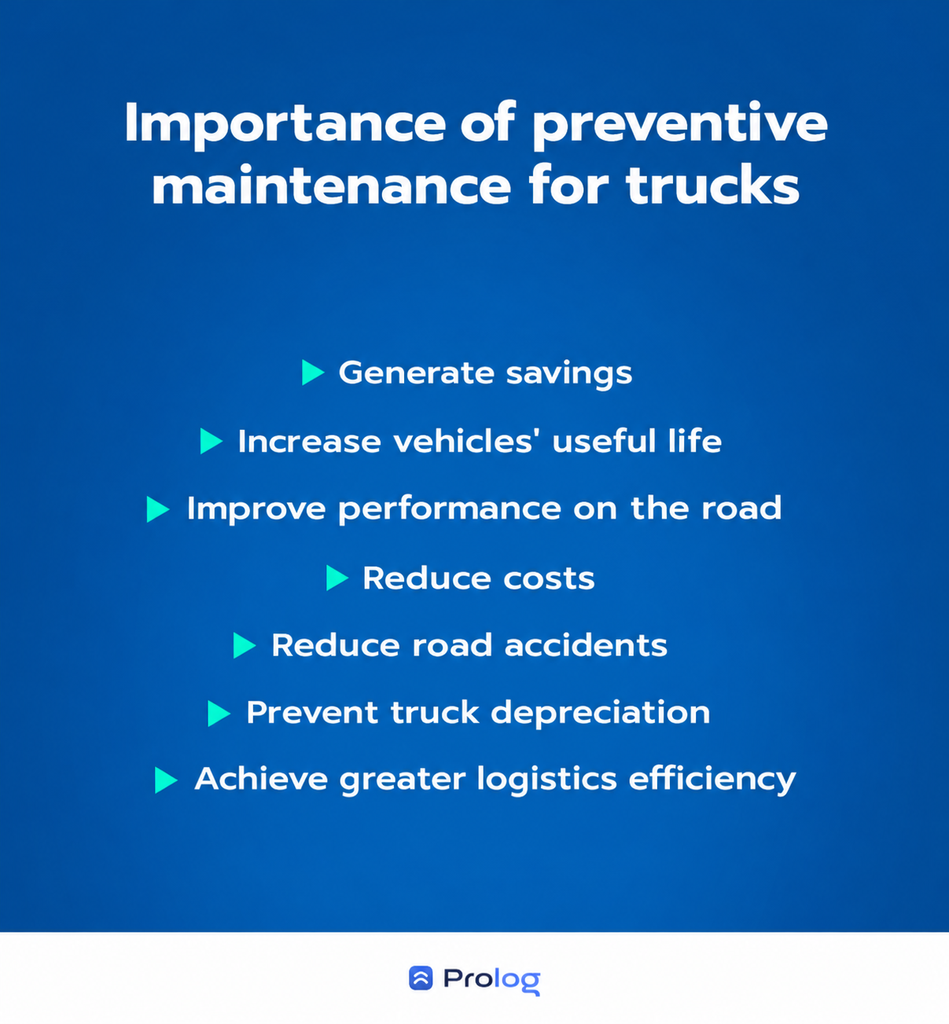
Avoiding bigger problems is the main intention of prevention. You also save resources by taking the actions needed to improve vehicle durability and sustain performance on the company’s routes.
Those carrying out preventive truck maintenance generally seek two main results: cost reductions and fewer road accidents.
However, we can mention other advantages that, far from being secondary, encompass the main focus of preventive truck maintenance:
- Increased fleet useful life;
- Higher vehicle resale value;
- Operational safety;
- Greater logistics efficiency.
In just a few words (and reasons), the importance of preventive maintenance is already very clear.
The goal is also to spread costs over time and avoid large expenses in a single maintenance service. That is, one month you might change the oil, the next, filters and spark plugs, and so on.
Also, small preventive expenses allow you to plan better for when a larger budget is needed — for example, for replacing tires.
It is worth noting a distinction often lost in daily routines: each item’s service intervals come from the vehicle manufacturer’s manual and vary by model, application and conditions of use; they are technical recommendations, not legally fixed deadlines. Safety limits defined in Brazilian regulations, however, apply to any fleet in Brazil, regardless of its internal plan. A well-designed preventive maintenance plan respects both, without treating one as the other.
Want to see this in your fleet? Talk to a Prolog specialist
What types of fleet maintenance are there?
Corrective
When a vehicle reaches the stage of needing corrective work, a major failure has occurred in the truck. Something broke, fell off, burned out, etc., creating a need for new parts and sometimes fleet renewal.
To reduce excessive corrective maintenance costs, the approach is to inspect vehicle components regularly and accurately — in other words, prevention. This does not eliminate corrective maintenance: even the best-organized fleet experiences unforeseen breakdowns, and the difference lies in how many were avoidable.
Predictive
Although predictive maintenance is not so widespread in truck fleet management, it remains a valid option for those wanting tighter vehicle control.
We can see some similarity with preventive truck maintenance, but the criterion differs: while preventive maintenance acts on a planned schedule, predictive maintenance decides based on a component’s measured condition — oil analysis, wear measurements, temperature, vibration, play. When measurements show degradation, the part is replaced even if it has not yet reached the end of its expected useful life.
Although this maintenance uses each part more efficiently, it is also usually the most expensive maintenance. After all, if parts and components are replaced before the end of their useful life, a larger budget and better financial planning are needed to cover that demand.
Also, the examination performed in predictive maintenance is rigorous.
This means funding is needed to buy specific analysis equipment, as well as people capable of interpreting what measurements indicate — without that interpretation, the instrument becomes a cost without a decision.
Preventive
Turning now to preventive maintenance itself, this is the best option if you want to reduce costs in your fleet management.
This type of service supports truck driver safety and vehicle reliability.
But how does this maintenance work?
It is simply a periodic check, which can take place daily, weekly or monthly, according to what needs inspection. During it, the inspector identifies failures or damage that impair truck operation.
Although a recurring expense, it is cheaper than the two types of maintenance mentioned earlier, providing good performance for transportation operations and helping reduce costs overall.
It is scheduled and uses a checklist to make it more practical. This way, vehicles do not remain stopped for long and can quickly return to the road.
And between predictive and corrective maintenance, which is better for a truck fleet? The comparison is uneven because only one is a choice: corrective maintenance is what remains when failure occurs, while predictive maintenance is a strategy requiring instruments, funding and people trained to interpret measurements. The practical question is therefore usually different: how much of your corrective maintenance was avoidable? Structuring preventive maintenance first reduces that share, and only then does it make sense to assess predictive maintenance for components with the highest downtime costs, such as engines, transmissions and tires.
What is needed to plan preventive truck maintenance?
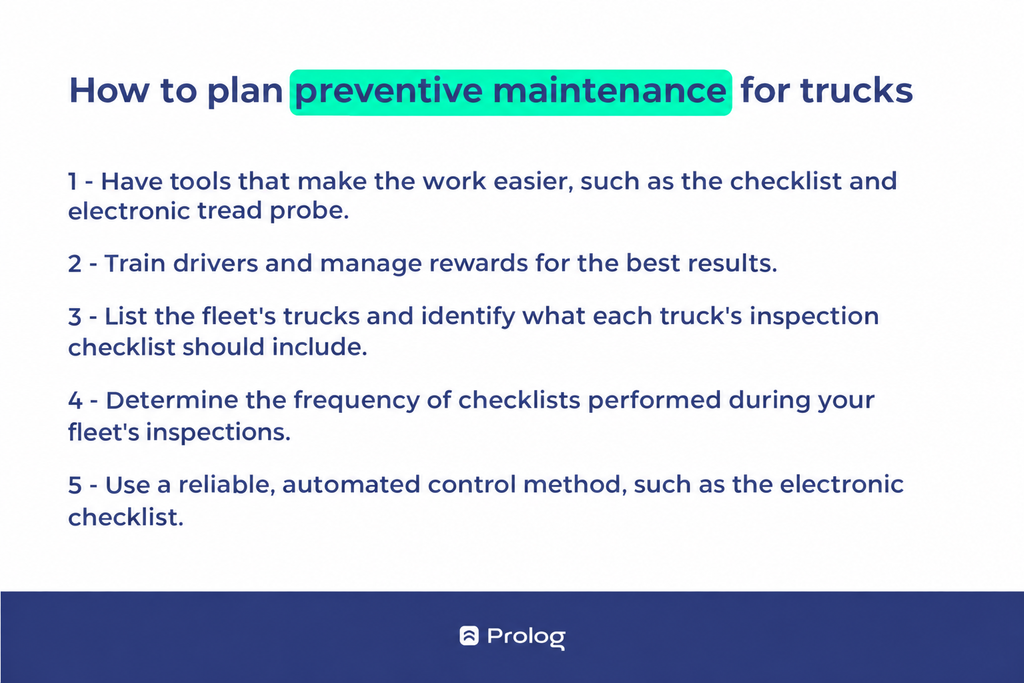
First, you need the necessary tools: a checklist, a schedule and a spreadsheet or system. You should also instruct drivers on the importance of the process and how they benefit from it.
Otherwise, you may end up with empty or carelessly completed checklists. Believe me, this is not uncommon. Especially with paper checklists, which are more tedious and time-consuming to complete.
How do you plan this maintenance?
Start by listing all fleet license plates and identifying how many vehicle makes and models you have. You can organize inspections by vehicle type or other characteristics, separating dry cargo and hazardous cargo vehicles, for example.
What matters most is knowing fully what should be inspected and how often items tend to develop problems, allowing you to identify the appropriate service interval for each part. Two sources help shape this: the manufacturer’s manual, with the expected intervals for the model, and your own fleet’s history, showing what fails earlier than expected in actual use.
This step is also important in answering the next question:
When is the right time for maintenance?
Before reaching the deadline when the vehicle usually develops problems. To illustrate with a hypothetical example: if a truck’s suspension in your fleet usually develops problems every 6 months, including this item in the inspection checklist every 4 months leaves room to act before failure — the right number is what your history shows, not a general rule.
This way, you can see whether there are already worn items, bent parts or other problems in that area. You can also send the vehicle for a planned preventive maintenance service.
Some limits, however, do not depend on your history. In Brazil, CONTRAN (the National Traffic Council) Resolution No. 913, of March 28, 2022, which addresses tire use on vehicles, prohibits driving a motor vehicle equipped with a tire whose tread wear has reached the indicators, or whose remaining tread depth is less than 1.6 mm — a depth which, according to the resolution itself, is visually determined through the wear indicators. For planning purposes, this type of limit serves as a fixed milestone in the schedule, regardless of what fleet history indicates.
How often should the inspection checklist be completed?
Ideally, preventive inspection should take place before each trip the vehicle makes, avoiding accidents and unforeseen events as much as possible.
The daily checklist is the foundation of this routine, and it is worth implementing if your operation does not yet use it. There are also items that should be checked every week, some every month, and so on.
That is why listing vehicles and the items inspected on each is essential.
There is no single ideal vehicle inspection frequency; it should happen constantly in your transportation operation. What exists is a common-sense criterion: the greater the consequence of an item’s failure, the shorter the checking interval tends to be.
How do you manage maintenance?
You can manage fleet maintenance, both preventive and corrective, in a few different ways:
Maintenance management spreadsheet
In spreadsheets, you can register vehicles and processes, as well as the employees responsible.
In these cases, with specific formulas and automations that you create yourself or hire someone with Excel knowledge to create, each time someone enters data, everything is filled in more quickly.
To build a spreadsheet, you should understand what is essential to your control and needs recording. To help, try asking yourself:
- What is the fleet’s goal?
- Which indicators should I keep track of to meet the goals?
- What do I need to analyze to make fleet decisions?
The answers help you understand whether it is more important to have a daily record of routes completed and items with problems, or whether inventory control is needed. Spreadsheet limits appear as the fleet grows: manual entry, parallel versions of the same file and dependence on whoever created the formulas.
Maintenance management system
With a ready-made system, you have control very similar to a spreadsheet; the difference is that you receive everything ready to use. This includes the necessary automations and report generation based on data entered into the system.
Each available solution may offer interesting features; assess which is most important for your goals and which makes it easier to control the data and indicators you need to keep track of.
When comparing, look at concrete items: whether the driver completes the checklist on a phone, whether workshop records go into the same place, whether history is kept per vehicle and whether you can export what you have recorded.
Since the vehicle inspection checklist is a fundamental tool in preventive maintenance, prioritize an alternative that also provides it.
Learn more in the next question:
How do you use technology in preventive truck maintenance?
Today’s alternative to paper is the electronic checklist within a management system.
Instead of holding a clipboard and papers and manually transferring data to your spreadsheet, all items are easily accessible in a computer system — or an app for tablets and phones.
Besides speeding up checks of fleet vehicle operation, data become available to management as soon as the inspection is submitted, without the data-entry step.
In other words, when an item fails inspection, you can configure which responses should automatically open a work order (WO), and the license plate view is updated — marking the need for service in the Checklist Traffic Light, the visual summary of each license plate’s status.
This is a way to increase fleet management efficiency and your team’s daily productivity. How about learning more?
With Prolog App, that is what you offer your operation. Learn more about our solution.
Frequently asked questions
Predictive or preventive maintenance: which is better for truck fleets?
What types of fleet maintenance are there?
Why carry out preventive truck maintenance?
How do you plan preventive truck maintenance?
How often should the truck inspection checklist be completed?
Are there legal limits to include in the preventive maintenance plan?
// newsletter
Fleet management content, straight to your inbox
Articles on tires, maintenance and fleet operations. No spam.


