Rodotrem: capacity, rules and types for your fleet
 Thiago Concado 11 min read
In a previous article, you learned about the main features and advantages of the bitrem in road freight transport. Now it is time to get to know another combination that is very common on Brazilian highways: the rodotrem.
Like the bitrem, the rodotrem is a high-performance solution, suited to operations that require greater load capacity and logistics efficiency.
Although at first glance these combinations look similar, the rodotrem has important particularities that directly affect the choice of the ideal vehicle for each type of operation. Knowing how to tell them apart and understanding in which contexts each one stands out is essential for making more strategic decisions in fleet management.
In this post, you will discover what a rodotrem is, how it compares to the bitrem, when it is worth using and which are the most common models available on the market. You will also understand how to choose the ideal rodotrem for your operation and what care to take to ensure the best performance from this combination.
See the topics:
- What is a rodotrem?
- Which is better: rodotrem or bitrem?
- Why choose a rodotrem?
- Get to know the 5 types of rodotrem and how to choose the ideal one for your operation
- How do you ensure the fleet's rodotrens perform well?
Keep reading and see how the rodotrem can be a competitive advantage for your fleet.
What is a rodotrem?
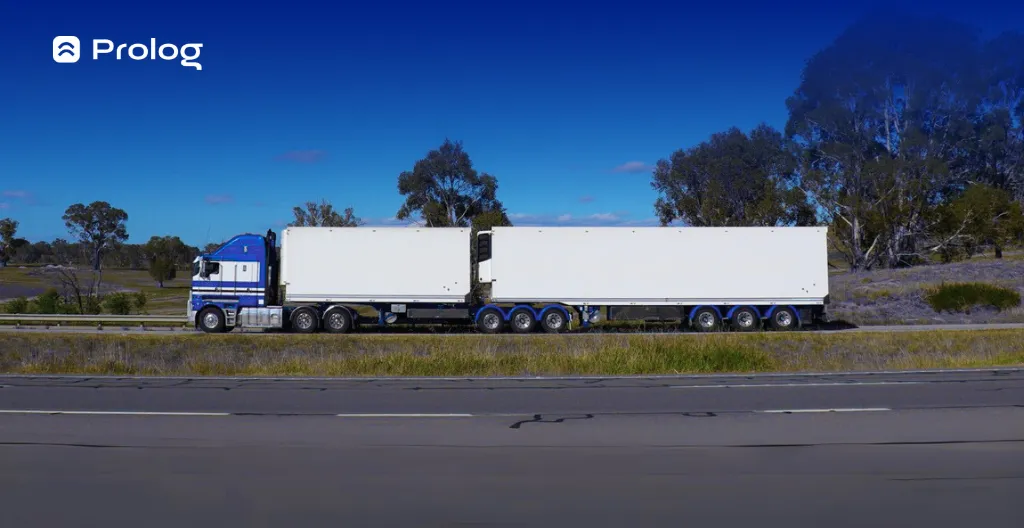
The rodotrem truck is a cargo vehicle combination widely used in road freight transport, mainly in long-distance, high-volume operations.
It is made up of a tractor unit and two semi-trailers, connected to each other by an implement called a dolly — an auxiliary trailer with its own axles, which has a fifth wheel to couple the second semi-trailer to the first.
This configuration results in a longer combination with greater load capacity than the bitrem, which can reach up to 30 meters in length and carry loads of more than 70 tonnes, depending on the model.
To pull this type of combination, the tractor unit must be compatible with the weight and dimensions of the combination, respecting the Maximum Traction Capacity (CMT) of the towing unit. In heavier operations, it is common for the fleet to use more robust configurations, such as a tandem-axle tractor unit, but suitability must be checked case by case.
As a result, the rodotrem is widely used in large-scale logistics operations, mainly in the agribusiness, mining, fuel and timber sectors, making it an efficient solution for transporting large volumes at a lower cost per tonne.
What is the load capacity of a rodotrem?
The load capacity of a rodotrem varies according to the model and the axle configuration, but, generally, this combination can carry between 57 and 74 tonnes of Gross Combined Weight (PBTC, its Brazilian acronym) — which includes the weight of the vehicle + the cargo transported.
This capacity is directly related to the number of axles in the combination. The traditional rodotrem, with nine axles, is the most common and makes it possible to reach the maximum limit of 74 tonnes of PBTC, as long as it meets the technical and legal requirements.
See a summary of the most common capacities:
- 9-axle rodotrem: up to 74 tonnes (PBTC)
- 7- or 8-axle rodotrem (less common): reduced capacity, ranging between 57 and 63 tonnes, approximately
- 11-axle Super Rodotrem: transport of up to 91 tonnes, but its circulation requires a special authorization, among other regulations.
Besides the number of axles, other factors also influence the payload capacity, such as:
- Weight of the combination's structure (implements + tractor unit)
- Type of cargo transported
- Route characteristics (gradient, paving, legal restrictions)
For this reason, when considering the use of a rodotrem in the fleet, it is important to evaluate the net load that can actually be transported, after deducting the weight of the combination.
How much does a rodotrem truck cost on average?
The rodotrem is one of the most robust and complex combinations in road transport, and its cost reflects this size. The market value can vary widely according to year, condition, the tractor unit chosen, type of implement, number of axles, manufacturer and the need for adaptations for the operation.
In the case of used models, the analysis needs to consider maintenance history, wear of the implements, condition of the dolly, tires, brakes, suspension, electrical system and documentation. These points can greatly change the total acquisition cost and also the operating cost in the first months.
In practice, the investment in a rodotrem tends to be evaluated by operational performance, especially on long-distance routes and in the transport of large volumes. In addition, the durability of the implements and the possibility of resale make this type of truck a strategic choice for many carriers.
For those looking for purchase alternatives, it is common to find offers directly from implement manufacturers, dealerships of heavy vehicles or on platforms specialized in the sector. Before deciding, compare the price with the configuration, the documentation and the expected maintenance cost.
Want to see this in your fleet? Talk to a Prolog specialist
What does CONTRAN say about the use of the rodotrem?
In Brazil, CONTRAN Resolution No. 882/2021, issued by the National Traffic Council, sets weight and dimension limits for vehicles traveling on land routes and covers Cargo Vehicle Combinations (CVC), such as the bitrem and the rodotrem.
According to this regulation, the combination must respect the limits of weight per axle, height, width and the Maximum Traction Capacity (CMT) of the towing unit. For articulated vehicles with more than two units, the general length limit is 19.80 meters; in CVCs with more than two units, including the towing unit, the PBTC can reach 57 tonnes within the conditions provided for in the resolution.
When the cargo vehicle combination does not fall within the weight and dimension limits set by CONTRAN, a Special Transit Authorization (AET) becomes necessary, a document issued by the competent highway authority for that combination to circulate.
Another important point: the use of the dolly is mandatory in the rodotrem configuration, since it is the implement that connects the two semi-trailers — a feature that sets the rodotrem apart from other combinations.
Meeting these requirements is essential to avoid traffic fines, ensure operational safety and preserve road infrastructure.
Which is better: rodotrem or bitrem?
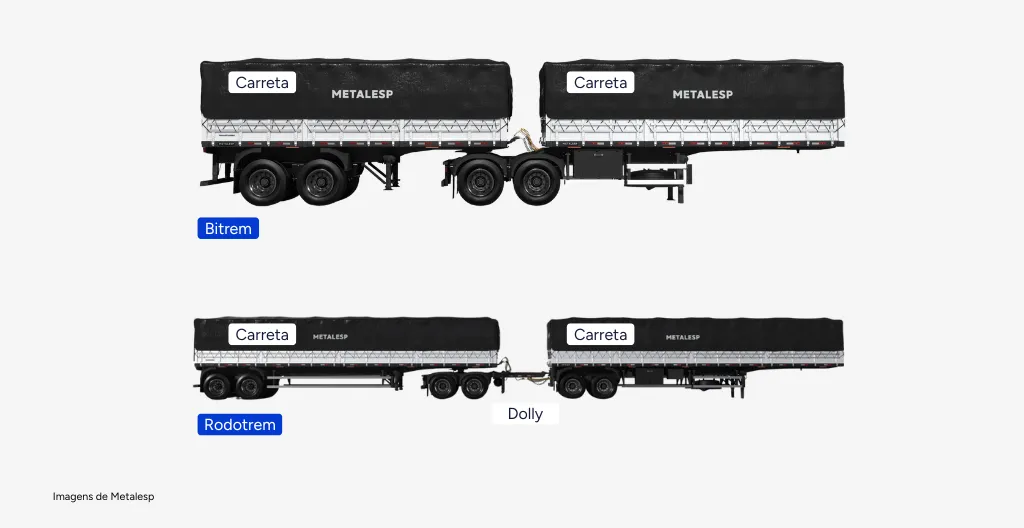
The choice between rodotrem and bitrem depends directly on the type of operation, the cargo transported and the routes used.
The main difference lies in the coupling between the semi-trailers. In the rodotrem, the connection is made by a dolly, an implement with its own axles that links the first semi-trailer to the second. In the bitrem, the two semi-trailers are connected directly through a fifth wheel, without the need for a dolly.
This structural difference affects the length of the combination, the turning radius and the legal requirements. While some bitrens up to 19.80 meters long can run without a Special Transit Authorization (AET), the rodotrem can only circulate without an AET when it meets the applicable limits for length, weight and configuration. Outside these limits, the AET is mandatory.
Another important distinction is the load capacity. The rodotrem can reach up to 74 tonnes of PBTC, while the bitrem generally carries up to 57 tonnes. For this reason, the rodotrem is more often used in large-scale operations, such as the transport of grains, timber, ore and fuel.
In short, the bitrem is simpler to operate and requires less structure, making it ideal for medium-length routes and moderate loads. The rodotrem, on the other hand, is suited to operations with greater volume and weight, even if this involves more technical care, investment and red tape.
Why choose a rodotrem?
The rodotrem is a strategic solution for operations that require high logistics performance, especially on long-distance routes with a large volume of cargo. Its main advantage is its transport capacity, which can exceed 70 tonnes, depending on the configuration of the combination.
With two semi-trailers and the use of the dolly, the rodotrem allows a better distribution of weight per axle, which contributes to making full use of the load within the legal limits. This makes the combination ideal for sectors such as agribusiness, mining, forestry and fuel, where the volume transported directly affects the costs and the efficiency of the operation.
Besides capacity, the rodotrem also offers gains in productivity and savings. By carrying more cargo per trip, it reduces the number of trips needed, fuel consumption per useful tonne and the wear of the fleet as a whole.
However, it is important to remember that the rodotrem requires more attention to the available infrastructure, both when choosing routes and at loading and unloading points, since its length and turning radius are greater. Even so, when well planned, it proves to be one of the most advantageous combinations in road transport.
Get to know the 5 types of rodotrem and how to choose the ideal one for your operation
For each type of cargo, there is an ideal rodotrem, one that ensures safety, efficiency and the integrity of the goods. See the main models:
- Dump (or tipper) rodotrem: equipped with an enclosed tipping body, it is ideal for transporting bulk cargo, such as sand, stone, soil and other loose materials.
- Sugarcane rodotrem: it has a taller, protected structure, designed especially for transporting sugarcane, ensuring the cargo is protected during the journey.
- Grain rodotrem: with an enclosed body, it is suited to transporting grains, soil inputs and fertilizers, and is widely used in agribusiness.
- Tank rodotrem: fitted with specific tanks for transporting liquids, such as fuels, chemical raw materials and other liquid cargo, requiring special attention to safety and regulations.
- Sider rodotrem: equipped with an enclosed body with side doors, ideal for palletized cargo and goods that need protection against the weather, making fast loading and unloading easier.
How to choose the ideal rodotrem for your operation
To define the ideal rodotrem, consider three main factors:
- Type of cargo transported: liquid cargo calls for specialized tank rodotrens; grains and bulk products call for grain models; dry and palletized cargo benefits from enclosed or open models.
- Capacity and legislation: evaluate the volume and weight of the cargo and whether the combination will be able to run within the legal limits without an AET or will need a special authorization. Rodotrens with fewer axles, a lower PBTC or a shorter length may have more flexibility, as long as they also respect the CMT of the towing unit and the other applicable limits.
- Routes and infrastructure: road conditions, access for loading and unloading, and local restrictions influence the choice. A longer rodotrem requires planning for maneuvers and for traveling on urban or narrow roads.
In addition, take into account acquisition, maintenance, fuel consumption and fleet wear costs. Analyzing operational indicators, such as cost per kilometer (CPK), helps align the choice of rodotrem with the company's goal: increasing load capacity, with safety and efficiency.
How do you ensure the fleet's rodotrens perform well?
Ensuring high performance with rodotrens goes far beyond choosing the ideal model. It is essential to keep the operation under control, with preventive maintenance, attention to costs and strategic use of data.
See some good practices to optimize the performance of your rodotrem fleet:
1. Carry out periodic and standardized inspections
Rodotrens operate with a greater volume of cargo and require extra attention to items such as brakes, suspension, tires, the dolly, coupling systems and lighting. Standardizing these inspections — with digital checklists, for example — helps prevent failures and increases safety on the road.
2. Manage tires efficiently
Because of the greater number of axles and the weight carried, rodotrens have an even greater impact on tire costs. Keeping a record of wear, pressure, replacements and retreads is essential to keep the CPK under control and ensure a safe, economical operation.
3. Train drivers constantly
Rodotrens require more careful maneuvers, mainly because of their length and turning radius. Inappropriate driving can compromise not only consumption and component wear, but also the stability of the cargo. Training drivers reduces risks and improves the combination's performance.
4. Use data to guide fleet management
Indicators such as consumption per tonne transported, downtime, cost per kilometer, performance by route and mechanical failures help identify bottlenecks and opportunities for improvement. Fleet management technology solutions are great allies in this process.
Want to make sure the tractor units of your rodotrens are always in good condition? Download the free tractor unit checklist now (in Portuguese) and start doing more complete, faster and standardized inspections today.
Frequently asked questions
What is the difference between a rodotrem and a bitrem?
How much does a rodotrem cost?
Does a rodotrem need an AET to circulate?
How much can a rodotrem carry?
What are the types of rodotrem and how do you choose one?
How do you keep rodotrens in the fleet performing well?
// newsletter
Fleet management content, straight to your inbox
Articles on tires, maintenance and fleet operations. No spam.