Truck load capacity: table and calculation
 Jean Zart 11 min read
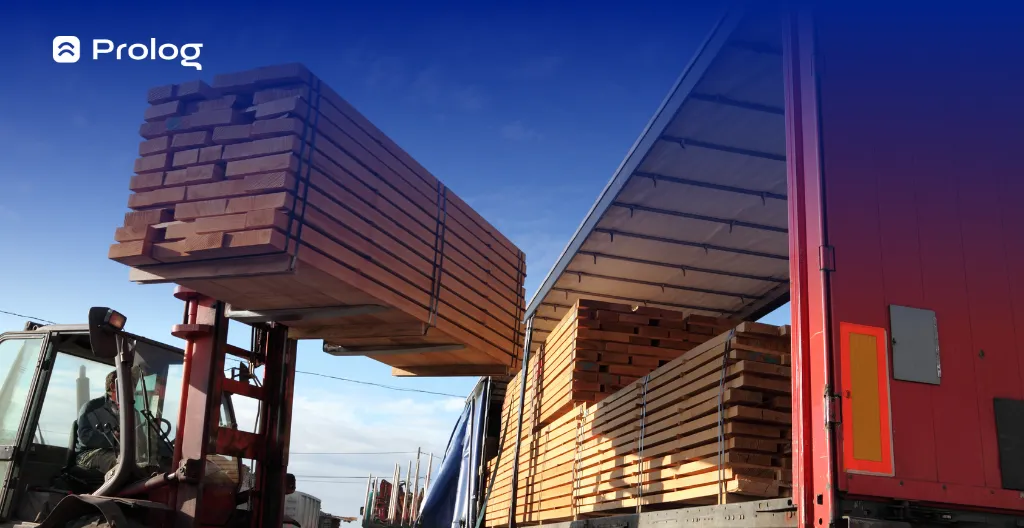
Picture this scenario: your operation needs to transport an urgent load, but when you check the data, you realize it exceeds the capacity of the available truck. The result? The delivery is delayed, the customer is dissatisfied and operating costs go up — whether because you need to reroute vehicles, request a special escort or even deal with citations for excess weight.
Situations like this are more common than they seem. Many fleet managers still face challenges when it comes to correctly calculating vehicles' load capacity and distributing weight safely and efficiently. And that is exactly why consulting a reliable truck load capacity table can make all the difference.
After all, ignoring load limits compromises the operation, speeds up truck wear and puts road safety at risk — on top of bringing operational and legal losses.
In this complete guide, you will learn:
- So, what is load capacity?
- How do you calculate the load capacity of your fleet's trucks?
- What is the maximum load heavy trucks can carry?
- How do you distribute the load correctly on trucks?
- The impact of load capacity on the useful life of fleet vehicles
- How do you extend the useful life of your fleet's trucks?
So, what is load capacity?
Load capacity is the maximum weight a vehicle can carry safely, without compromising its structure, its performance or traffic legislation. It takes into account both the payload (the weight of the goods and, under the legal rule on rated load, also the driver and passengers where applicable) and the total permitted weight (which includes the vehicle itself, the fuel, the driver and other components).
This figure is set by the vehicle manufacturer and, in Brazil, regulated by bodies such as CONTRAN (the National Traffic Council) and SENATRAN (the National Traffic Secretariat). Exceeding this limit leads to traffic fines, vehicle detention and — most importantly — compromises the safety of everyone on the road.
Within a truck's total capacity, there are three fundamental concepts you need to understand:
- Gross Vehicle Weight (PBT, from the Portuguese Peso Bruto Total): the maximum weight the vehicle transmits to the pavement, made up of the tare weight plus the rated load.
Payload or rated load: how much is left to carry as cargo after deducting the weight of the vehicle and its components; under the legal definition, it includes the driver and passengers. - Gross Combination Weight (PBTC, from the Portuguese Peso Bruto Total Combinado): the maximum weight transmitted to the pavement by the combination of a tractor unit with its semi-trailer, or of a truck with its trailer or trailers.
- Maximum Towing Capacity (CMT, from the Portuguese Capacidade Máxima de Tração): the maximum weight the towing unit is able to pull, as indicated by the manufacturer.
According to Brazil's CONTRAN Resolution No. 882 of December 13, 2021: “No vehicle or combination of vehicles may travel with a Gross Vehicle Weight (PBT), Gross Combination Weight (PBTC) or weight transmitted per axle greater than that set by the manufacturer, nor exceed the Maximum Towing Capacity (CMT) of the towing unit.”
In other words, knowing exactly what each vehicle's capacity is in freight transport is essential to avoid excess weight, plan routes better and distribute volumes more efficiently.
How do you calculate the load capacity of your fleet's trucks?
Correctly calculating the load capacity of each vehicle has to be part of the routine of the operation. It helps avoid unpleasant surprises, extra costs and dissatisfied customers. But don't worry! The calculation is relatively simple, although it requires attention to the manufacturer's technical data and to the type of vehicle used.
The formulas are:
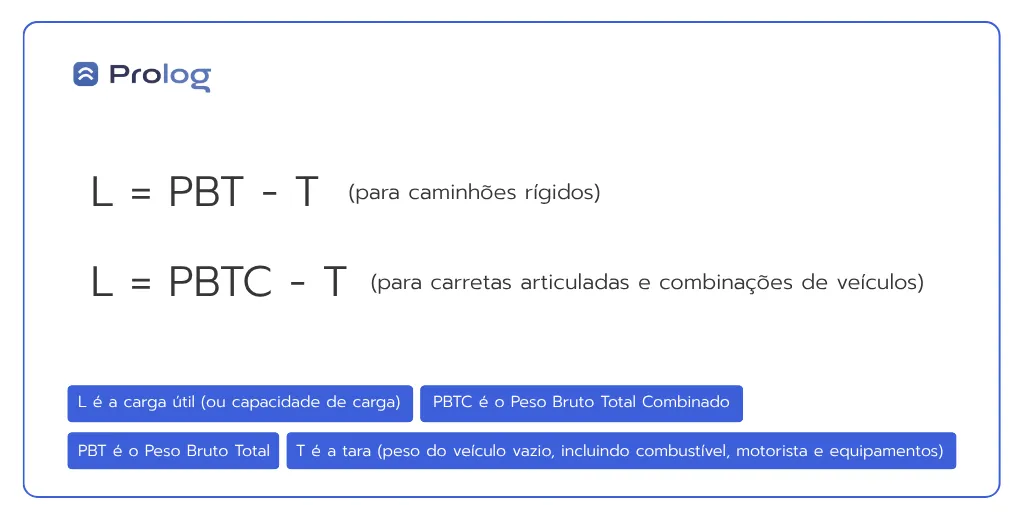
Here is a practical example:
- Tare weight: 5,500 kg
- PBT: 16,000 kg
Applying the formula: L = 16,000 – 5,500 = 10,500 kg
In other words, this truck's payload capacity is 10.5 tonnes.
For semi-trailers and vehicle combinations, use the PBTC as the reference, considering the tractor unit + semi-trailer or truck + trailers combination. In Combination Vehicles for Cargo Transport (CVC, the Brazilian acronym), the reference is the combination formed by the towing vehicle and the coupled units.
Important: PBT, PBTC and CMT limits are set by the manufacturer and must be respected, as required by CONTRAN Resolution No. 882/2021. When more than one limit applies to the operation, the lowest of them must be observed as the regulatory limit. Exceeding these values can lead to traffic fines, compromise safety and speed up fleet wear.
How do you factor payload into transport management?
In practice, factoring payload into transport management means making decisions based on the actual weight of the load that will be moved. This goes beyond knowing the type of goods: it means understanding how much they weigh and how that weight affects vehicle occupancy, performance on routes, fuel consumption and even fleet wear.
When the weight of the load exceeds the truck's payload capacity, you may face:
- Risk of accidents and mechanical failures;
- Penalties for excess weight;
- Greater wear on components such as tires and brakes;
- Higher fuel consumption and operating costs.
On the other hand, when the vehicle runs well below its payload capacity, it is important to analyze the context. In some cases, such as transporting bulky or sensitive loads or loads with a specific delivery window, this choice is strategic. But if it happens frequently without an operational justification, it may point to opportunities for logistics optimization, such as load consolidation or resizing the fleet.
That is why the weight of the load needs to be considered in decisions such as:
- Choosing the type of truck or vehicle combination;
- Route planning and shipment scheduling;
- Consolidating orders to make better use of available capacity.
Balancing the use of payload means reducing costs, preserving the fleet and keeping the operation efficient.
What is the maximum load heavy trucks can carry?
(video in Portuguese)
A vehicle's maximum load capacity depends on its type, the truck's number of axles and the configuration of the combination (truck, trailer or semi-trailer). These limits are set by the manufacturer and, in Brazil, regulated by CONTRAN Resolution No. 882/2021, which establishes the PBT and PBTC values permitted by law.
Under Article 6 of the resolution, the main limits are:
- Non-articulated vehicle (PBT): up to 29 tonnes;
- Combination with trailer/semi-trailer (except trucks): up to 39.5 tonnes;
- Tractor unit + semi-trailer (shorter than 16 m): up to 45 tonnes of PBTC;
- Tractor unit + semi-trailer with triple tandem axles (over 16 m): up to 54.5 tonnes;
- Tractor unit + semi-trailer with spread axles (≥16 m): up to 54.5 tonnes;
- Tractor unit + semi-trailer with 4 axles (≥17.5 m): up to 58.5 tonnes;
- Truck + trailer (shorter than 17.5 m): up to 45 tonnes of PBTC;
- Truck + trailer (≥17.5 m): up to 57 tonnes of PBTC;
- CVC (combinations with more than 2 units and <17.5 m): up to 45 tonnes;
- CVC with up to 7 axles, between 17.5 and 19.8 m and tractor-unit traction: up to 57 tonnes.
These legal limits refer to the total transmitted to the pavement. They are not “capacity per axle” and need to be compared with the vehicle's documentation, with the per-axle limit and with the CMT; when the limits differ, the lowest of them applies as the regulatory limit.
These parameters serve as a basis for sizing the operation and for avoiding citations for excess weight. In the next section, you will find a practical table with the main types of trucks, their average lengths and approximate capacity references.
Check the average truck load capacity table
Below is the load capacity table with the main types of vehicles used in road freight transport, with their respective average lengths and approximate capacities. Use the table as an initial reference for PBT, PBTC or payload, depending on the vehicle configuration; do not treat the total values of combinations, such as a semi-trailer rig or a bitrem (B-double), as the limit of a single axle.
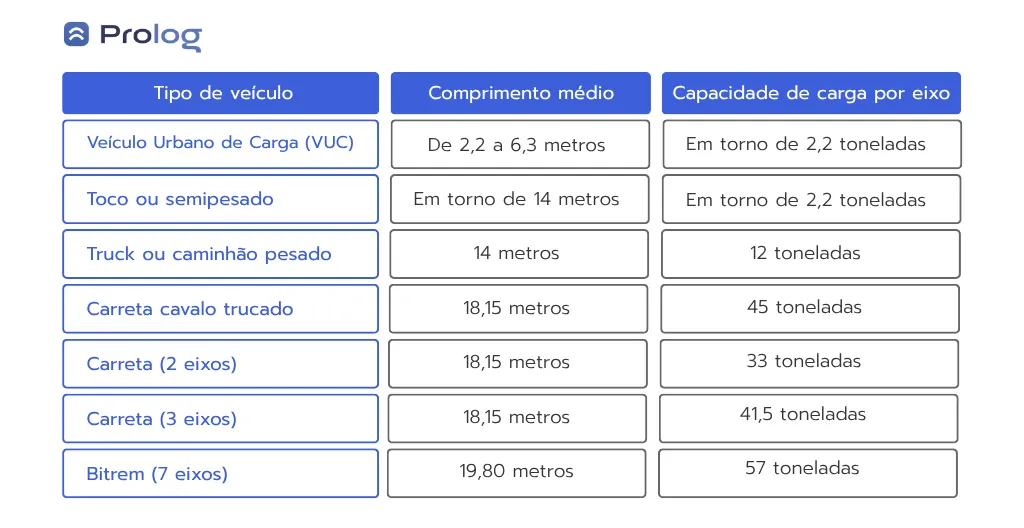
In practice, reading the table correctly avoids the most common confusion: a semi-trailer rig with a reference of 45 tonnes or a CVC with a reference of 57 tonnes refers to the combination and the total weight permitted in that configuration, not to a “capacity per axle”. For the operation, this means checking three layers before loading: the limit of the vehicle or combination, the weight distribution per axle and the capacity set by the manufacturer.
How do you distribute the load correctly on trucks?
Distributing the load correctly inside the truck is as important as respecting the total weight capacity. Even if the vehicle is within the permitted PBT or PBTC limit, a poorly distributed load can cause serious operational and safety problems.
Why does this matter?
When the weight is not well distributed:
- The truck's stability is compromised, especially in curves or sudden braking;
- There is overload on specific axles, which speeds up wear on tires and suspension components;
- Braking becomes less effective;
- Steering loses precision and the risk of rollover increases;
- There may be a citation for excess weight per axle, even with the PBT within the permitted limit.
Best practices for distributing the load correctly:
- Follow the load plan defined for the vehicle type: some trucks were designed to carry weight more concentrated at the rear, others require a more balanced distribution between axles.
- Redistribute the load at each drop-off: this makes balancing easier, as well as unloading at each stop.
- Avoid gaps and spaces between loads that could cause shifting during the trip — this compromises the distribution of forces and raises the risk of an accident.
- Use straps, chocks and other tie-down accessories to keep the load secured during transport.
- For indivisible or high-volume loads, it is essential to consult the company's traffic engineering team and, if necessary, request a Special Transit Authorization (AET, from the Portuguese Autorização Especial de Trânsito).
In Brazil, the AET is the document issued by DNIT (the National Department of Transport Infrastructure) for a vehicle or combination of vehicles used in freight transport that does not fall within the weight and dimension limits established by CONTRAN, according to the rule that applies to the transit of this type of load.
Distributing the load well does not just mean “fitting in everything that fits”, but thinking strategically about weight, risks and the integrity of the fleet and the road.
The impact of load capacity on the useful life of fleet vehicles
Respecting load capacity limits goes far beyond complying with legislation: it is about preserving the integrity of the fleet and ensuring maximum operational performance at the lowest possible cost. When a vehicle constantly runs above its payload, the consequences show up quickly — especially in tires and maintenance.
Tires: premature wear and a higher risk of failure
When the load exceeds the recommended limit, the excess weight increases the deformation of truck tires, creating more friction with the ground and accelerating tread wear. This significantly reduces the useful life of tires and raises the risk of:
- Casing bursts at high temperatures;
- Reduced retreadability;
- Higher fuel consumption due to greater rolling resistance.
According to the CNT (Brazil's National Transport Confederation), excess weight also damages roads and can reduce the useful life of poorly maintained highways by 30% to 70% — a direct reflection of overloading on truck axles.
Mechanical system and maintenance
Suspension, brakes, clutch and bearings suffer when the load exceeds the ideal limits. The extra strain speeds up parts wear, demands more from the engine when picking up speed and compromises the vehicle's structure over time.
The impacts include:
- More frequent breakdowns and unexpected failures;
- Higher costs for parts and labor;
- Loss of fleet availability due to unscheduled downtime.
Maintenance management in fleets is also a smart strategy for reducing costs, increasing safety and extending the useful life of fleet assets.
How do you extend the useful life of your fleet's trucks?
If you want to get maximum performance from the fleet and keep vehicles running longer, you need to look at fleet management as a whole — and that starts with well-defined processes, data control and well-grounded technical decisions.
The first step toward efficient fleet management is to structure a preventive maintenance plan and adopt tools that give you real control over your tires. When you keep an eye on indicators such as mileage driven, wear patterns, consumption and damage, you avoid surprises and keep trucks on the road longer — and less time stopped at the mechanic's shop.
But the fleet's useful life does not depend on maintenance alone. It is also linked to how well you respect the load capacity of each vehicle, distribute weight correctly and make decisions based on data rather than routine. When these points line up, the result shows on the bottom line: lower costs, more availability and operational safety.
If you want to understand how to do this in a structured and practical way, based on data and processes that work in the day-to-day of people who work in freight transport, it is worth going deeper.
Download Prolog's free Fleet Management e-book (in Portuguese) and start applying right now the strategies that will give your fleet a longer useful life.
Frequently asked questions
How do you calculate a truck's load capacity?
What is the difference between PBT, payload, PBTC and CMT?
What is the maximum load allowed by law in Brazil?
Why does load distribution matter as much as total weight?
How do you distribute the load correctly on a truck?
What does excess weight do to tires and maintenance?
// newsletter
Fleet management content, straight to your inbox
Articles on tires, maintenance and fleet operations. No spam.