
Fleet maintenance ROI: formula and metrics
 Luiz Felipe 4 min read

The concept of Return on Investment is widely known and used in any company's financial area. Now, ROI in maintenance management is starting to be understood, given the high investments being made in this fleet department.
As fleets recognize the importance of maintaining their vehicles efficiently, analyzing ROI in maintenance management becomes a tool for evaluating investment effectiveness and turning expenses into opportunities for savings and profit.
Here is a closer look:
- What ROI is in fleet maintenance management;
- Why identifying ROI in maintenance management is important;
- How to calculate ROI for this department;
- How to demonstrate ROI in fleet maintenance management;
- Which metrics help explain ROI;
- How to maximize your fleet's ROI in the maintenance department.
What is ROI in fleet maintenance management?
ROI, or Return on Investment, is an indicator widely used to evaluate the return provided by an investment made by a company. It measures the recovery of the amount invested and also highlights the ability to generate profits.
In fleet maintenance management, ROI helps determine whether investments in new vehicles, processes and tools are actually generating positive results.
Why is identifying ROI in maintenance management important?
ROI plays a fundamental role in fleet maintenance management for several reasons. First, it offers a clear view of the value being obtained from maintenance investments.
This helps the company understand whether resources directed toward maintenance processes are being used efficiently or whether there is room for optimization.
Thus, identifying ROI in maintenance management makes it possible to make informed decisions about allocating new resources.
In addition, if a given investment is not generating a positive ROI, this may indicate a need for adjustments or a search for more effective alternatives.
Want to see this in your fleet? Talk to a Prolog specialist
How do you calculate ROI in maintenance management?
The ROI calculation in maintenance management is what will be used to evaluate the performance of investments in this area. The formula involves subtracting cost from total gains (revenue) and dividing that result by the initial cost.
Finally, multiply everything by 100 and you will have the investment's rate of return.
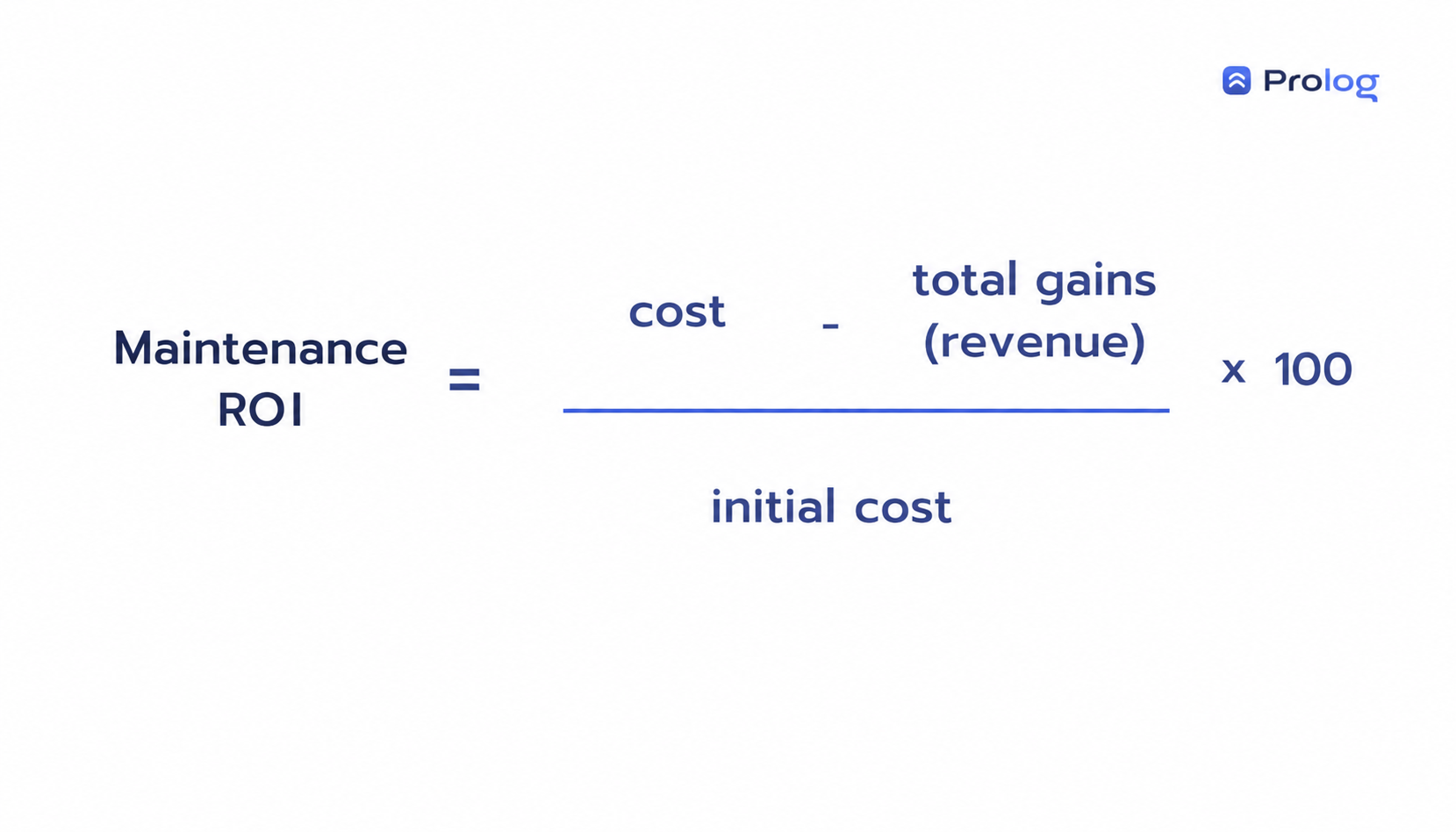
Although the formula itself is simple, data accuracy is essential for obtaining reliable results.
Make sure all costs and revenues are properly documented, as this will contribute to a deeper and more accurate understanding of how maintenance management works in your fleet.
After all, ROI is a valuable tool for measuring the financial impact of maintenance decisions and strategies and should be calculated accurately.
How can ROI in maintenance management be demonstrated?
Demonstrating ROI in maintenance management is a fundamental step in showing the value of maintenance initiatives to the company.
One effective way to do this is through data analysis and specific metrics.
For example, by keeping track of performance indicators (KPIs) such as reduced maintenance costs, increased vehicle useful life, fewer unscheduled stops and improved operational efficiency, you can establish clear connections between maintenance investments and the results obtained.
In addition, comparing data from before and after maintenance strategies were implemented can highlight the financial benefits achieved.
By gathering this evidence, you will have what you need to demonstrate ROI and show how maintenance management is contributing to the financial success of the fleet and even the company as a whole.
Which metrics help explain ROI?
Maintenance costs
Keeping track of direct and indirect maintenance costs, including parts left in inventory, labor, equipment and materials, is essential. A reduction in these costs is a positive ROI indicator.
Unscheduled downtime
Measuring the time fleet vehicles are unavailable due to unscheduled breakdowns can help quantify the negative financial impacts. Reducing this time is an important objective.
Asset useful life
Increasing fleet vehicles' useful life can result in significant savings by avoiding the need for replacement before the asset's full life cycle has been used.
Fleet availability
This index measures the percentage of vehicles available for operations at any moment. Increasing it shows improvements in maintenance efficiency.
Maintenance indicators
Using maintenance-specific KPIs, such as mean time between failures (MTBF) and mean time to repair (MTTR), helps evaluate the performance of maintenance processes and their financial impact.
How can you maximize fleet ROI in the maintenance department?
To maximize ROI in fleet maintenance management, you need to adopt a strategic, data-driven approach.
To do so, you should invest in monitoring and maintenance technologies that offer real-time visibility into vehicle performance.
This allows early problem identification and the implementation of corrective actions before problems become more serious.
In addition, training the maintenance team and drivers also contributes to maximizing ROI, since knowledge and awareness can result in more efficient vehicle use and faster problem identification and correction.
By keeping close track of the impact of maintenance strategies, it is possible to make adjustments to maximize ROI in maintenance management over time. The constant pursuit of efficiency and improvement is the key to positive results in your operation.
Ready to maximize your fleet's ROI? Enroll in our Fleet Maintenance Management course now (in Portuguese) and start turning your investments into solid results!
Frequently asked questions
What is ROI in fleet maintenance management?
How do you calculate maintenance ROI?
Why keep track of fleet maintenance ROI?
Which metrics help explain maintenance ROI?
How can maintenance management ROI be demonstrated?
How can fleet maintenance ROI be maximized?
// newsletter
Fleet management content, straight to your inbox
Articles on tires, maintenance and fleet operations. No spam.


