Fleet maintenance management: a complete guide
 Jade Zart 12 min read
Maintenance management is an area of fleet control whose goal is to ensure vehicles work properly.
It is not just about carrying out repairs when an asset has a defect, but actually controlling preventive and corrective maintenance, using collected information to optimize processes and have efficient vehicles with high durability and performance.
By ensuring ideal conditions for vehicle use, you can also reduce operating costs and increase safety in operations.
Explore below:
What is maintenance management?
Maintenance management is an area of asset management directly linked to a set of actions focused on preserving a company's equipment. For carriers and vehicle fleets, maintenance concerns vehicles.
The goal of this management is to ensure vehicles have ideal driving conditions, with few or no failures, savings in fuel consumption and greater safety on the road.
Without control that pays attention to and provides the care needed to keep vehicles running, there is a risk of major losses in the workflow.
In these cases, the consequence would be not only delays in service delivery, but also a compromised relationship with customers and even employees themselves.
FREE DEMONSTRATION
Simpler, faster and more organized maintenance management for your fleet
What are the importance and benefits of maintenance management?
Maintenance management's function is to make vehicles work correctly and at their best performance. This brings several noticeable benefits, such as:
- Lower fuel consumption: well-maintained vehicles tend to use fuel more efficiently.
- Reduced operating costs: it minimizes costs from unexpected repairs and parts replacements, contributing to overall long-term savings.
- Greater team productivity: with less time spent on unscheduled repairs and maintenance, teams can focus more on their core activities, increasing productivity.
- Better road performance: regular maintenance ensures vehicles operate at peak performance, which is crucial to meeting schedules and keeping customers satisfied.
- Reduced accident risk: preventive maintenance lowers the likelihood of mechanical failures that can lead to serious accidents.
- Ensuring transport safety: keeping vehicles in ideal condition is fundamental to the safety of operators and the cargo transported.
Maintenance management can influence the entire supply chain, as it affects distribution flow and deadline delays.
Another point about the importance of maintenance management is that vehicles quickly lose value without proper care.
In this case, maintenance management is a way to avoid wasting the investment in acquiring the fleet and even a way to ensure a resale value later.
What are the types of maintenance in a fleet?
The main maintenance types include:
Preventive maintenance
Usually applied to vehicles that have more failures and require closer control.
This maintenance is carried out according to a predefined schedule, based on regular time or mileage intervals, to minimize the likelihood of failures.
Predictive maintenance
It constantly monitors vehicle performance and condition to anticipate and identify the source of issues as far in advance as possible.
This maintenance type works well for vehicles with less predictable failures, using data analysis and technologies such as IoT and sensors to predict issues before they occur.
Corrective maintenance
It uses practices to correct failures or defects identified in vehicles. To avoid excessive costs, it should be carried out with as much planning as possible, often as a result of discoveries during preventive or predictive maintenance.
Autonomous maintenance
It allows vehicle operators to perform regular inspections and simple maintenance interventions, such as cleaning and lubrication, based on appropriate training.
This maintenance type involves the teams using the vehicles, making them jointly responsible for daily maintenance.
Total productive maintenance (TPM)
A method that aims to involve every part of the organization in maintenance, from management to operational employees. Its goal is to maximize equipment and vehicle effectiveness, reducing downtime and increasing productivity.
Data-driven maintenance
It uses large amounts of data collected by telemetry systems and other monitoring devices to analyze and improve maintenance practices.
This includes identifying trends, predicting future maintenance needs and optimizing the maintenance schedule based on usage patterns and actual performance.
Condition-based maintenance
Similar to predictive maintenance, but focused specifically on performing maintenance based on vehicles' current condition, identified through inspections and continuous monitoring.
This approach seeks more precise and less frequent interventions, depending on the equipment's actual condition.
Intelligent maintenance
It uses advanced technologies such as artificial intelligence (AI) and machine learning to provide a more accurate and efficient approach to maintenance.
It can predict failures before they occur and recommend specific maintenance actions, thereby improving vehicle efficiency and useful life.
How do you implement maintenance management in the fleet?
To implement maintenance management in your fleet, you need to create a maintenance plan (PCM). In it, you will:
- Identify the operation's vehicles;
- Define budgets for parts and maintenance service costs;
- Build the schedule for maintenance routines and services;
- Determine vehicles' current condition and expected fleet renewal.
In addition, implementing maintenance management requires a clear policy defining the maintenance types and recommended frequencies for each vehicle type.
Choosing maintenance management tools and software that integrate well with other systems used by the company and meet your specific needs must also be a step in planning and implementation.
Then, you need to take care to train your team in the defined processes, the use of subscribed platforms and even the importance of maintenance management for the fleet.
It is also important to determine performance indicators to assess this management and be adaptable in adjusting routines and processes, always seeking the best results.
Who is responsible for maintenance management?
The person primarily responsible is the maintenance manager. They handle management activities, organizing the team's routine, making improvement decisions and analyzing indicators, as well as looking after the team and delegating tasks.
Meanwhile, the fleet manager also plays a part in the maintenance department.
They can either be primarily responsible, if the company does not yet have a dedicated role, or act as a “decision-maker,” with the maintenance manager bringing data, reports and analyses to them for approval or revalidation.
There is also the fleet analyst, responsible for handling vehicle maintenance data collection, organizing it coherently and generating reports to help managers make decisions.
Drivers, as the people responsible for driving vehicles, have their role in maintenance management. Their responsibility is to drive carefully, following best practices and maintaining defensive driving behavior.
This helps preserve vehicles longer and reduce corrective service costs.
Speaking of services, the others responsible for fleet maintenance are the maintenance suppliers and/or the fleet's in-house workshop. Both perform various services on vehicles, from in-depth inspections and parts replacements to more difficult repairs.
Main challenges of maintenance management
Maintenance management challenges range from department organization to data analysis. You need to learn a little more about each to understand which affect your operation:
- Lack of department organization
Disorganized maintenance management can lead to redundant processes, delays in necessary maintenance and difficulty prioritizing urgent tasks, directly affecting fleet productivity.
- Defining a maintenance plan
Establishing a maintenance plan is fundamental to anticipating and scheduling preventive and corrective interventions, ensuring maximum vehicle availability and minimizing unexpected downtime.
- Too many manual processes
Dependence on manual processes increases the risk of errors and inefficiencies, making it harder to keep track of important information and optimize maintenance activities.
- Parts stock and inventory management
Maintaining control over parts inventory helps avoid maintenance delays. Challenges include demand forecasting and managing obsolete or excess parts.
- Team training
Investing in training and skills development helps maintain service quality and best practices in vehicle use. Challenges here may include adapting to new technologies.
- Low vehicle durability
A lack of clear maintenance indicators or data for analysis ends up harming the planning of servicing and preventive work.
This leads the vehicle to undergo more corrective services and affects its durability, challenging maintenance management to find solutions that extend assets' useful life.
- Unplanned or unscheduled maintenance
Unplanned interventions can result in high costs, making it a challenge to keep the budget under control and maintain good vehicle availability.
- High maintenance costs
Managing and reducing maintenance costs without compromising quality is an ongoing challenge, involving negotiating with suppliers and choosing parts and services that offer the best return on investment.
Alongside, of course, carrying out maintenance management and identifying improvement opportunities, whether by promoting driving awareness, renewing the fleet or increasing the frequency of preventive vehicle inspections.
- Low parts quality
Using low-quality parts can result in recurring failures and more maintenance. Selecting reliable suppliers and checking parts quality are important steps in facing this challenge.
- Acquiring management tools
Choosing the right maintenance management tools can be challenging, especially with technology constantly evolving.
So focus on finding specific solutions to resolve your operation's issues and demands, and make sure they integrate easily with solutions already in use.
- Sustainability and ESG practices
Integrating sustainable practices and adhering to ESG principles can be complex, especially in choosing vehicles, parts and products, as well as processes, that reduce environmental impact without compromising efficiency.
- Concrete data analysis
With data becoming increasingly available, analyzing it to improve decision-making and optimize maintenance management also becomes a challenge.
Centralizing and interpreting it requires effort and dedication, but this can be resolved by applying technologies that automate the task.
Which tools should you use for maintenance management?
Different tools can help your maintenance management and, although prioritizing technologies and automation matters, methodologies and manual tools can also be useful.
PDCA cycle
The PDCA (Plan-Do-Check-Act) cycle is a process management methodology that helps continuously improve operations and resolve issues.
In maintenance management, it can be used to plan maintenance, carry it out, check results and act on lessons learned to optimize future interventions.
5W2H method
The 5W2H method is a planning tool that answers seven fundamental questions: What (What will be done?), Why (Why will it be done?), Where (Where will it be done?), When (When?), Who (By whom?), How (How will it be done?) and How much (How much will it cost?).
In maintenance management, it is useful for clearly defining maintenance actions, ensuring every aspect is considered before taking action.
Control spreadsheet
Spreadsheets are versatile maintenance control tools, allowing you to keep track of servicing, costs and the status of each fleet vehicle.
Although more basic, spreadsheets are accessible and can be customized to meet the fleet's specific needs, making them a great option for smaller fleets or as support for simpler systems.
Electronic Checklist
This is a digital tool where different checklist templates are created for inspecting fleet vehicles. Lists can be customized by vehicle, inspected items or frequency of completion.
You can also have all these types available, since templates are saved on the platform and freely accessible to users.
What you need to do is plan which checklists should be completed and when.
Then inform drivers, so they complete the checklist and feed the system the necessary information.
With constant checklist use, reports and charts will be generated automatically so you can identify which vehicles have the most issues, what the main issue is, which driver generates the most occurrences, and so on.
In addition, the electronic checklist system has a feature to view vehicle health, marking vehicles with open work orders as “critical” and preventing them from departing on trips.
Maintenance management system
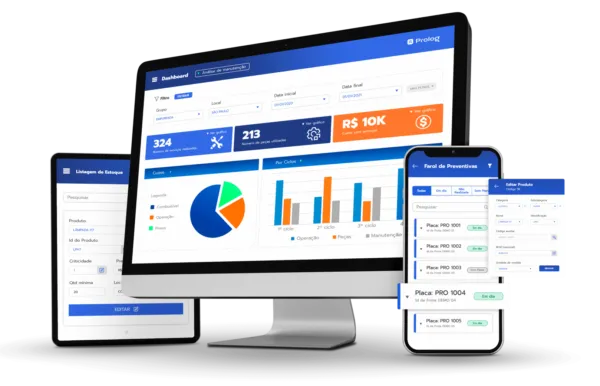
The maintenance management system, besides having the checklist itself as one of its complements, provides visibility into maintenance as a whole. Its screens include control of fleet parts inventory and workshop service costs.
In many cases, this type of system also has partnerships with suppliers and workshops, allowing quote comparisons through the platform so you can hire them for your company.
For those seeking efficient, precise control, it is an essential system to acquire for the fleet.
Maintenance indicators
Maintenance indicators are used to measure information that helps identify issues and determine precise solutions. MTBF, Mean Time Between Failures, helps identify how long a vehicle runs before needing another corrective service.
The unavailability rate shows how long the vehicle was inactive in operations, unavailable to run because of a more serious maintenance issue.
Other indicators widely used in maintenance management are: MTTR (Mean Time to Repair), asset reliability and maintenance cost over replacement value (CPMV).
How do you assess maintenance management results?
Maintenance management results are assessed through metrics and performance indicators, such as maintenance costs and asset availability.
However, you can go further and invest in an even more complete approach. For example, you can measure the time from when maintenance is requested to its completion, as an indication of operational efficiency.
Analyzing maintenance cost per kilometer driven helps you better understand maintenance practices' effectiveness from a cost-benefit perspective.
Another idea is to collect driver feedback, which can provide important data about how maintenance is affecting daily vehicle use. If satisfaction is high, maintenance is (probably) up to date.
The role of technology in maintenance management
Technology in maintenance management offers tools that increase the efficiency, accuracy and reliability of maintenance processes. This makes early issue identification easier and reduces corrective maintenance and vehicle downtime.
Technology also helps automate repetitive tasks, organize maintenance information and improve data-based decision-making, resulting in reduced operating costs and increased vehicle useful life.
Trends in fleet vehicle maintenance management
Trends in maintenance management for fleet vehicles highlight the growing role of digitalization and automation, which simplify processes by integrating management systems with other platforms.
Adoption of Internet of Things (IoT) technologies and telemetry is expanding, enabling real-time vehicle monitoring and collection of precise data about performance and operating conditions.
This facilitates the implementation of predictive maintenance, which uses algorithms and data analysis to predict failures before they occur, optimizing vehicle operating time and reducing unexpected corrective maintenance costs.
Sustainability is also growing stronger, with an increasing need to adopt practices that meet global demands to reduce environmental impacts.
To explore how Prolog can transform your fleet's maintenance management, schedule a free demonstration today.
Frequently asked questions
My workshop only fixes what breaks. How can I break this cycle?
What is the difference between preventive, predictive and corrective maintenance?
What other maintenance types exist in a fleet besides preventive, predictive and corrective?
How do you choose a fleet maintenance management tool?
Who is responsible for maintenance when the company has no maintenance manager?
How can you tell whether maintenance management is delivering results?
// newsletter
Fleet management content, straight to your inbox
Articles on tires, maintenance and fleet operations. No spam.