Vehicle checklist: 5 types and the items to check
 Jean Zart 8 min read
The vehicle checklist is one of the main allies of safety, productivity and control in freight transport fleets. Much more than a check-off list, it helps verify whether each vehicle is fit to drive — preventing failures, reducing accident risks and avoiding unnecessary losses.
Despite this, it is still common to see operations without a clear standard, relying only on visual guesswork or rushed checks. The result? Conflicting information, incomplete records and decisions based on assumptions. With a structured vehicle checklist used regularly, you reduce these risks — and strengthen fleet control.
In this post, you will learn how to use checklists strategically in your heavy vehicle fleet — from what needs to be inspected to the benefits of digitizing this process.
Explore the topics:
- What is a vehicle checklist?
- What is a vehicle checklist for?
- What should you include in a fleet vehicle inspection checklist?
- Why use electronic vehicle checklists?
- 5 advantages of Prolog's Electronic Checklist solution
What is a vehicle checklist?
A vehicle checklist is a document — physical or digital — bringing together all the items that need to be checked before or after vehicle routes. It helps you check whether trucks are in good condition to drive, with greater safety, fewer unforeseen events and much more control.
The checklist assesses points such as tires, brakes, lights, electrical systems, seat belts, documentation, mandatory items and even cab cleanliness. Most importantly, this process needs to match the realities of your operation. In Brazil, before putting a vehicle on public roads, the driver must check that the mandatory equipment is present and in good working order, as required by the Brazilian Traffic Code.
To meet the demands of different operations, there are also different types and fleet checklist templates — each with its own timing and purpose. Below are those most commonly used in transport companies' daily routines:
Departure checklist (pre-trip)
This checklist is completed before the truck leaves on its route. In Brazil, it checks the essential items for a safe, legally compliant trip: tires, headlights, turn signals, brakes, oil and water levels, tachograph, fire extinguisher, spare tire, among others.
It serves to reduce the chance of a vehicle leaving with a fault that could be detected at base.
Return checklist (post-trip)
Completed when the truck returns, this checklist records the vehicle's condition after the route. It helps identify wear, damage or problems that arose during the trip — and need to be corrected before the next departure.
Daily or routine checklist
Some fleets use the checklist daily, even when the vehicle is not going out on the highway. This is common in urban operations, which run every day with lighter vehicles or on short routes. The focus is to keep a close eye on the truck's general condition and act quickly at any sign of failure.
Safety checklist
This template focuses specifically on items that directly affect operational safety: brakes, tires, lights, steering, seat belts, fire extinguishers, airbags, among others.
It can be completed on its own or incorporated into other checklists — it all depends on the criticality of what is being transported.
Preventive maintenance checklist
More comprehensive and technical, this checklist is generally completed by mechanics or those responsible for maintenance. In this format, mechanical, structural and electrical items are assessed in greater depth — as well as helping decide which vehicles need maintenance before driving again.
What is a vehicle checklist for?
The vehicle checklist serves as a control and prevention tool within your operation. It helps verify whether vehicles are in suitable condition to drive safely, efficiently and in compliance with legal requirements in Brazil.
More than a bureaucratic process, the checklist helps you identify failures before they turn into losses. When completed correctly, it reveals problems such as bald tires, worn brakes, burned-out lights or expired documentation — before they become a road hazard or a fine at a roadside inspection.
The data shows how urgent this is: according to Brazil's Federal Highway Police (PRF), between 2011 and 2020, more than 59 thousand accidents were caused by vehicle mechanical defects — resulting in 1,399 deaths in the country.
Another alarming figure is that in 2024, large vehicles accounted for 53% of deaths on Brazilian federal highways. In other words, keeping fleet maintenance up to date is a matter of safety.
The checklist also:
- Improves fleet productivity by reducing unplanned stops
- Increases vehicles' useful life by detecting wear early
- Supports preventive maintenance by serving as a basis for work orders
- Avoids fines and penalties by keeping trucks legally compliant in Brazil
- Provides safety for drivers, who can drive with greater confidence
- Makes inventory control easier by allowing recurring demand for parts and supplies to be identified
- And helps you make decisions based on concrete data, rather than assumptions.
It is important to emphasize that if this process is not yet standardized, you are likely making decisions based on guesswork — and sooner or later, that becomes expensive.
What should you include in a fleet vehicle inspection checklist?
An efficient vehicle checklist goes far beyond taking a quick look at the truck. It needs to cover all the points that could compromise the vehicle's safety, performance or legal compliance in Brazil — including visual, structural, mechanical and documentary items.
Below are the main items that must be included in a freight transport fleet's vehicle checklist:
1. Tires
- Correct calibration
- Tread depth
- Absence of bulges, cuts or uneven wear
- Valve and cap check
2. Braking system
- Brake fluid level
- Pad and lining wear
- Pedal operation
- Parking brake response
3. Lighting and signaling
- Front and rear lights
- Tail lights and brake lights
Reverse light, license plate light and turn signals - Interior dashboard lights
4. Electrical systems
- Horn operation
- Instrument panel and warning lights
Windshield wiper and washer operation - Battery condition
5. Safety items
- Seat belt
- Fire extinguisher within its expiry date
- Warning triangle, jack and wheel wrench
6. Mandatory documentation in Brazil
- Vehicle licensing
- Driver's license valid and appropriate for the category
- Proof of mandatory inspections
- Mandatory insurance and cargo documents (where applicable)
7. General body and cab condition
- Load securing
- Doors, locks and hinges
- Rearview mirrors
- Windshield wipers and glass condition
Why use electronic vehicle checklists?
If the vehicle checklist is already essential in the fleet's routine, an electronic version takes the process to another level. You leave crumpled papers, lost spreadsheets and inaccurate records behind — and gain more reliable, organized data.
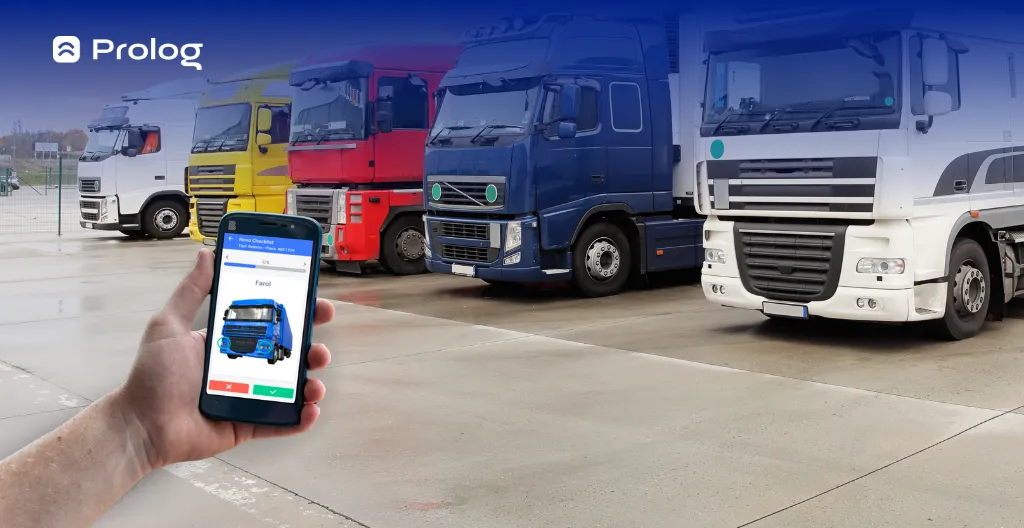
The electronic checklist for fleets allows the entire inspection to be completed directly on a phone or tablet, with information automatically sent to the management system when the checklist is finished. This helps centralize data and identify nonconformities faster.
But the benefits go far beyond convenience. Here are the main ones:
- Faster inspections: the driver or inspector completes the checklist in minutes, with guided, mandatory answers
- Process standardization: all vehicles follow the same checking procedure, avoiding errors due to forgotten items or differing interpretations
- Automatic work orders: if an item fails, the system can already notify maintenance or generate a work order.
- Full traceability: each saved checklist records the date, time, name of the person responsible and, when configured, inspection geolocation — bringing greater transparency to the history.
- Easier audits: electronic records let you quickly access any vehicle's history during a regulatory inspection or internal audit.
If your goal is more control, less paper and data-based decisions, the electronic checklist is the right path. It not only increases fleet safety and information reliability, but also frees up your team's time to focus on what really matters: keeping the operation running efficiently and profitably.
5 advantages of Prolog's Electronic Checklist solution
Far beyond digitizing the vehicle checklist, Prolog transforms this process into a strategic management tool. With a complete focus on heavy vehicle fleets and freight transport operations, the Electronic Checklist was created to resolve the main bottlenecks in your operation — with speed, control and reliable data.
Discover 5 advantages available only to those who use Prolog:
1. View vehicle availability after checklists
With the checklist traffic light, you can see which vehicles are cleared, pending or failed based on inspection records — reducing scheduling errors, departures without inspection and operational safety risks.
2. Maintenance process automation
Checklists with failed items generate automatic work orders, integrated with the Maintenance Management system. This reduces communication failures and speeds up the necessary corrections.
3. Full inspection traceability
All checklists are saved with the date, time, name of the person responsible and inspection geolocation. This ensures transparency, makes audits easier and provides greater legal certainty for your operation.
4. A customized checklist for your fleet
You can customize the forms, with mandatory fields, conditional logic, photos and comments. Everything is adapted to your fleet's realities — without complications.
5. Works even offline
Even in places without an internet connection, the app allows checklists to be completed offline. The original data is recorded when a connection is established, keeping the inspection process available for operations with an unstable signal.
With Prolog's Electronic Checklist, you eliminate paper, organize data and make decisions with much greater confidence — all in a simple, direct way connected to the realities of your operation.
Want to try it in practice? Download the Practical Checklist Kit now (in Portuguese), a 100% free resource with ready-to-use examples for your heavy vehicle fleet.
It includes two printable checklist templates + a best practices manual, so you can immediately start using them and improving your vehicle inspections. Take a look!
Frequently asked questions
What are the types of vehicle checklist?
What should be checked before the truck leaves?
Why does the vehicle checklist matter so much for safety?
What must a freight fleet checklist include?
What are the advantages of an electronic checklist over paper?
What makes Prolog's Electronic Checklist different?
// newsletter
Fleet management content, straight to your inbox
Articles on tires, maintenance and fleet operations. No spam.