
Fleet control: what it is and how to do it in 4 steps
 Luiz Felipe 10 min read

Fleet control is fundamental for a transport operation to function properly.
It is a routine that can be challenging for many reasons, such as when preparing a budget and finding ways to stay within it.
In addition, overseeing the fleet means observing and checking daily processes, seeking the best ways to improve them.
As a fleet manager, you should constantly seek to make employees' day-to-day work easier while bringing more results to the company.
So, learn more about:
- What fleet control is;
- Why efficient fleet control matters;
- The most common difficulties
- How to carry out good fleet control;
- Tips for more efficient fleet control.
What is fleet control?
It is a way of managing the fleet's routine that includes controlling vehicles and maintenance, finances and budgets, drivers and other employees, and so on. Everything involving a fleet falls within this control.
Some examples of activities include:
- Creating routes for the fleet's daily deliveries;
- Refueling management;
- Controlling tire wear;
- Approving maintenance services;
- Assessing driver performance.
Why is fleet control important?
Good fleet management ensures that the fleet operates more efficiently, reducing risks, losses and costs. Controlling operational processes is essential for strategic decision-making and making the most of the fleet's potential.
The advantages range from increased customer and employee satisfaction to increased team productivity.
Its importance also lies in the most basic reason for fleet control: organizing the processes of a transport operation.
What are the difficulties of fleet control?
Cost control and analysis
One of the biggest challenges is properly controlling the carrier's costs. This is largely due to the work of correctly identifying all company expenses.
Because it is a manual process in most companies, errors happen frequently, whether through incorrect recording or even forgetting to update an expense in a control spreadsheet.
Having help from technology is an important step toward increasing revenue and creating an effective cost reduction strategy.
It is also important to create a routine for keeping track of the data to have better control over this information.
Cost reduction
Cost reduction is another major obstacle in fleet control, and the difficulty in performing this task lies in cost analysis. If the analysis is not done well, it becomes difficult to find areas where budgets can be reduced or increased without harming fleet functioning and productivity.
Using technology in this case also makes cost analysis easier and is the best solution for making informed decisions.
Fleet maintenance
Preventive maintenance is one of the most important stages in fleet management. Through it, you prevent unexpected events during transport.
If a part is worn or about to break, the fault is corrected before it causes greater damage.
There is also predictive and corrective maintenance.
In predictive maintenance, the idea is to analyze the truck fleet's performance to discover which trucks are close to developing failures and obtain a highly accurate forecast of their useful life. Corrective maintenance corrects the failures the vehicle presents.
So, why is fleet maintenance one of the biggest difficulties?
This happens because many transport companies still do not automate their processes.
However, with the help of an electronic checklist, maintenance becomes more practical and efficient. All data are also already stored and organized within the management system.
Fuel price variations
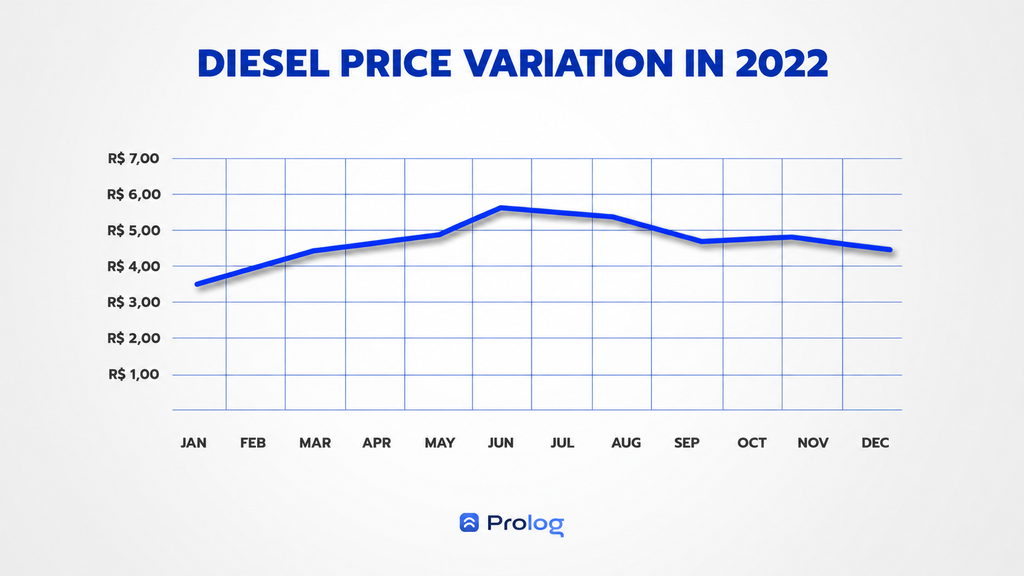
The chart above records diesel price variations in 2022 and should be read as a historical reference. For current values in Brazil, ANP (the National Agency of Petroleum, Natural Gas and Biofuels) maintains a weekly fuel price survey, which includes regular diesel and S-10 diesel.
No company can predict when fuel prices will rise or fall, which prevents setting a definitive budget for this area.
The best way to deal with this situation is to maintain a budget plan with a reserve for unexpected events. This way, even if the increase is very large, you will be prepared with some assurance.
Insecurity on the roads
Road risks can include accidents, theft, lost goods and others. We cannot predict most of them. However, we can prepare solutions through a risk management plan.
Identifying the best way to act in certain situations is fundamental so that fleet employees can make decisions that do not harm the operation.
Moreover, you should prepare training and skills development so that these contingency plans actually work.
4 steps for fleet control
1 – Diagnosis
The fleet diagnosis should be carried out using all available information. It is crucial that it be based on real data rather than assumptions.
Before starting anything, you should have a diagnosis of your fleet. This will be a way to understand what the fleet needs at the moment, as well as a document you can use later to compare the effects of your actions.
Look for information on vehicle conditions, the number of occurrences of each issue, the number of tires discarded per month, average trip time, the number of fines received in the month, those responsible for the fines and so on. Everything relevant to diagnosing current management.
2 – Planning
Based on the diagnosis, fleet planning can begin. With a view of what is currently happening in fleet control, pain points and improvements become clearer.
In other words, you know which objectives and goals to set based on what the carrier is today and what it intends to achieve in the future.
In planning, you can consider:
- Changing routine processes;
- Implementing new technologies in the fleet;
- Alternatives for cost reduction.
3 – Execution
With everything planned and budgets approved by the directors, you can start executing your plans. This is the most intuitive part of fleet control: putting everything on paper into practice.
4 – Analysis
Along the way, changes and adaptations to previously planned actions may occur. That is why metrics and indicators should be analyzed at the end of each defined period, such as monthly or quarterly.
This is the best way to see what the mistakes and successes were, allowing you to define the adjustments needed for each objective and goal initially set.
Having this analytical approach in fleet control today is essential to stand out and create effective differentiators in the market.
Tips for more efficient fleet control
Create a fleet policy
A fleet policy is a comprehensive document explaining everything related to transport operations.
It contains company rules, how to act in certain situations, a list of fleet vehicles (license plates), the ideal way to drive a vehicle, instructions on performing vehicle inspections, etc.
All fleet-related tasks will be somewhere in your policy, which will be made available to all employees. This way, you can standardize your fleet's processes.
Forecast monthly expenses
A view of how much is spent each month is what you need to create an expense forecast. To create a savings and resource optimization plan, you need a history of fleet accounts indicating the amount and purpose of each expense.
This also makes it possible to plan fleet renewal, new hires and investments in fleet technology.
If you can establish an average cost for each fleet area, the next step is to calculate the expense forecast.
With all data at hand, it is possible to identify average expenses for the coming months and plan the purchase of new vehicles, tires, hiring or whatever else the fleet needs.
Monitor and manage transport routes

Take care to select routes with fewer tolls and traffic lights.
Route planning means choosing, before trips, the paths each vehicle will take and determining the fastest route with the best conditions to the cargo's destination.
Sometimes the fastest route has a road in terrible condition; other times the road in better condition may take an extra day to reach the intended location. That is why the choice should be made carefully, analyzing all possibilities.
Keeping track of routes helps understand operational efficiency and identify planning adjustments.
One action is analyzing how many customers can be included on a route and whether “last-minute” deliveries could be added to a specific route.
It also becomes an opportunity to reduce fleet costs, whether by optimizing routes, finding shorter journeys or roads that are less damaging to vehicles.
Assess driver behavior
Road behavior influences vehicle upkeep, safety and spending on fines. Management can use inspection records, incidents, training and clear criteria to guide each driver.
Vehicle inspection data, damage, fines and incidents can indicate points that deserve discussion and guidance.
Fleet damage and fines received help analyze whether drivers are performing well and how they can improve. Remember to assess them as company employees too: good relationships are part of the job, both with colleagues and with customers.
This will be vital to understand who is acting appropriately and who needs new instructions. It also leads to the next point:
Conduct driver training
It is essential that all fleet drivers know how to practice defensive driving and the ideal care for each vehicle they drive.
Drivers should also be instructed on how best to eat during the long working hours they sometimes need to complete, medications to avoid when getting behind the wheel, etc.
These actions do not concern driving itself but are fundamental for drivers to remain attentive and focused at the wheel.
Other training includes traffic laws and care for specific products, such as chemicals, pharmaceuticals and frozen goods.
Invest in safety
Training drivers, keeping vehicles in proper condition and preparing contingency procedures are fleet control actions related to safety.
Investment therefore takes place on these different fronts.
Bringing in a specialist to prepare drivers for a possible cargo theft and defining response procedures are decisions that contribute to operational safety.
Keep vehicles and tires in good condition
Tires are essential to vehicle balancing, stability and efficiency. Calibration above or below the ideal increases the risk of accidents and rollovers, endangering the safety of the fleet and other drivers on the road.
In Brazil, keeping vehicles in good condition is also a legal requirement.
Having a fleet maintenance routine is therefore essential. The benefits are reduced asset idle time, improved road performance and more efficient fuel consumption.
Create a vehicle inventory
You should list all vehicles in your fleet and record models, license plates, year, mileage and other information collected during each vehicle's last inspection.
Knowing the vehicles and their condition is the best way to get a complete view of expenses and how to save in this area.
For example, worn tires are a reason for increased fuel consumption.
So, if one or more vehicles have tires in this condition, you need to resolve this issue to save on refueling.
Maintain a preventive maintenance schedule

Example of a fleet preventive maintenance schedule.
Yes, preventive maintenance is an expense, and you could save by avoiding this process. However, corrective maintenance is much more expensive than maintaining a preventive schedule.
By neglecting basic vehicle component checks, oil changes, filter cleaning, etc., you put the vehicle, the driver and the fleet's financial situation at risk.
With prevention up to date, you prevent vehicles from being unable to complete a route and increase operational productivity.
Analyze monthly expense reports
Everything should be included in the accounts: fuel, maintenance, tire replacement, fines, unexpected events and so on.
By bringing this information together in a central view, even using a logistics dashboard, for example, it becomes more practical to understand what is happening in the fleet and what measures you need to take.
Control fleet refueling
Fuel consumption is a fleet's biggest expense, which is why managers are so keen to find ways to save.
Instead of seeking the lowest prices, planning should focus on fuel station partnerships and optimized routes. This way, you avoid using low-quality and/or adulterated fuel.
Set fleet goals
To get the best results, you need to know what you are looking for and set goals for your fleet.
Analyze what is happening, what issues recur, the average number of monthly deliveries, etc., and create objectives and goals based on that. This is also one of the stages in fleet planning.
Use technology for fleet control
There are specific systems for different fleet stages, such as maintenance management, tire management, checklists and route planning.
When you carry out your planning and identify the fleet's pain points, you will already know which systems should receive your budget.
Want to keep learning and improving your fleet control? Download our free e-book (in Portuguese) and gain access to everything you need to generate savings, safety and productivity in transport operations.
Frequently asked questions
What is fleet control?
What are the most common difficulties in fleet control?
What are the 4 steps of fleet control?
How can you reduce costs in fleet control?
What tips help maintain efficient fleet control?
Why maintain a preventive maintenance schedule?
// newsletter
Fleet management content, straight to your inbox
Articles on tires, maintenance and fleet operations. No spam.


