What is a tachograph and what is it for in fleet management?
 Jade Zart 7 min read
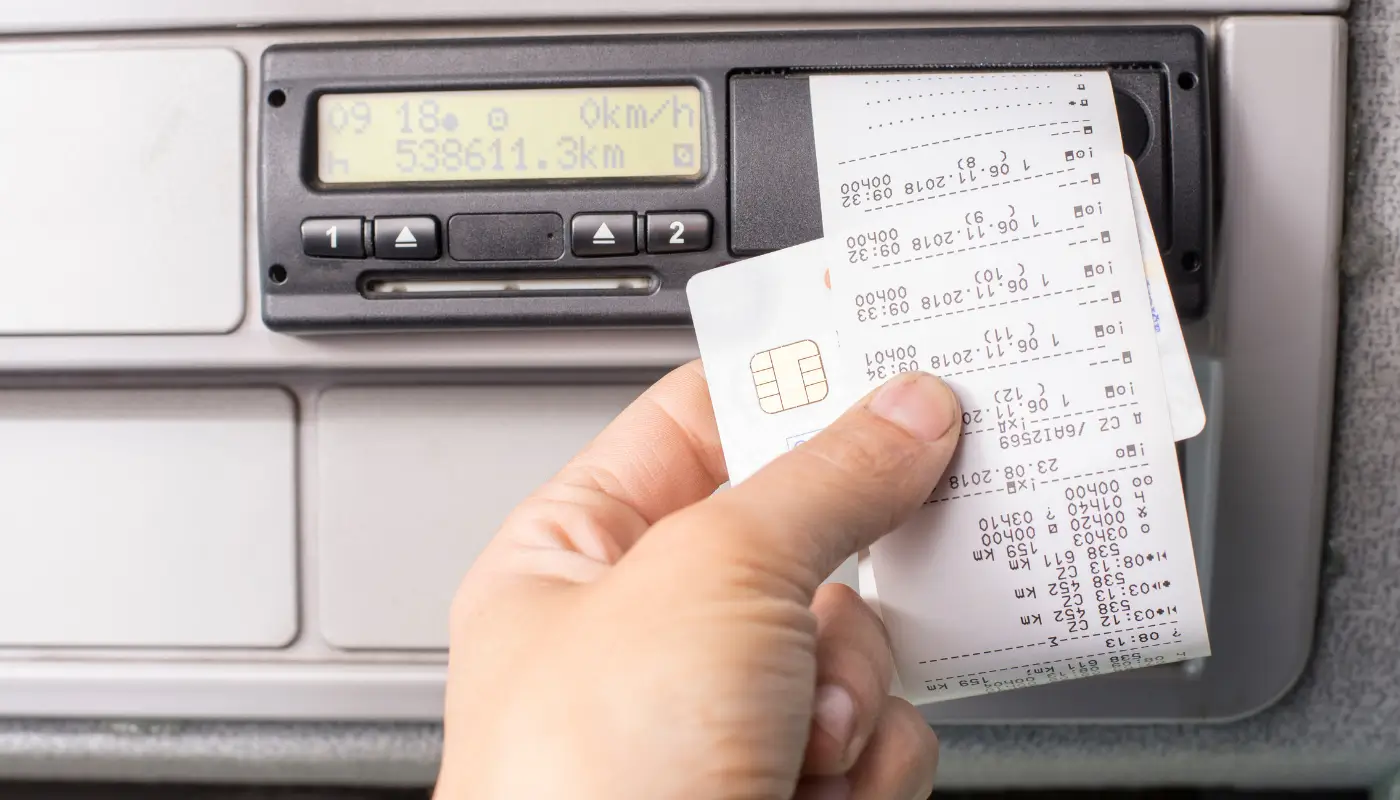
The tachograph, a device installed in transport vehicles, records data about the trips made, including speed, distance traveled and the driver's activity and rest times.
It is often compared to an airplane's black box, being an important resource for understanding what happened in the last moments before an accident. This makes it possible to understand, for example, whether the driver accelerated too much and may have been to blame for the situation.
This tool is also a way to comply with the transport legislation in force, and its use is mandatory in several types of vehicles, including trucks.
Check out more details below:
- What is a tachograph and what is it for?
- What is its importance for fleet management?
- How does a tachograph work?
- What are the types of tachograph?
- Is the tachograph mandatory?
- Who needs to use it?
- How do you choose a tachograph?
What is a tachograph and what is it for?
The tachograph, also known as a “tachograph disc” or “chronotachograph”, is a device for recording information about the performance of transport vehicles.
It documents data such as the distance traveled, speed variation and time in motion and stopped.
Depending on the tachograph model being used in the vehicles, the information may be saved for one day or for one week.
Its main purpose is to be a safety tool for fleet management.
However, it also serves to ensure compliance with transport regulations and can be consulted to help the manager identify issues in drivers' behavior and in driver working hours management.
What is the importance of the tachograph for fleet management?
By documenting drivers' behavior on the road and ensuring compliance with working hours, including assessing mandatory stop times, the tachograph allows managers to have more precise control over their operations.
Although this is not the most practical method for daily, real-time monitoring of this data, it helps to look up and confirm the most important information when necessary.
Especially in accident situations, the tachograph record is fundamental to help determine liability, showing whether or not there was inappropriate acceleration. In this way, it can even clear the driver of blame, using concrete evidence.
The benefits of using the tachograph in fleet vehicles include greater safety, fuel savings and even a reduction in fines and maintenance costs.
How does a tachograph work?
The basic operation of tachographs is the same: collecting data on the vehicle's operation and use. However, there may be variations depending on the model, analog or digital.
In general, the more traditional tachographs are chart discs, which is where the name “tachograph disc” comes from.
On it, the data is recorded on a circular chart, usually by marking a black line at different points on the disc to identify usage time, speed and distance traveled.
With advances in technology, digital tachographs began to collect data electronically, mainly relying on reading the information after it is recorded.
In any case, it is important to remember that the tachograph's make and model must be approved by Inmetro (Brazil's national metrology institute), ensuring the required quality and safety standards.
How do you read the tachograph?
To carry out the inspection of the analog tachograph, you need to remove the chart disc from the vehicle. This disc contains circular charts that record the data in lines indicating the different activities.
You can imagine that this is a somewhat time-consuming and error-prone activity, and it really is. However, it is still a source for accessing this information, if you do not have other, better means of doing the task.
In short, the edges of the tachograph show the time from 0h to 24h. From the edge to the center are the speed markings, which increase in increments of 20 km/h, with a dotted circle marking every 20 km/h.
For mileage data, there are two circles near the center of the disc with marks, each representing 5km.
In this case, you also need to write down the tachograph reading in a spreadsheet or system to avoid losing the information. It is recommended that the reading be done by a certified professional to increase the accuracy of the information.
Reading the digital tachograph, on the other hand, is simpler and more precise, as it is automated, and the data is transferred to software that the manager can access to view the actual figures.
What are the types of tachograph?
Analog
Analog tachographs work by means of a chart disc, on which the vehicle's activities during the trip are recorded. As the vehicle runs, the disc rotates and marks the information through a needle or stylus that marks the information on the circular chart.
The main characteristic of these devices is their simplicity and their reliance on visual interpretation of the data, requiring manual replacement of the disc after the complete recording period.
Electronic
The term “electronic tachograph” can refer to intermediate devices between analog models and the more advanced digital ones.
This model records data electronically, but may not offer all the features of digital models, such as the use of smart cards to identify the driver.
Digital
These devices use smart cards to identify drivers individually, ensuring the collected data is correctly attributed.
This collection is automated and can be easily accessed, transferred and analyzed through specific software, increasing efficiency in fleet management.
1-day tachograph
1-day tachographs are models that record the vehicle's activities over a 24-hour period.
After this period, the recording disc must be replaced in the case of analog models, or the data must be downloaded and cleared, depending on the electronic or digital model in use.
Otherwise, the data will be lost and the recording of a new day will be made “on top of” the last one.
7-day tachograph
7-day tachographs allow continuous data recording over an entire week.
This capacity provides a more comprehensive view of the vehicle's and the driver's activities without the need for daily replacements, ideal for long-distance transport operations that run for several consecutive days.
In digital models, this capacity is easily achieved through the internal memory, which stores data for extended periods before transfer or analysis is needed.
Is the tachograph mandatory?
Yes. Although there is no exclusive tachograph law, its mandatory use in transport vehicles is defined by a series of laws and regulations in Brazil.
According to article 105, item II, of the Brazilian Traffic Code (CTB), the tamper-proof instantaneous speed and time recorder is mandatory, among other cases set out in the legislation, for passenger transport vehicles with more than ten seats and cargo vehicles with a gross vehicle weight above 4,536 kg.
The CTB also provides for an infraction for driving with the tamper-proof instantaneous speed and time recorder tampered with or defective. That is why fleet management should keep track of the equipment's compliance, without relying on outdated fine amounts or old regulatory references.
In special situations, such as after accidents, the legislation also determines that the reading and interpretation of the information recorded by the tachograph must be carried out by specially trained professionals. This is established by Resolution 92/99 of CONTRAN (Brazil's National Traffic Council) and by article 279 of the CTB.
Who needs to use it?
Among the groups of vehicles covered by the requirement set out in article 105 of the CTB are:
- Passenger transport vehicles with more than ten seats, such as buses;
- Cargo vehicles with a gross vehicle weight above 4,536 kg.
How do you choose a tachograph?
To choose a tachograph, you need to consider the budget and the types available. Your assessment should include understanding whether the model meets the specific goals of fleet management.
To make the right decision, start by defining the fleet's operational and safety needs.
Also define how important the tachograph data will be for your operation: will it be the main source of information on speed, mileage and drivers' working hours? In that case, it would be more important to have a digital tachograph, which is more precise.
Or is the tachograph a complement, intended only to meet the legislation? For this situation, a simple analog disc fulfills the role and can save your budget.
Therefore, choosing the tachograph should be a strategic decision, balancing the available budget with the need to meet management goals and legal requirements.
Want to keep learning and take your fleet management to the next level? Sign up now for our “Fleet maintenance management” course (in Portuguese).
Frequently asked questions
What is a tachograph and what is it for?
Is the use of a tachograph mandatory?
What types of tachograph are there?
What is the fine for driving without a tachograph disc?
Which vehicles are required to have a tachograph?
// newsletter
Fleet management content, straight to your inbox
Articles on tires, maintenance and fleet operations. No spam.