Tire maintenance: how to do it and mistakes to avoid
 Luiz Felipe 11 min read
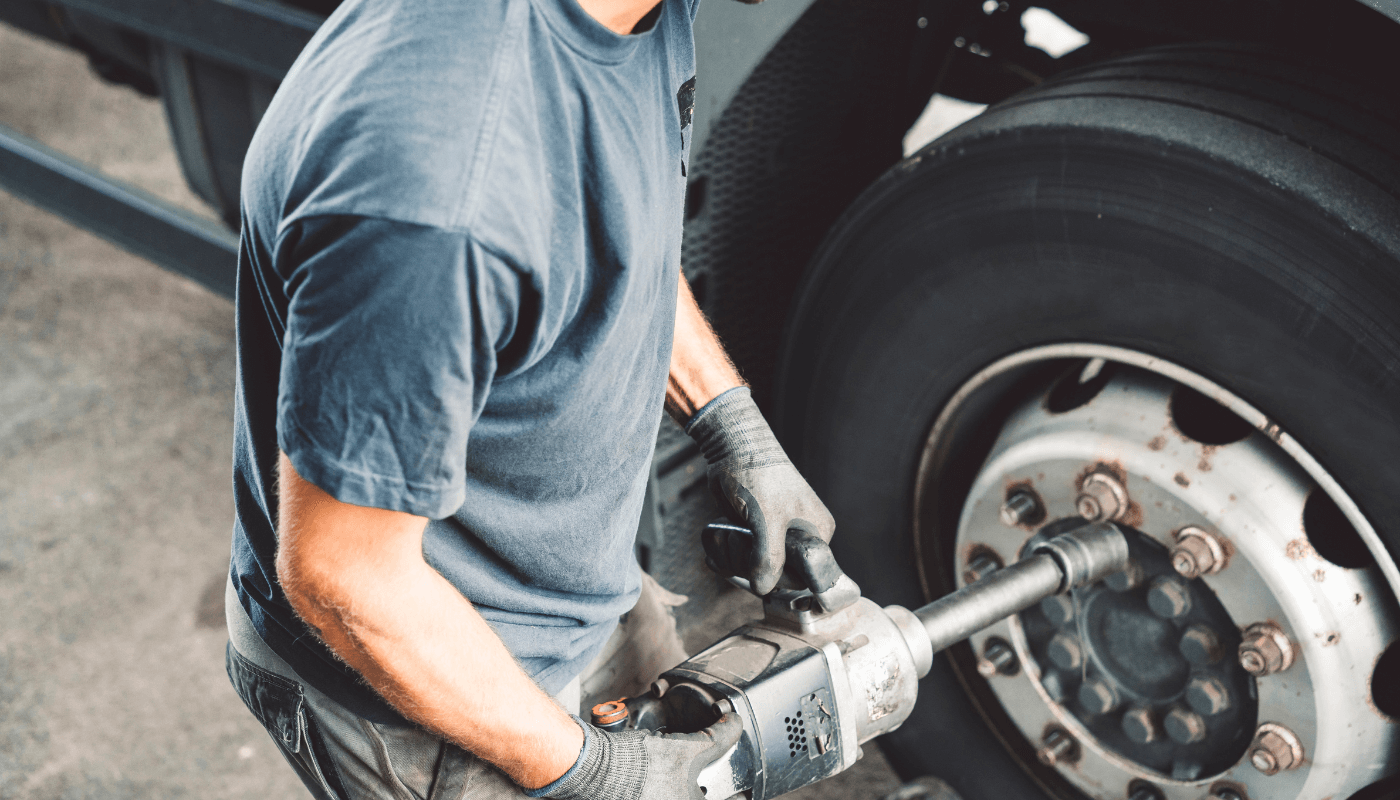
Tire maintenance is part of the fleet management routine. The main activities include controlling tire condition for safer driving and to allow tires to be used for longer.
How structured this routine is still varies widely between fleets: some control each tire individually, with recorded inspections and a history by position, while others treat tires as consumables, buying them when supplies run out. Where the routine is established, it tends to pay for itself through the benefits it generates, lowering costs and increasing tire useful life.
Read on:
- What preventive maintenance for tires is;
- Benefits of maintaining tires correctly;
- How to maintain tires;
- Tire maintenance mistakes.
What is preventive maintenance for tires?
Tire maintenance is part of an area of transport operations we call “tire management”. In this activity, tires are inspected and assessed, identifying the need for refurbishment, mainly in their tread.
Preserving ideal running conditions is the main objective of this type of maintenance, helping prevent above-average wear and premature tire loss due to deformation.
In practice, the routine relies on a few measurements always repeated in the same way: tread depth, pressure, visual damage assessment and tire position on the vehicle. Recorded repetition — rather than an isolated measurement — reveals uneven wear, pressure loss and alignment or suspension issues.
Benefits of maintaining tires correctly
Tire condition influences other aspects of the vehicle. If tires are not looked after properly, they can hinder fleet performance over time. That is why tire maintenance generates benefits such as:
Increase a tire's useful life
If the aim of tire maintenance is to preserve the asset's characteristics, the useful life of these vehicle parts consequently tends to increase.
A company that does not carry out tire management and its maintenance activities can lose up to 50% more tires. This percentage is an industry practice reference, not official data or a benchmark set by regulation: the actual difference depends on the application, refurbishment policy and inspection quality, and needs to be measured using the fleet's own history.
Cobeb, for example, was one of the transport companies that halved retreading rejections after implementing management software to control these fleet assets.
Many losses occur precisely because retreading is rejected due to casing fatigue, when the tire has already run beyond its limit and the internal structure has been damaged.
In these cases, carrying out any kind of maintenance or refurbishment becomes risky, as well as being a cost that may not pay off, because refurbishment tends not to deliver the expected additional life. The reference of around two extra years per refurbishment is an expectation from market practice, not a guarantee: results depend on casing condition, application and the refurbisher.
Refurbishment also has limits defined by regulation in Brazil. Article 5 of CONTRAN (Brazil's National Traffic Council) Resolution No. 913, of March 28, 2022, which governs tire use on vehicles, prohibits refurbished tires — whether through retreading of the tread, retreading of the tread and shoulders, or remolding — on mopeds, motor scooters, motorcycles and tricycles, and on the front axle of buses and minibuses. The prohibition covers only the categories and axle position listed in that article.
That is why tire maintenance processes are essential to increase the durability of these parts.
Reduce operating costs
Costs are reduced in three areas:
Tire purchasing
By making better use of tires, preventing excessive damage and always keeping their maintenance up to date, it is possible to buy fewer tires each month. This reduces the cost of purchasing new parts.
The effect also shows in the choice of what to buy: with a history by make, model and application, the decision stops being based on the price of the part and starts considering how much each tire delivers per kilometer traveled.
Vehicle maintenance
Tires running with calibration pressure below or above the ideal level suffer more damage and affect the vehicle structure, experiencing every sway and vibration. In addition, maintaining correct calibration helps reduce the risk of accidents and rollovers on the road.
The relationship works both ways: uneven wear is often a symptom of misadjusted alignment, balancing, suspension or brakes. When the same wear pattern recurs in the same position on several vehicles, the tire itself is unlikely to be the issue.
Less vehicle maintenance work means more savings for your fleet.
Fuel
When tires are underinflated, for example, the engine needs to work harder, as the vehicle becomes “heavier” when running with more ground friction. This burns more fuel than necessary.
So, if tires are in ideal running condition, they allow the vehicle to move more “smoothly” and fleet fuel consumption tends to become more efficient — reducing refueling costs.
The size of this effect varies with the application, tire design and load carried. That is why it makes more sense to keep track of your own fleet's consumption before and after adjusting the calibration routine than to adopt a ready-made savings percentage.
Generate data for analysis
For those who maintain tires using logistics technologies, data generation is a reality. And there is no denying it: generating concrete, real information to analyze and make informed decisions is essential today.
Some of the data collected includes: variation in calibration and tread depth, number of tires sent for retreading, number of retreading rejections, maintenance service quality, how long a tire lasts after refurbishment, etc.
These numbers only hold up when each tire has its own identification and records are made by vehicle position at every inspection. Otherwise, the fleet is left with an average — and the average hides precisely the tire being lost prematurely.
From these figures, you start to better understand the factors influencing tire durability and the main causes of damage and issues. This results in more accurate and effective decisions.
How do you maintain tires?
1 – Draw up a maintenance plan
The maintenance plan is essential for the whole fleet, whether for vehicles or tires. What is set out there lets everyone know their role and the activities to carry out in day-to-day operations.
Make sure you clarify all the activities involved, how often they should take place and who is responsible. It is also important to identify the company's objective for this routine and the metrics being assessed.
A useful plan answers concrete questions: how often tires are inspected, what tread depth triggers replacement or refurbishment scheduling, what operating pressure applies to each application and what to do when a tire fails inspection. Without these written criteria, each inspector makes a different decision.
The clearer it is why employees should perform tasks and how important their roles are in fleet management, the greater the chance they will perform well in their duties.
2 – Make the schedule available to those responsible
Every maintenance plan comes with an activity schedule. It is important to make it available on an activity board or in management software, such as a Kanban view, so everyone knows when to carry out their activities.
It is worth fitting this schedule into the existing routine — refueling, shift changes, returning to base — rather than creating a stop just for inspections. A routine that competes with operations for time is often the first to be abandoned.
3 – Keep track of the measurements taken
Fleet and/or tire managers should ideally always pay attention to and keep track of tire management and maintenance activities. This is both to make sure they are being carried out and to assess whether there are unusual or concerning results that should be analyzed immediately.
In Brazil, there is a legal minimum that serves as a reference for tread depth readings. Article 4 of CONTRAN Resolution No. 913/2022, in the text published in Brazil's Official Gazette, prohibits motor vehicles from driving with tires whose tread wear has reached the indicators, or whose remaining tread depth is less than 1.6 mm; paragraph 1 adds that this remaining depth is to be checked visually through wear indicators. These indicators exist because Article 3 requires every tire to be manufactured or refurbished with them at the bottom of the tread pattern. The resolution has been in force since April 1, 2022 and, in Article 22, provides that noncompliance subjects offenders to the penalties under item X of Article 230 of the Brazilian Traffic Code.
This value is the limit for driving in Brazil, not the management target. Fleets often set an operating margin above the legal minimum, with technical guidance and compatible with their refurbishment policy, so the tire reaches retreading with its casing in good condition — but this margin is a company decision and does not replace compliance with the regulation. To compare measured tread depth with expected wear, see the tread depth table.
4 – Take appropriate action
When managers notice issues or unusual situations, they need to act quickly. Fortunately, with all the data available, their work can be entirely focused on finding the necessary information and understanding the most suitable solution at each point.
Whether it means adding a new activity to the routine or increasing tire inspection frequency, these decisions should be reviewed regularly.
Also record what was decided and why. When the same situation comes up again — and it often does — the fleet can consult the previous decision rather than restart the discussion from scratch.
5 – Keep the other fleet management areas functioning properly
All fleet areas are connected. If tires are damaged, vehicles also suffer damage, and the opposite happens too: if the vehicle has issues, it harms the tires.
That means all management areas need to function as well as possible, from vehicle and driver management to refueling, delivering the best performance in transport operations.
An example makes the connection concrete: pressure outside the range shows up as higher fuel consumption, uneven tire wear and extra strain on suspension. It is the same deviation appearing in three different areas, and only cross-referencing records shows the common cause.
Main tire maintenance mistakes
- Doing no maintenance: the main mistake is not doing any kind of maintenance. Without recorded inspections, fleets often discover the issue when the tire is already lost.
- Saving on purchases: buying the cheapest tire without knowing the best model for your fleet is a mistake. You need to keep track of data to know which make and model has the best CPK — cost per kilometer — for your application, and only then buy new parts.
- Waiting until a tire is bald before replacing it: if a tire is bald, casing damage is more likely, which may make tire retreading impossible and prevent longer reuse. In addition, as explained above, in Brazil Article 4 of CONTRAN Resolution No. 913/2022 prohibits driving when tread wear has reached the indicators or remaining depth is less than 1.6 mm.
- Cutting “grooves” into tires: once a tire is bald, marking grooves by hand by cutting the rubber is an extremely wrong practice. It harms the rubber and the tire, and running with an unsuitable tire can damage the vehicle.
- Not rotating tires: tire rotation helps keep wear even and balanced across all vehicle tires. Skipping it can cause more pronounced wear on the front tires, since they often support the engine's weight. In Brazil, when relocating tires, comply with paragraph 2 of Article 4 of the same resolution: when on the same axle and symmetrically fitted, tires must have identical construction, the same size and load rating, and be mounted on rims of equal dimensions; asymmetry is allowed when caused by fitting a spare wheel in an emergency.
- Not finding the ideal calibration: calibration keeps wear even across the tread surface and allows the vehicle to run in a balanced way. If you do not know the ideal calibration, you may be harming fleet performance. The reference is the technical specification for size, load and application: for extra-wide tires, for example, in Brazil Article 21 of the same resolution assigns the vehicle manufacturer responsibility for specifying recommended pressures and load capacities in the owner's manual.
- Not inflating the spare tire: the spare tire must be kept in suitable condition for use if something unexpected happens on the road. In Brazil, for categories M1 and N1 — which the resolution itself defines as passenger vehicles with up to eight seats in addition to the driver and freight vehicles weighing up to 3.5 t — Article 10, in the chapter on temporary-use spare wheel and tire assemblies, requires that the tire structure of the spare wheel/tire assembly guarantee its use while the tread depth is greater than 1.6 mm.
- Using a repair string in a punctured tire: this part is used to cover a hole when a tire is punctured. It can be used in emergencies to reach a place where the tire will be replaced, but should not be kept as a way to make the tire run for longer. After the emergency, the tire needs a technical assessment before returning to operation.
To look after your fleet's tires properly, you need to avoid these mistakes and carry out suitable tire management and maintenance care. This includes controlling tire inspection data.
You can do this using a tire control spreadsheet developed for this purpose. Download this free resource here (in Portuguese).
Frequently asked questions
How do you maintain fleet tires?
What is the minimum permitted tread depth?
What are the main tire maintenance mistakes?
What are the benefits of maintaining tires correctly?
How much does a fleet lose without tire management?
Can refurbished tires be used on any vehicle?
// newsletter
Fleet management content, straight to your inbox
Articles on tires, maintenance and fleet operations. No spam.