
Tire management: what it is, benefits and fleet routines
 Luiz Felipe 30 min read

Tires represent one of the largest operating costs in a road transport fleet, behind only a few daily operating items such as fuel. In a long-haul combination, a single semi-trailer can run with dozens of tires, and each one requires purchase, inspection, maintenance, refurbishment and proper disposal.
Multiplied by fleet size, this cost grows quickly.
What largely determines whether this cost is under control or slipping away month after month is the quality of tire management practiced in the operation.
Take a look:
- What is tire management?
- Why is tire management so important?
- What are the benefits of tire management?
- What is part of a tire management routine?
- Who is responsible for tire management?
- How do you manage tires?
- What tools are used for tire management?
- The importance of technology in tire management
- What are some of these technologies?
- Why do these tire technologies emerge?
- How do these technologies affect tire management?
- Frequently asked questions about tires
- What are the trends in tire management?
What is tire management?
Tire management is the strategic control and preventive maintenance of a fleet's tires. It aims to maximize useful life, ensure safety and reduce operating costs, since tires represent one of the largest expenses for transport companies.
In practice, it involves periodically collecting each tire's pressure and tread depth data, recording and analyzing this information, and making decisions about services, refurbishment and replacements based on evidence (rather than assumptions or reactivity).
As Jean Zart, Prolog's CEO, defines it:
“The set of periodic activities for collecting (inspection), storing and analyzing data on fleet tire condition, with the purpose of converting it into relevant information for decisions on the fleet's physical, financial and personnel resources.”
Jean Zart – Prolog CEO
Tire management is not only about the tire itself, but also about what tire condition reveals about the operation's vehicles, drivers and routes.
Why is tire management important?
Because an ignored tire rarely stops costing money; in fact, it starts costing even more.
A tire with incorrect calibration increases fuel consumption, accelerates wear and can lead to retreading rejection, requiring premature disposal. Likewise, a tire worn beyond the limit poses an accident risk on the road.
In addition, uneven tire wear indicates an alignment, suspension or driver behavior problem, affecting the whole vehicle, not just the rubber.
Controlling these assets therefore provides valuable information to the manager: which tires offer the best value for the fleet.
Furthermore, controlling and reducing costs is one of the main reasons for managing fleet tires. Knowing which tires are best means making smarter purchases and reducing the amounts allocated to acquiring new parts.
Tire refurbishment also starts happening more often, since tire management reduces retreading rejection.
It also improves safety for the fleet, driver and cargo, since incorrectly inflated or worn tires are more susceptible to failures and accidents. That is why maintaining a schedule for checking and controlling tires is fundamental.
What are the benefits of tire management?
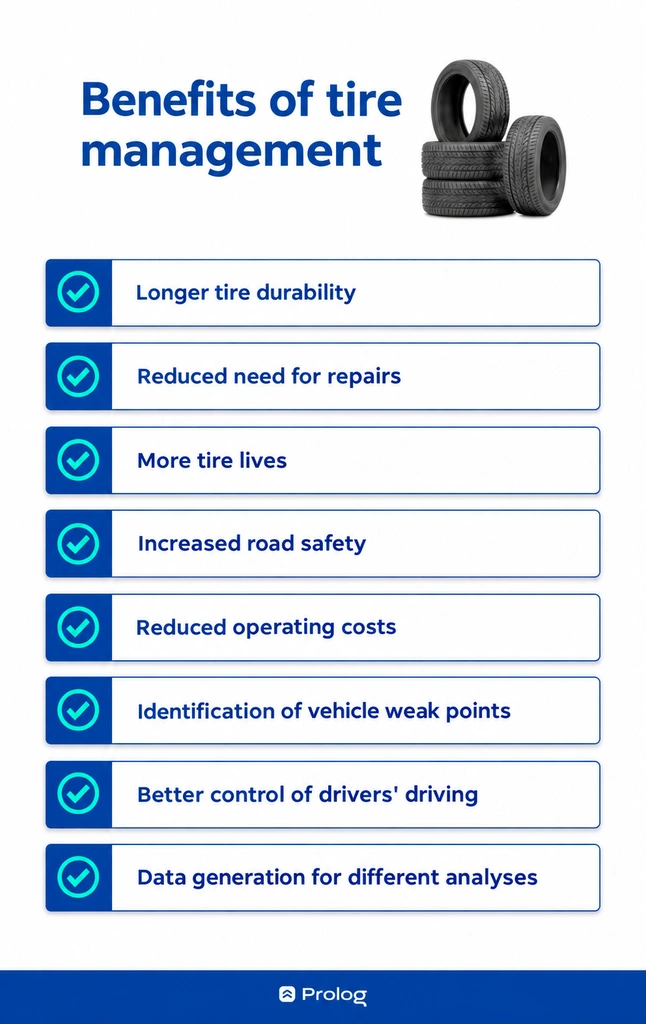
Benefits of tire management.
Take a closer look at each of the benefits of tire management:
Greater tire durability
Through tire inspections and all other care provided for in this management, ideal running conditions are established for these assets.
They are maintained at the calibration specified for the application, with even, minimal wear and using the best-performing model for each route.
When all care is up to date, tires reach their useful life without major problems. They may even exceed the useful life estimated by the supplier.
This provides greater control to plan investment needs for new purchases to replace the asset.
Reduces the need for repairs
With appropriate care, tires will perform better, also ensuring fewer repairs to the truck's structure as a whole.
After all, an unbalanced tire can damage the vehicle's axle and suspension system, generating more expenses and even reducing vehicle quality.
Improves road safety
Worn tires increase skidding risk, especially on rainy days. That is why caring for tires provides greater safety in transport operations.
Following technical recommendations and performing tire management is what you need to assure both drivers and the customer receiving the goods that there will be no problems along the way.
Lower operating costs
Many efforts are made to save on tires because they are expensive to acquire. The price of each new tire varies according to size, application, make, model and purchase timing. If new purchases are needed monthly, for example, this becomes unviable for some fleets.
In most cases, this is what leads managers to allow vehicles to depart on trips with bald or irregularly worn tires.
However, this generates even higher expenses, because it increases premature tire disposal frequency.
Tire management does not necessarily require high investment, but acquiring resources such as software that helps with this control is an excellent alternative for fleet savings, agility and productivity.
Fewer weak points in vehicle inspection
Through tire management, it is possible to identify whether preventive maintenance tasks are being performed. After all, some types of wear, such as localized or uneven wear, are caused by a lack of vehicle alignment and balancing.
With appropriate care, tires will perform better, also ensuring fewer problems like these in the truck's structure. This consequently generates fewer expenses and increases truck performance.
The opposite also happens: a lack of tire management can lead to damage to the vehicle structure.
When tires are not properly inflated or have mounting faults, they affect the vehicle's suspension system and increase the impacts received on the road. They can therefore cause greater damage to the entire vehicle.
Likewise, underinflated tires increase vehicle fuel consumption, causing financial losses for the fleet.
In general, if tires are correctly inflated and show no wear beyond normal levels, you already know that if the vehicle has irregularities, you should look for other reasons for the problem.
More tire lives
Retreading is a type of tire refurbishment that allows the asset to provide more lives. This means that instead of being discarded after reaching its running limit, it can receive a new tread and run for about another 2 years, providing one extra life.
A tire can have up to three extra lives, although this can only happen when the casing has not suffered excessive damage or fatigue.
Tire management therefore plays a fundamental role, reviewing tires according to use and removing them from vehicles before they reach an advanced state of damage.
Accelerated and improper tire wear leads to what is known as “retreading rejection,” preventing extended tire use. Wear needs attention to provide the chance to retread and use these parts for longer.
Greater traffic safety
If tires receive no attention, they can reach the bald tire stage, when highway transport becomes even more dangerous.
Bald tires are characterized by a total loss of ground grip. They therefore become much more susceptible to skidding or hydroplaning on rainy days.
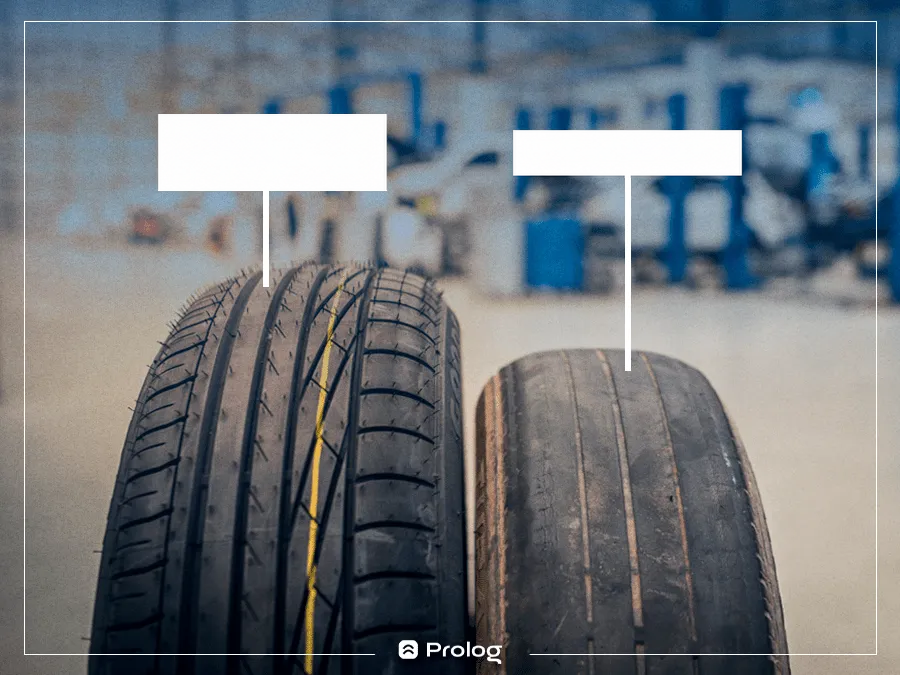
Tire in good condition
Bald tire
- Tire in good condition
- Bald tire
Comparison of a good tire and a bald tire.
Performing tire management is the best alternative to keep track of tire wear and grip, always having solutions ready for each situation that arises in your transport operation.
This provides greater safety for the vehicle, drivers and the company's cargo or goods.
Better control of driver behavior
By analyzing tires and noticing different damage, you can also investigate how drivers are behaving behind the wheel. Some actions that cause problems and should be avoided include:
- Accelerating at a yellow light;
- Accelerating excessively to overtake;
- Not slowing down for speed bumps;
- Not respecting highway or tire speed limits;
- Taking shortcuts along unplanned roads, generally dirt roads with many stones and debris.
All these factors damage tires, accelerating wear or creating bulges, cuts and punctures in the rubber. Although they can be refurbished, this type of behavior increases operating costs unnecessarily.
Generating data for different analyses
Data collection through tire management allows the CPK calculation, the Cost per Kilometer of each tire — decisive information. Through it, the best tires for the operation are identified, determining the value offered by each make and model.
It is important to note that this calculation should be analyzed per tire, considering purchase cost, cost of services performed and mileage covered before and after refurbishment.
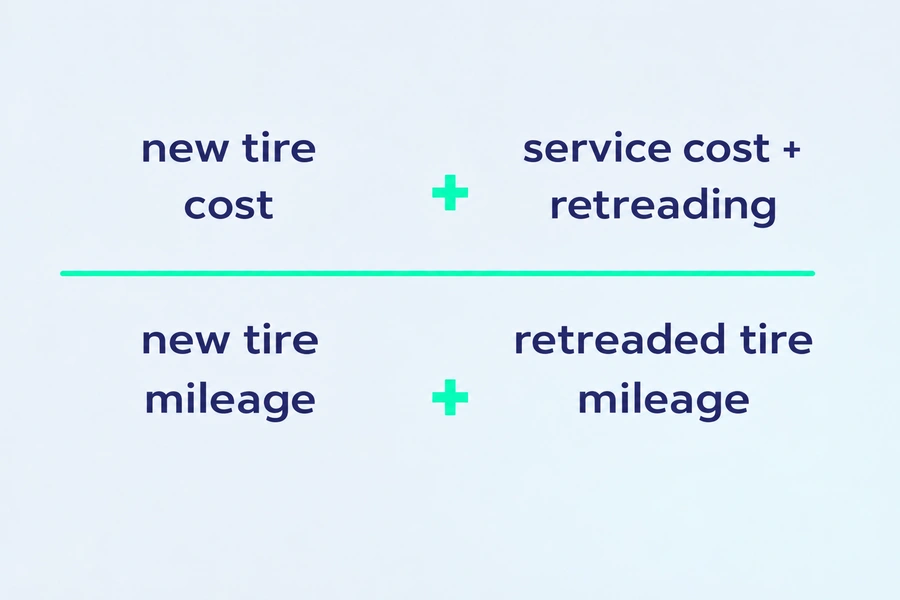
Tire CPK calculation.
Calculation of tire CPK.
In addition, you need to consider external factors: routes traveled, vehicles they were installed on and drivers responsible. After all, you have just read how much these elements can influence extending tire useful life, right?
So remember to bring all this information into your decision-making the next time you analyze and purchase tires.
What is part of a tire management routine?

Stages of a fleet tire management routine.
Every task related to fleet tires is part of this management. From purchase to disposal, tire management is the entire process of handling these components of a fleet vehicle.
Discover all the tire management processes:
Fire-number branding on tires
The first step in starting fleet tire management is hot branding. This is an inscription applied to the tire sidewall, next to information already provided at the factory.
Its purpose is to give the tire a unique identification, making individual control possible. Besides making management more practical, it also allows better organization of tire inventory, since you can keep track of exactly which tire is installed or in inventory.
The most common way to identify tires is with a hot iron or modern marking tools that also use heat.
Although making this small “burn” in the rubber may seem dangerous, the risks of causing damage are minimal — just have the service performed by a professional and there is nothing to fear.
There are also tire marking tools that use lasers and can be faster, if you prefer that approach.
Keeping track through tire inspection
Tire inspection brings together two crucial tasks for controlling these assets, making it possible to identify services and forecast replacements:
1 – Tire pressure inspection

Tire measured with a digital tool.
Inspecting tire pressure simply means measuring current pressure and arranging calibration if it is noncompliant.
Inspection can be performed manually using a pressure gauge, or digitally using an electronic tread probe, also known as a “digital inflation pressure measuring device.”
Tire care specialists recommend checking pressure with a measuring device at least once a month and before long trips. In operations that run every day, the routine can be more frequent according to use and the fleet's maintenance policy.
If that is the recommendation, you may be asking: “if calibration will already be performed, why is measuring tire pressure necessary?”
It is a completely valid question. Here is the explanation:
One stage of tire management is analyzing the data collected in this process. It should not replace the technical calibration reference defined for the vehicle-tire combination, but helps identify deviations, recurring issues and causes of wear before the asset is lost.
Even if there is a specified tire calibration pressure in the owner's manual or applicable technical guidance, you may encounter routes, usage frequencies and operating conditions that require constant attention.
Through inspections performed weekly, every two weeks or monthly, according to how critical the operation is, you stop suffering from premature wear and tire loss.
This is because you start accurately analyzing pressure data and tire wear levels. Pressure below the recommendation generates heat, stress, uneven wear and internal damage; pressure above the recommendation increases the chance of cuts, punctures or damage when hitting obstacles such as potholes.
This is just one example of action you can take based on this tire management analysis.
2 – Checking tire tread depth
Just as pressure must be measured and controlled, so must tire grooves. More directly, their depth must be kept track of, since it indicates whether tire wear is natural, uneven or accelerated.
To clarify, grooves are the “openings” following a pattern along the tread and helping air and water pass through while driving on roads. They have different depths depending on tire types, each with different advantages and disadvantages for your fleet.
This tread depth, sometimes called “groove height,” can also be measured with manual or digital tread probes. In fact, the same electronic tread probe that measures tire pressure can be used here.
One thing you need to avoid is measurement tricks. Some managers use “unofficial” ways to measure tread depth, such as the 1 real coin, since its gold band corresponds to the minimum depth grooves must have in Brazil, 1.6 mm.
Like tire pressure control, depth measurement and analysis play an important role in helping your tires last longer:
You can understand the tire's wear level and identify the right time for a replacement, sending the asset for retreading and increasing its durability and operational performance.
Cleaning and drying
Cleaning and drying tires should be part of your management routine, because debris and dirt that “stick” to tires along their routes can accelerate damage to the rubber.
For example, stones caught in the tread cause vehicle instability and can make the tire “bounce” at higher speeds. This can cause both localized tire wear and cuts or punctures.
Therefore, always include these tasks in your fleet tire care routine.
Maintenance services
For highly durable tires, some maintenance services are necessary. Among them:
- Tire calibration;
- Wheel and casing inspection;
- Vulcanization;
- Repairs and refurbishment;
- Alignment;
- Balancing;
- Brake and suspension inspection.
Tire refurbishment
Tire refurbishment is also part of maintenance services, but an important distinction must be made here between the different refurbishment possibilities. They are:
- Retreading: in this process, only the tire tread is replaced. The tire undergoes inspection to analyze damage to its rubber and casing. If the damage is repairable, the tire proceeds to necessary repairs and application of a new tread. If retreading is rejected, the tire must be discarded because it has become unusable.
- Shoulder-inclusive retreading: this is the tread replacement process used when shoulders are worn, since tread-only retreading does not cover that part of the tire.
- Remolding: the tire's entire exterior is renewed, causing it to lose its original factory information (located on its sidewall). It is a more complex and little-used process, because the work is usually not worthwhile.
Data management
Once tires are identified, each relocation can be recorded and kept track of in spreadsheets or digital systems. From placement in inventory or installation on a vehicle to dispatch for and return from retreading.
Everything is information, or in more technological language: everything is data.
Every detail can be studied to understand problems and generate solutions. For fleet tires, the main data that provides knowledge to managers is pressure and tread depth measurements — as you saw above.
With the right tools to measure and record this information, you create a much more practical analysis routine in your operation.
Tire purchases
After being able to view all tire data, understanding which perform better, which generate higher costs, which suffered premature loss or retreading rejection, the CPK of each model and so on, you reach a crucial conclusion:
Discovering the best tire for your operation.
Who is responsible for tire management?

Fleet tire management responsibilities.
There are different people responsible for tire management, covering more operational or administrative tasks:
Tire manager
This person is responsible for defining tire inspection routines and performing measurements according to schedule. Some operations have a dedicated inspector for this stage, but if not, the tire manager performs this role.
In addition, when tires arrive at the operations center, this manager must define and oversee tire marking, whether through heat or another method.
The manager also needs to manage purchases, seeking reliable suppliers and closing good deals. To choose the best makes and models, analyzing collected data is also part of the routine.
The manager needs to find the most relevant information showing which tire performs best for each stage of the operation.
Another task is overseeing work at the company's tire repair shop when repairs or refurbishment are needed. In general, the role is to keep track of the tire's useful life cycle through disposal.
In fact, correct and environmentally sound tire disposal is also something the tire manager must know how to perform.
Fleet manager
The fleet manager may be responsible for fleet tires if the company is not large enough to hire specifically for this function.
However, when there is a person responsible for these tasks, the fleet manager becomes responsible for analyzing reports provided by the tire manager or fleet analyst to make decisions aimed at fleet savings, safety and efficiency.
Even if the tire manager determines which assets are the best purchases for the operation, the fleet manager has the final say and decides whether the arguments are valid to carry out this decision.
Fleet analyst
In some cases, especially in large operations with more than 400 vehicles, the fleet analyst is a position present in tire management.
This person performs no operational tasks, being exclusively responsible for reviewing field-collected data. The analyst organizes fleet information, centralizing data from several areas, such as tires, maintenance and drivers, in a single view.
This provides a broad view of everything happening in the operation and a more accurate understanding of which factors may be causing fleet problems and which solutions should be adopted.
The analyst also generates reports from these analyses to take to the fleet manager, who makes the final decisions on actions to implement.
How do you manage tires?
We can organize tire management into 6 steps. They are:
- Perform hot branding: as discussed, tire identification is the first step to enabling control of these assets.
- Measure pressure and tread depth: this is tire management's most important task, and understanding asset performance is only possible by collecting this information.
- Have a control method: this means determining where information will be recorded and which tools will be used, as well as the process and daily tasks of each fleet employee.
- Implement the routine in the operation: communicating with the team and applying new processes are part of the manager's responsibilities if you have not yet started a tire management routine in your operation.
- Be consistent and use collected data: collecting data is pointless if it is not used to generate knowledge, goals and solutions to problems identified in the fleet.
- Support decisions made based on data analysis: when using data for new purchases and process implementation, you need to present it in reports to support and substantiate your hypotheses.
What tools are used for tire management?
Tire management tools include both asset pressure and calibration measuring devices and a method to record and organize all information collected during tire inspection.
Take a closer look:
Pressure and tread depth measuring devices
These measuring devices can be manual or digital, dedicated to measuring pressure or depth, or measuring both in a single device. Among the options, you can find:
- Analog caliper: measures only tread depth, like a ruler inserted into each groove and checked by the manager to identify the correct measurement.
- Electronic tread probe: can be adapted to measure both pressure and tread depth, reads information automatically and sends it directly to a management system connected to the device — with 99% reading accuracy.
- Tire inflator: regulates the calibration of tires identified as having low or high pressure during inspection.
Besides measuring devices, you need a method to record and organize all information collected during tire inspection. Both spreadsheets and management systems offer this functionality. Take a look:
Tire control spreadsheet
Tire control spreadsheets (in Portuguese) can be simple or even more robust if paid for and built by an Excel professional. Their design may vary, but most have a set of tabs including:
- Tire registration;
- Driver registration;
- Vehicle registration;
- Service control;
- Inspection control;
- Service reports.
It is an excellent tool for those who do not yet perform any control and have few vehicles. However, the more vehicles a fleet has, the greater the need for quick, easy access and the ability to search for a tire by its identification whenever necessary.
In this respect, a tire control spreadsheet does not meet needs as well as a more modern, technological system.
Tire management system
It is quite common to find more general systems, such as ERPs, containing tire management modules. What usually happens is that this control is limited, allowing only relocation between inventory and installation on a vehicle.
On the other hand, a tire management system is truly complete, providing tire relocation along with other features that become essential, such as:
- License plate, tire and driver registration;
- Tire inspection control;
- Refurbished tire control by ID;
- Inspection schedule;
- Work order generation;
- Data analysis;
- Service completion;
- Automated tire CPK calculation;
- Tire replacement forecasts;
- Photos in the inspection record.
In general, managers tend to look at fleet tires only through the lens of savings: they seek the lowest-cost models that will not be discarded too quickly.
What they should do is look through the lens of information generation. Collecting and analyzing tire data allows them to understand not only the best-performing tires, with the desired CPK and a contribution to financial results.
It also allows them to confirm certain types of problems vehicles present more frequently and how drivers drive along their routes.
Savings, maintenance and safety are three pillars tires help support, so tire and fleet managers should bring this care closer to tires while keeping an eye on the whole fleet.
To know what to use in your tire management, see the differences between a spreadsheet and a tire control system:
| SPREADSHEET | SYSTEM | |
| PRACTICALITY | LOW | HIGH |
| CUSTOMIZATION | YES | YES |
| PRODUCTIVITY | MEDIUM | HIGH |
| AUTOMATION | NO | YES |
| DATA ANALYSIS | MANUAL | AUTOMATED |
| DATA CENTRALIZATION | NO | YES |
| DATA HISTORY | YES | YES |
| REPORT CREATION | MANUAL | AUTOMATED |
| RECORD UPDATES | MANUAL | FASTER |
Comparison between a spreadsheet and a tire management system.
The importance of technology in tire management
The importance of technology, as perceived by managers, is immense. From the savings technologies bring to productivity and agility in everyday work.
Technologies such as tire management systems emerge as a way to make tires last longer and avoid retreading rejection, providing 1 to 3 extra tire lives.
Technologies in tire development have also emerged over the years with this intention — making tires more durable and less susceptible to damage.
Since the beginning of tire history, their construction has undergone many changes, and now there are several different models with distinct concepts and manufacturing methods.
These even incorporate technologies into their own structure, such as stronger rubber or protections developed to withstand tread punctures and cuts.
What are some of these technologies?
Tire sensors
In several vehicles, tires already come with sensors, sometimes similar to a “tag,” that identify their air pressure and alert the driver by illuminating a dashboard light in case of irregularities.
There are also studies analyzing the development of tires with special treads. These would have sensors to detect road conditions, thus “adapting” the tread to provide better grip in different conditions.
Even when the vehicle has TPMS, this feature does not replace periodic checks with a measuring device. In some cases, the alert may appear too late to avoid damage, which is why the inspection routine remains necessary.
Puncture-resistant tires
Popularly known as “run-flat tires,” these tires have “self-supporting” technology that allows continued driving with full vehicle control after a puncture or major pressure loss.
This happens because their structure is developed with a “protection” that reinforces the tire sidewall, supporting the weight of the vehicle and load when the tire suffers damage.
If the technology is activated after the tire suffers an impact, the driver can travel up to 80 km, provided a maximum speed of 80 km/h is maintained. After that, there is a risk of tire bead unseating.
Despite the technology, this tire type usually wears faster because of its weight and reinforced construction. This means it has lower durability than traditional models, and refurbishment is also not recommended, even though it is possible.
Self-sealing tires

How a self-sealing tire works.
Major tire makes identify this tire differently. For example, in Pirelli's catalog it is the Seal Inside tire; in Continental's, it is ContiSeal.
Self-sealing tire technology prevents pressure loss even after punctures, ensuring greater safety in transport operations. There are limits for it to work properly: Michelin cites immediate sealing for tread punctures smaller than 6 mm; Pirelli's material sits in the area corresponding to the tread and forms a sealing layer.
If a puncture occurs in the tire sidewalls, the sealing material may not work.
Here is how it works:
The sealing material inside the tire tread bonds to the object when a puncture occurs.
When the object is removed from the tire, the material is “dragged” into the hole, sealing its edges. This prevents air pressure loss from the tire.
Even with this technology, any punctured tire needs professional evaluation. Self-sealing protection is limited until proper repair is completed.
Green tires (eco-friendly)
Continental, for example, is currently developing models produced with special latex instead of natural or synthetic rubber.
The development of tires using other alternative, more ecological materials is also being studied. Such as using silica in the composition, reducing friction with asphalt and generating savings.
Besides promoting sustainability, increasingly present in fleets, this is something that could make tires cheaper.
Airless tires
With reinforced sidewalls that can support vehicle weight without air filling, these may also have an internal support ring — this model is developed by Michelin, and there were expectations of use in passenger cars starting in 2024, but they are still not commercially available on the broad market.
It works through support from resistant fiberglass blades covered in rubber, making the part very flexible and helping the suspension cushion the vehicle.
The technology concerns its construction: made from small glass-reinforced plastic spokes and without the need for inflation with pressurized air. In other words, it cannot burst or puncture.
In addition, we can consider airless tires a “green” model, since they require less rubber to produce and are estimated to last about 3x longer than an ordinary tire, similar to the lifespan of tires developed for lunar vehicles.
Self-inflating tires
To avoid running at improper pressure, these tire types have a system that uses rolling to pump air into the chamber and stops only when inflation reaches its ideal level, interrupting pumping and allowing air to circulate inside the tire.
Remolded tires
Tire recycling is a common practice to avoid wasting resources and promote greater sustainability in the transport industry. This is how remolded tires emerged.
Although there are many questions about using these models, advanced technology transforms a used tire into a new one with useful life as good as that of new tires.
So there is no need to fear acquiring these parts.
Why do these tire technologies emerge?
At the beginning of tire history, it was a part made of solid material, most commonly wood. At the time, it was simply an alternative for use on carts and bicycles.
Over time it improved, and when vulcanization emerged, increasing the part's resistance and durability, rubber could be used in fabric and nylon structures and in some types of steel, allowing tires to be used on cars.
From there, various studies and tests were conducted to develop different tires for all vehicle types, leading to the tires we know today and the technologies you have just seen above.
More than that, these technologies emerged because of some underlying needs fleet managers felt, such as financial challenges and premature tire wear, or manufacturers' lack of raw materials and the need to explore other resources.
How do these technologies affect tire management?
In general, these tire types have a low impact on management. This is because collecting data and keeping track of performance throughout fleet use remain necessary.
If it is not pressure and tread depth data, it will be other data. It is a matter of adapting, since tires' importance remains the same. After all, they still need to support heavy vehicles and provide safe, efficient transport.
Even so, except for airless tires, all the others perform similarly to conventional tires. We can even think of them as updated conventional models.
Frequently asked questions about tires
What causes the most tire wear?
Careless driving
When a driver drives carelessly, errors slip through that could have been avoided to extend tire use and even the vehicle's own use.
Ideally, all fleet drivers should undergo defensive driving training. Even with years of experience, it is important to undergo this “knowledge refresher.”
This is because they may adopt habits harmful to the operation. Likewise, training drivers on traffic law updates and company conduct rules is essential.
Not keeping track of tires
Tire inspection is crucial for the fleet. Controlling pressure loss and tread depth is a task that cannot be set aside.
Only by using this data can you draw conclusions about tire wear, such as:
- Its level, whether within or beyond normal;
- The type of wear identified;
- Likely causes;
- The best corrective measure to take;
- The preventive measure to adopt going forward.
It seems like such simple data, but it carries great weight in improving your fleet management.
Poor roads
Although this factor cannot be fully controlled, roads in poorer condition along the route should be considered when analyzing wear on parts.
This factor can be identified through conversations with the drivers responsible for each journey, receiving firsthand information to plan new routes. In addition, news about each region should be kept up with to check where roadworks or traffic changes are taking place.
All this information helps create routes less harmful to fleet vehicles and tires.
Using the wrong models for the route
Assessing the roads to be traveled on a trip is also important to identify the best tires for each trip.
For example, if the tire will travel on many highways, you should favor low-severity tires, which provide greater fuel economy.
For urban distribution routes, especially when the vehicle encounters heavy traffic and many accelerations and braking events, high-severity tires should be chosen, with rubber more resistant to damage from temperature increases.
On routes that combine both situations, balancing travel on highways and in cities, medium-severity tires usually provide better performance for the operation, offering the necessary rubber resistance and maintaining good fuel consumption throughout the trip.
Using a very resistant tire on a longer-distance trip, such as interstate routes, can cause accelerated wear and higher maintenance and fuel costs.
Incorrect tire calibration
Both overinflation and underinflation cause uneven tire wear problems. When pressure is below what it should be, wear is more pronounced on the tire shoulders.
When it is above ideal pressure, wear is concentrated in the tread center.
In both cases, there is a chance that the tire will be lost before retreading, because they can also cause greater damage to the tire's internal structure — besides increasing the risk of blowouts on the road.
What are the types of tire wear?
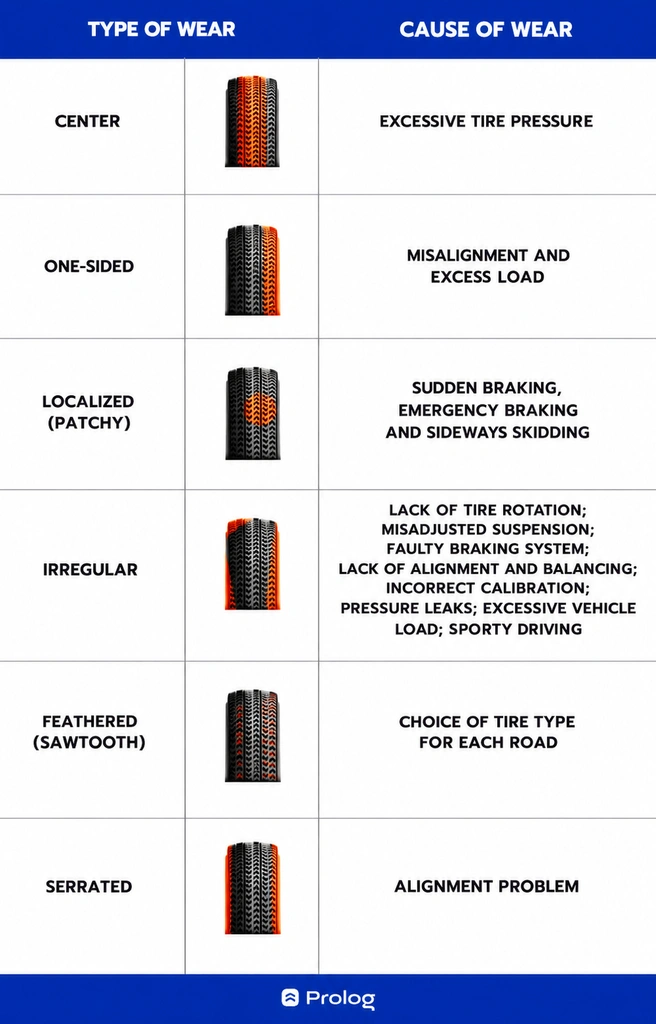
Types of tire wear.
Do tires have an expiration date?
Tires should not be treated as products with a single expiration date applicable to every operation. The safest approach is to keep track of the manufacturing date, rubber condition, usage history, storage conditions and the manufacturer's or retreader's technical recommendations.
That is why you should avoid calculating a universal “expiration date” solely from the date on the tire. This date helps understand the asset's age, but the decision to continue using, refurbish or discard it depends on inspection and technical evaluation.
In fleet management, the practical rule is to record tire age alongside inspections, services, refurbishment and damage. This way, the manager stops deciding by an isolated period and starts deciding based on the asset's full body of evidence.
What is a tire's useful life?
A tire's useful life depends on several factors, including calibration used, types of roads encountered, mileage covered, installed position, alignment, balancing, driver behavior, vehicle maintenance and the possibility of refurbishment.
That is why it is better to keep track of useful life per tire, with inspection, service and mileage history, than to work only with an overall average for the entire fleet.
When should a tire be thrown away?
A tire should only be discarded when refurbishment is not worthwhile. When its structure is too damaged and retreading is not possible, this tire can (and should) be removed from fleet inventory.
When is the right time to replace a tire?
When inspection shows 3 mm of tread depth. Although the minimum depth in Brazil is 1.6 mm, removing tires from the vehicle while they still have 3 mm ensures retreading proceeds without problems and allows greater durability in the fleet.
What is a tire life cycle in the fleet?
A tire goes through 9 stages in its life cycle in the fleet:
- Purchase;
- Hot branding;
- System registration;
- Addition to inventory;
- Installation on a vehicle;
- Tire inspections;
- Refurbishment;
- Return to inventory and use;
- Disposal.
How do you dispose of tires correctly (and sustainably)?
When it reaches the end of its useful life, even after tire retreading processes, the asset must be sent for disposal. There is extensive debate on this subject in an effort to promote actions that reduce environmental impacts.
The reason for this concern is that conventional tires take about 600 years to decompose in nature. Therefore, more conscious disposal is needed, if possible with companies that reuse the parts.
Your alternatives for taking this kind of action in your fleet are:
- Return the tire to the dealer or manufacturer: you can even consider this a criterion when defining tire purchase contracts, making collection of tires at the end of their useful life a condition of purchase. If this is not possible, the tire make itself has distributors around the country that may accept your tire.
- Deliver the tire to the company's partner tire repair shop: it is quite common for tire repair shops to accept tires when performing replacement services. They know what to do and where to send the tires, making this the most practical solution for your fleet. Your role is to seek certification that disposal is indeed correct.
- Identify a municipal collection point: many cities collect recyclable materials, including tires. You can find this information at your local city hall. If the city does not accept tires, it is probably because a dedicated company already exists — your next disposal alternative.
- Hire a disposal company: specialized tire disposal companies collect old parts and perform a series of assessments to direct each one toward production of a new tire, known as upcycling. If this is not possible, items can be sent to companies that produce new items from tire remains, such as ottomans, stools and small coffee tables.
What are the trends in tire management?
Some tire management trends show that this area continues to grow and is an increasingly important part of transport operations.
The search for the best value when purchasing tires is an acquisition trend. Managers seek models combining greater durability with lower rolling resistance and higher fuel efficiency.
First, this information can only be determined through correct tire management. Then, tires can only fulfill their promise of high durability with proper care in your fleet's routine.
Manufacturers' tendency to use different materials has a low impact on how tire management is performed.
Although construction methods and technologies benefit management, they have little influence on tire inspection schedules; this process of collecting and analyzing asset information remains necessary.
Likewise, there is a trend in developing solutions to help fleet managers make tires last longer and be more economical, safer and more efficient in the fleet.
With a tire management system and electronic tread probe, you only need to focus on instructing employees about management processes.
Frequently asked questions
What is tire management in practice?
What tools are used in tire management?
When is the right time to remove a tire from the vehicle?
How many lives can a tire provide through retreading?
Who is responsible for tire management in a fleet?
Spreadsheet or system: which should you use for tire control?
// newsletter
Fleet management content, straight to your inbox
Articles on tires, maintenance and fleet operations. No spam.


