Types of fleets: by purpose, ownership and vehicle
 Jade Zart 8 min read
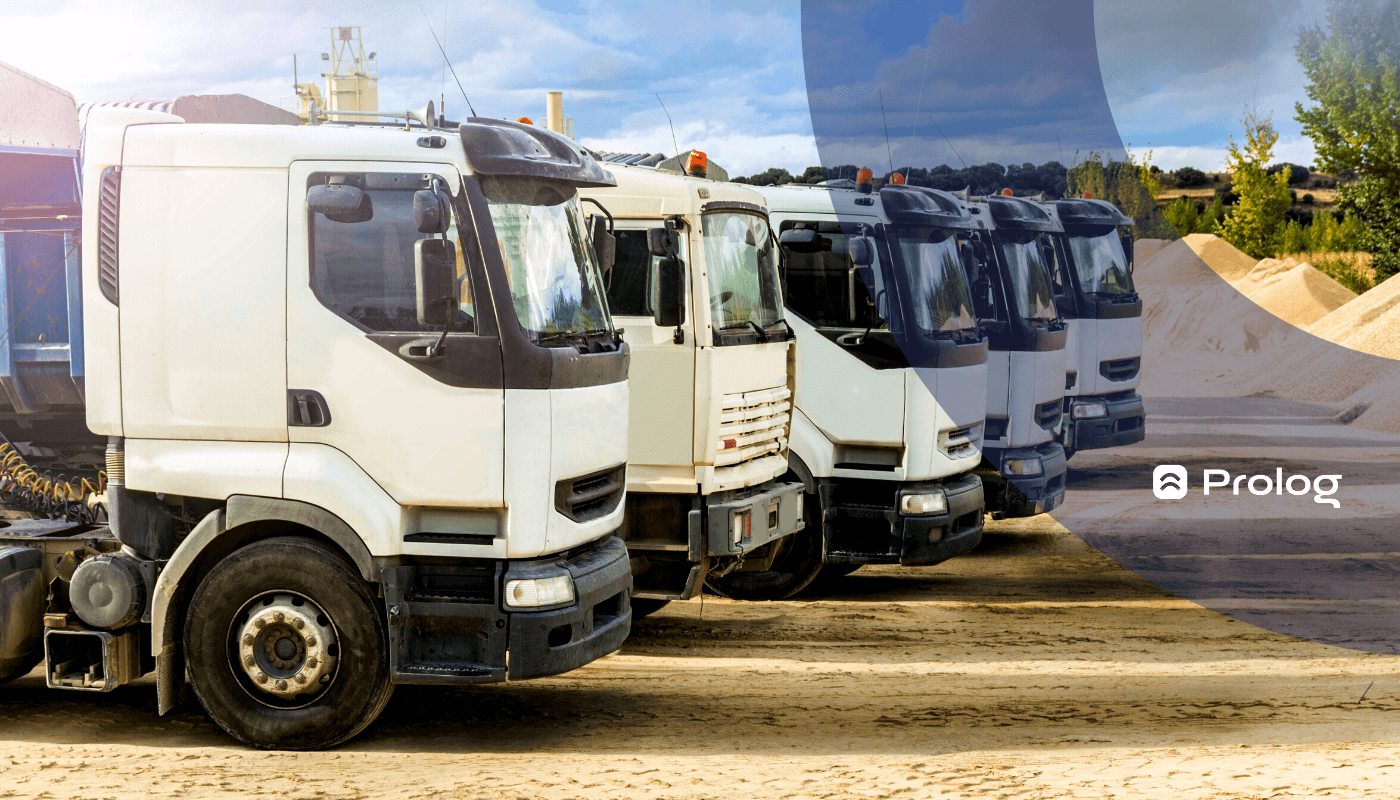
Types of fleets are made up of different vehicle models, which can be owned, rented or outsourced. And also of varied models, from motorcycles to trucks.
Before comparing one arrangement with another, it is worth separating questions that usually come mixed together. "Type of fleet" can mean three different things: the purpose of the operation (commercial, delivery, public service), the ownership or contract model (owned, rented, outsourced) and the vehicle type that makes it up (cars, buses, motorcycles, trucks). This post goes through the three axes, in that order — and that is why the same fleet can be described in more than one way at the same time.
The vehicles are at a company's disposal and are run by a manager, the professional in charge of managing the team's expenses and performance. Besides dealing with the management of the vehicles themselves, or with the contact with suppliers, in the case of a rented or outsourced fleet.
Each fleet meets a certain demand, and it is up to the company to decide which one best fits its goals. Let's get to know them:
What are the types of fleets?
This first cut is by purpose: what the fleet exists for within the business. It says nothing about who owns the vehicles — that is the next cut.
Commercial fleets
Commercial fleets serve the largest operators on the market, such as large corporations and multinationals. This is because they have thousands of vehicles, of the most diverse models, including trucks, semi-trailers, pickups, cars and vans.
These vehicles are used for different day-to-day tasks, serving anything from moving employees to freight transport — two uses that coexist in the same fleet and explain why it brings together models that are so different from each other.
If you think of operations like those of Coca-Cola or even McDonald's, these are companies whose logistics volume is the size of a corporate fleet. Each one's arrangement can be made with owned vehicles, with contracted logistics operators or with a combination of the two, and it varies by country and by stage of the chain: what the example illustrates is scale, not a specific ownership model.
Delivery fleets
The main function of this model is to move certain goods to deliver them to customers in urban centers.
Because it covers a wide variety of products to be delivered, the models used can vary, but they are all smaller, such as: cars, motorcycles, vans, light commercial vehicles and small trucks.
In practice, the vehicles may also go through more distant areas, since their goal is to reach the end consumer. It is a fleet of short routes and many stops per day, a profile very different from that of a long-distance fleet.
Public service fleets
Public service fleets belong to institutions that provide services to the population, such as energy and sanitation companies.
They are made up of trucks capable of carrying the team and its tools. Transport can also be done by vans and cars, depending on the need. When the vehicle is adapted — with an aerial basket, crane, compressor or dump body —, a second set of maintenance appears, that of the equipment body, added to that of the vehicle itself.
As you have seen, there are several kinds of vehicle fleets. However, everything only works efficiently with a good plan and fleet management software, ensuring greater organization and standardization in the operation's routines and processes.
How does management work in the different types of fleets?
Here the classification axis changes. It is no longer about the fleet's purpose, but about who owns the vehicle and what the contract provides for — which directly changes the manager's routine: at one end, they run a workshop, parts and drivers; at the other, they manage a supplier, a service level indicator and contract clauses.
Rented fleet
A rented fleet is generally chosen by companies that use the vehicles for a limited time, only a few days or weeks.
This type of operation is not usually applied to long-term strategies. Mainly because the company depends solely and exclusively on the other company's availability to provide the services.
That is why the manager should research the market to get better conditions and set them in a contract.
It is worth noting that the boundary between "rented" and "outsourced" is contractual, not technical: what separates the two models is the period of use, who is responsible for maintenance and which services are included in the agreement. Two contracts with the same name can divide these responsibilities in very different ways, and it is the signed text that decides — not the name of the arrangement.
Owned fleet
An owned fleet consists of vehicles purchased by the company itself, which has enough demand to adopt this approach.
In this case, the manager also needs complete command of vehicle management. On top of the other specialties already required in fleet management, such as:
- Preventive maintenance — the schedule of services by time or mileage interval, and the decision about what is done in-house and what goes to third parties;
- Driver control — each driver's license, schedule, training and incident history;
- Tire care — control of pressure, tread depth, rotation and retreading, item by item;
- Data analysis and reports — cost per kilometer, fleet availability and comparison between models and makes.
Its main disadvantage is the high cost, since all expenses are borne by the company — from purchase to maintenance, including the vehicle's depreciation over its use. However, its biggest advantage is the centralization of processes and greater fleet control over the vehicles.
Outsourced fleet
An outsourced fleet belongs to another company and has a contract defining the period of use of the vehicles, responsibilities for care and maintenance, among other conditions.
This way, the company can count on predictable expenses, less red tape and 24-hour support, with vehicle replacement in emergencies. These are contracted conditions, not automatic features of the model: each of them needs to be in writing, with a defined response time and responsibility, to count when the vehicle stops.
It is usually a very common arrangement, since many companies need transport services for inputs to production and from there to points of sale (or even to the end customer), but do not want to deal with maintaining a transport and logistics department within their own company.
After all, this involves hiring people for administrative and operational work, including drivers, assistants, mechanics, analysts, among others. Besides needing to acquire the vehicles and technologies to manage the entire operation efficiently.
In the owned vs. rented fleet debate, it is up to the company's manager to identify where its needs fit. A caveat on method: the comparison is only fair on total cost of use, not on the monthly fee — in an owned fleet, items such as maintenance, vehicle downtime and depreciation simply do not show up as a monthly fee.
See in the video how to choose the most suitable type of fleet for your operation (video in Portuguese):
What vehicles make up different types of fleets?
One distinction before moving on: the classification below is operational, based on use. The legal classification is a different one. In Brazil, the Brazilian Traffic Code (in Portuguese) classifies vehicles, by kind, as passenger, cargo, mixed, competition, traction, special and collection vehicles (art. 96, II). These are registration and licensing categories, which do not correspond one to one to the types of fleets described here.
To give the subject some scale: according to Senatran, Brazil's National Traffic Secretariat, the fleet of vehicles with license plates in Brazil totaled 132,323,836 units in July 2026, including 65,579,622 automobiles (49.56%), 30,965,839 motorcycles (23.40%), 3,246,591 trucks (2.45%) and 769,940 buses (0.58%) — figures from the spreadsheet of the fleet by state and vehicle type (.xlsx file) (in Portuguese) published by the Ministry of Transport. It is the country's total fleet, not only the share that is in company fleets: it serves as an order of magnitude, not as a cut of the corporate market.
In each type of fleet, a certain vehicle is used to meet a demand. Among them:
Car fleet
A car fleet is of considerable size and is usually set up near airports, bus stations and tourist centers. The term here refers to rental companies' fleets — whose management logic is different from that of a company fleet, because the vehicle is the very product being sold, and not the means of delivering another service.
Among the types of fleets, this model offers car rental to people looking to use one for just a few hours or days.
Bus fleet
A bus fleet is used daily for the public and private transport of people, which is why it has a large capacity.
Attention and care for this service must be doubled. The demands go far beyond fueling the vehicles and putting them on the road, requiring maximum safety in vehicle maintenance and driving. Since capacity is large, a mechanical failure exposes many people at once — which is why the inspection before driving is usually treated as a non-negotiable part of the routine.
Motorcycle fleet
Commonly used by urban delivery services for smaller products and, in most cases, for medical products and food. This is because the vehicle offers more agility and speed when it comes to dodging traffic.
In this case, motorcycle tracking is usually an ally when it comes to security. It is a service contracted from companies specialized in vehicle tracking, which depends on equipment installed on the motorcycle.
Truck fleet
This fleet is aimed mainly at transporting goods, with greater storage capacity.
Generally, truck fleets carry electronic equipment and raw materials, such as grains and other inputs. Since the vehicle runs a lot and carries a lot, each unplanned stop takes a large cargo capacity out of circulation — which usually puts tires and maintenance at the center of cost control for this fleet.
Now that you know the main types of fleets, you also need to learn how to apply good management to reach full operation.
Check out our free e-book: How to create more efficient and economical management (in Portuguese).
Frequently asked questions
What are the types of fleets?
What is the difference between a rented and an outsourced fleet?
What are the advantages and disadvantages of an owned fleet?
What characterizes an outsourced fleet?
How many vehicles make up Brazil's fleet?
// newsletter
Fleet management content, straight to your inbox
Articles on tires, maintenance and fleet operations. No spam.