Acceptable tire scrap rate: 5% to 12%
 Jean Zart 5 min read

Tire scrapping occurs when a tire is no longer viable for the operation, whether because of wear, damage, loss of performance or a safety requirement. The decision needs to consider the actual condition of the tire and the applicable technical procedure.
Type of terrain, overloading, improper pressure, alignment, operating conditions and maintenance failures can speed up wear. That is why comparing tires without considering the application can lead to mistaken diagnoses.
Keeping scrapping under control matters for operating costs because new tires, retreads, downtime and disposal make up important fleet decisions. In the technical literature, a study presented at ENEGEP 2006, a Brazilian production engineering conference, places the tire among the highest-cost items for freight transport companies and concludes that, on average, about 2% of the tires in operation need to be replaced monthly in the fleet analyzed.
As an industry practice reference (and not as official data or a parameter set by a standard), it is also estimated that tire replacement alone can account for up to 8% of a fleet's total maintenance costs. The real weight varies with the application and needs to be calculated from the operation's own cost.
Without records of condition and history, the company loses context to assess retreads, purchases and causes of disposal. The possible savings depend on the application, the maintenance policy and the condition of each casing.
Next:
- What is the acceptable tire scrap rate?
- What is the tire wear limit?
- What is the ideal tire treadwear?
What is the acceptable tire scrap rate?
The tire scrap rate is the proportion of tires that, in a defined period, reached the wear limit or another condition that requires removal. A tire can be classified as scrapped when it can no longer be retreaded or reused safely, according to its technical assessment.
For fleets of tandem-axle trucks in highway applications, the acceptable scrap rate can range from 5% to 10% a year, depending on factors such as mileage, type of operation and maintenance conditions. Looking more broadly, for a truck fleet in general, the rate can also range from 5% to 12% a year, depending on the type of fleet and the operating conditions.
These ranges are a fleet management and industry practice reference, not an official benchmark or a parameter set by a technical standard. Load, route, tire make, working pressure, maintenance and road conditions change the result significantly, and no range applies equally to every fleet.
So, instead of adopting a generic percentage as a target, establish a baseline for your own fleet by application and keep track of how it evolves. An increase can indicate a change in operation, a maintenance issue, a classification error or a combination of these factors.
Vehicles that operate in urban areas can show a wear pattern different from highway vehicles, because of braking, acceleration, maneuvering, speed and street conditions. A history by route and by tire position helps to understand this difference.
Rural, industrial or off-road operations, on the other hand, can expose tires to abrasiveness, cuts, impacts and uneven terrain. This context should go into the target and the investigation, instead of a direct comparison with a highway fleet.
Keeping track of the rate should include recording the application, position, depth, damage, pressure, interventions and final destination of the tire. With a consistent historical series, management identifies the factors that really influence the scrap rate of that fleet.
When the rate moves out of its historical range or the internal target, review the inspection, maintenance, storage, mounting and replacement procedures. The investigation should look for causes before simply bringing tire purchases forward.
What is the tire wear limit?
In Brazil, the minimum wear limit is set in a regulation of CONTRAN, the National Traffic Council. Article 4 of CONTRAN Resolution No. 913, of March 28, 2022, which governs the use of tires on vehicles, establishes that a motor vehicle may not be driven when fitted with a tire whose tread wear has reached the wear indicators, or whose remaining tread depth is less than 1.6 mm.
In other words: in Brazil, below 1.6 mm of remaining depth, the tire cannot be driven on. Shallow tread also reduces water drainage, which can compromise grip on wet surfaces. Consult the Brazilian Traffic Code and the regulations in force before defining any operational limit; an isolated measurement does not replace the assessment of tread depth, damage and operating conditions.
However, the legal limit is the floor, not the management target. Prolog, a company specializing in tire management technology, recommends that fleet managers consider a more conservative limit of 2.5 mm of tread depth. It is a management practice recommendation, not a legal requirement: the margin preserves some slack before the limit in the Brazilian regulation and keeps the possibility of retreading or repair open before the condition of the casing gets worse.
This operational margin should be defined by the company with technical guidance, compatible with the application and the retreading policy, and it does not replace compliance with the applicable requirements.
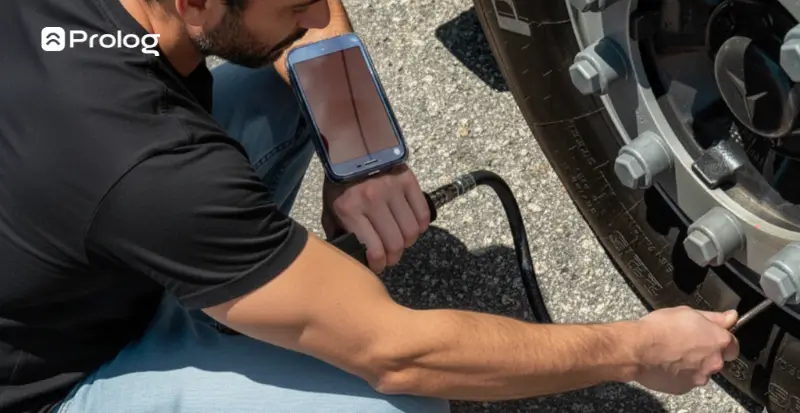
Regularly checking tread depth, with a measurement recorded at each inspection, is an essential part of tire management. Electronic tread probes and other inspection records can organize the assessment of replacement or retreading; the decision should also consider damage, casing condition and technical recommendation.
What is the ideal tire treadwear?
Treadwear is a rating associated with tire durability under test conditions. It can be a comparison reference, but on its own it does not predict how long the tire will last in the fleet's real application.
A higher treadwear rating can indicate greater wear resistance under the rating conditions. Even so, the tire needs to be chosen according to load, route, temperature, pavement and the other requirements of the operation.
In fleets of tandem-axle trucks that travel long distances, tire selection should consider the manufacturer's recommendation and the characteristics of the application. Resistance to wear and to heat are aspects to assess together with load capacity, design and retreading policy.
Managing tire scrapping helps to identify causes of disposal, plan replacements and reinforce the safety of the operation.
To learn about Prolog's tire management solution, schedule a demo. The platform organizes the records of inspections and interventions to support keeping track of the fleet.
Frequently asked questions
What is the acceptable tire scrap rate for a truck fleet?
What is the tire scrap rate?
What is the legal tire wear limit in Brazil?
How do I set the tire scrap target for my fleet?
How much do tires account for in fleet maintenance costs?
Does treadwear indicate how long a tire will last in the fleet?
// newsletter
Fleet management content, straight to your inbox
Articles on tires, maintenance and fleet operations. No spam.